
Limbic System
Limbic System
What You'll Learn
- Papez circuit — trace the full loop and know which lesion site produces which amnesia syndrome
- Hippocampal anatomy — CA subfields, trisynaptic circuit, selective vulnerability of CA1 to hypoxia
- Amygdala — nuclei, fear conditioning pathway, Klüver-Bucy syndrome features
- Memory taxonomy — declarative (episodic + semantic) vs non-declarative (procedural, priming, conditioning) and their anatomical substrates
- Korsakoff syndrome — mammillary bodies, anterior thalamic nucleus, and mammillothalamic tract; confabulation as the hallmark
- Autoimmune limbic encephalitis — antibody-specific presentations (anti-LGI1 faciobrachial dystonic seizures, anti-NMDA-R psychiatric + movement disorder, anti-CASPR2 neuromyotonia)
- Mesial temporal sclerosis — hippocampal sclerosis as the substrate for drug-resistant temporal lobe epilepsy
- Cingulate gyrus — anterior cingulate lesions → akinetic mutism; posterior cingulate → spatial memory
HighYield Pearls
- CA1 selective vulnerability: most ischemia-sensitive hippocampal subfield — global hypoxia, cardiac arrest, hypoglycemia, status epilepticus → CA1 pyramidal neuron loss; substrate for mesial temporal lobe epilepsy with hippocampal (Ammon’s horn) sclerosis
- Trisynaptic circuit: entorhinal cortex (perforant path) → dentate gyrus granule cells → CA3 (mossy fibers) → CA1 (Schaffer collaterals) → subiculum → entorhinal output; dentate gyrus/subgranular zone is a canonical adult neurogenesis niche (subventricular zone is the other classic niche; adult human hippocampal neurogenesis remains an active/debated research area)
- Papez circuit (memorize cold): hippocampus → fornix → mammillary bodies → mammillothalamic tract → anterior thalamic nucleus → cingulate gyrus → entorhinal cortex → hippocampus; lesion anywhere → anterograde > retrograde amnesia
- Wernicke-Korsakoff: thiamine deficiency → mammillary body petechial hemorrhages + medial dorsal thalamus → confabulation + anterograde amnesia; give IV thiamine before or with glucose when feasible in malnourished/alcohol-use patients (do NOT delay emergent dextrose for severe hypoglycemia)
- Klüver-Bucy syndrome: bilateral amygdala / anterior temporal lesion → hyperorality + hypersexuality + placidity + visual agnosia + hypermetamorphosis + amnesia; classic causes — HSV encephalitis, bilateral temporal lobectomy, frontotemporal dementia, Pick disease
- HSV encephalitis: tropism for medial temporal + insular + orbitofrontal cortex → fever, aphasia, behavioral change, focal seizures; chronic sequelae include amnesia, post-encephalitic epilepsy, and post-HSV anti-NMDA-R encephalitis (autoimmune relapse weeks later)
- Uncal herniation: uncus pushed through tentorial notch → ipsilateral CN III (blown pupil, down-and-out) + PCA compression (occipital infarct) + Kernohan notch (contralateral peduncle on tentorial edge → ipsilateral hemiparesis — false localizing sign)
- Alzheimer Braak staging: tau pathology starts in transentorhinal → entorhinal → hippocampus → neocortex; FDG-PET shows early posterior cingulate / precuneus hypometabolism
- Transient global amnesia (TGA): sudden isolated anterograde amnesia + repetitive questioning, intact procedural memory + identity, resolves <24h, age ≥50, triggers (cold water immersion, Valsalva, emotional stress, sexual activity); DWI may show punctate CA1 lesion; benign — rule out TIA / seizure if atypical
- Anterior cingulate lesion: abulia → akinetic mutism (awake but no motor / verbal output); bilateral ACA infarct classic cause
- Autoimmune limbic encephalitis: subacute amnesia + psychiatric + seizures + T2/FLAIR medial temporal hyperintensity — anti-LGI1 (faciobrachial dystonic seizures, hyponatremia), anti-NMDA-R (young women, ovarian teratoma, orofacial dyskinesias), anti-CASPR2 (Morvan, neuromyotonia), anti-Hu/Ma2 (paraneoplastic, SCLC/testicular)
- Memory taxonomy: declarative = episodic (hippocampus) + semantic (anterior temporal — lost in svPPA); procedural = striatum + cerebellum (preserved in H.M., Korsakoff); working = dorsolateral prefrontal; emotional = amygdala
🔍 Quick ReferenceAnatomy · Circuits / function · Lesion syndromes
Anatomy
- Ammon’s horn / cornu ammonis (CA1-CA4) → hippocampus proper (CA1 = Sommer sector, most ischemia-vulnerable)
- Dentate gyrus granule cells (subgranular zone) → canonical adult neurogenesis niche (subventricular zone is the other classic niche; adult human hippocampal neurogenesis remains an active/debated research area)
- Perforant path · mossy fibers · Schaffer collaterals → trisynaptic hippocampal circuit (entorhinal → DG → CA3 → CA1)
- Subiculum → main hippocampal output via fornix
- Entorhinal cortex (Brodmann 28) → gateway to hippocampus; first site of Alzheimer tau pathology
- Fornix → hippocampus → mammillary bodies + septal nuclei (colloid cyst / basal forebrain ICH → amnesia)
- Mammillary bodies → posterior hypothalamus relay in Papez (atrophy on coronal MRI in Korsakoff)
- Uncus → medial temporal tip — uncal herniation through tentorial notch
- Nucleus accumbens (ventral striatum) → mesolimbic reward / addiction (VTA dopamine target)
- Septal nuclei (medial septal) → cholinergic projection to hippocampus — theta rhythm, memory modulation
- Anterior cingulate (Brodmann 24/32) → conflict monitoring + motivation + autonomic
- Posterior cingulate / precuneus → default mode network hub + spatial memory retrieval
Circuits / function
- Papez circuit → memory loop (hippocampus → fornix → mammillary → MTT → anterior thalamus → cingulate → entorhinal → hippocampus)
- Yakovlev circuit → emotion / drive loop (orbitofrontal → temporal pole → amygdala → dorsomedial thalamus → anterior cingulate)
- Mesolimbic dopamine (VTA → nucleus accumbens) → reward + addiction + positive symptoms of schizophrenia
- Amygdala central nucleus → hypothalamus / brainstem → fear conditioning + autonomic fear response
- Medial septal cholinergic input → hippocampal theta rhythm (memory encoding)
- Default mode network (posterior cingulate + medial PFC + angular gyrus) → self-referential thought, autobiographical memory — hypometabolic early in AD
- Procedural memory → striatum + cerebellum (intact in hippocampal amnesia)
- Working memory → dorsolateral prefrontal cortex
Lesion syndromes
- Hyperorality + hypersexuality + placidity + visual agnosia + amnesia → Klüver-Bucy (bilateral amygdala / anterior temporal)
- Confabulation + anterograde amnesia + ophthalmoplegia + ataxia + confusion → Wernicke-Korsakoff (thiamine deficiency, mammillary bodies + medial dorsal thalamus)
- H.M. case → bilateral medial temporal lobectomy → profound anterograde amnesia, intact procedural learning
- Mesial temporal sclerosis / Ammon’s horn sclerosis → drug-resistant temporal lobe epilepsy (CA1 loss + reactive gliosis)
- Rising epigastric aura + déjà vu + olfactory/gustatory hallucination + dystonic posturing + automatisms → mesial temporal lobe seizure
- Ictal fear / panic aura → amygdala seizure
- Faciobrachial dystonic seizures + hyponatremia + amnesia → anti-LGI1 limbic encephalitis
- Young woman + psychiatric prodrome + orofacial dyskinesias + autonomic instability + ovarian teratoma → anti-NMDA-R encephalitis
- Bilateral medial temporal + insular + orbitofrontal T2 hyperintensity + hemorrhage → HSV-1 encephalitis
- Blown pupil + down-and-out eye + contralateral hemiparesis (or ipsilateral via Kernohan) → uncal herniation
- Akinetic mutism / abulia → bilateral anterior cingulate (ACA) lesion
- Sudden isolated anterograde amnesia with repetitive questioning, resolves <24h → transient global amnesia (TGA)
- Loss of semantic knowledge / word meaning with preserved fluency → semantic variant PPA (anterior temporal atrophy)
- Posterior cingulate / precuneus FDG-PET hypometabolism → early Alzheimer disease
Overview & Components
Defining the Limbic System
- The limbic system is a functional network — not a single anatomical structure — linking emotion, memory, motivation, and autonomic regulation
- Originally described by Paul Broca (1878) as the “great limbic lobe” (structures on the medial surface surrounding the corpus callosum)
- James Papez (1937) proposed the circuit for emotional expression; later expanded by Paul MacLean (1952) who coined “limbic system”
- Board-relevant core: hippocampus, amygdala, cingulate gyrus, fornix, mammillary bodies, anterior thalamic nucleus, septal nuclei, entorhinal cortex
Major Limbic Structures at a Glance
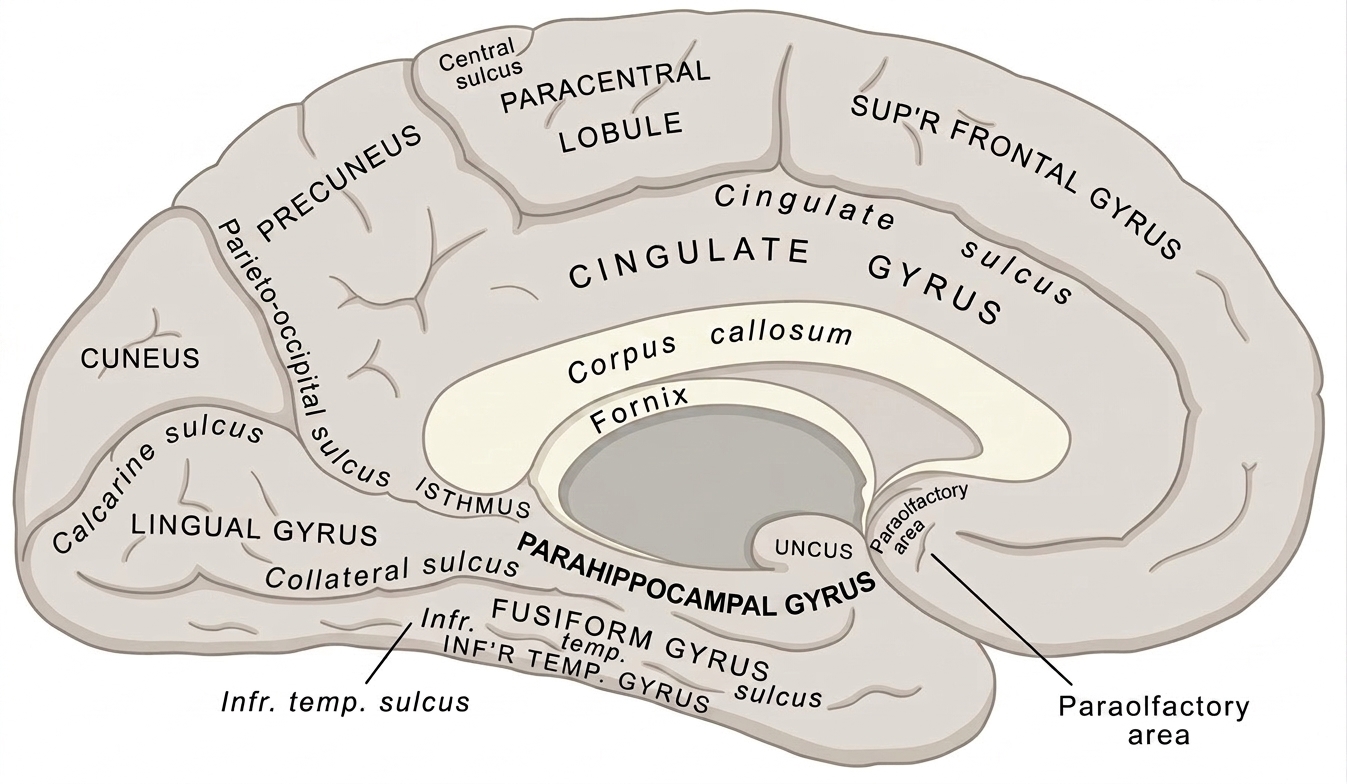
| Structure | Location | Primary Function |
|---|---|---|
| Hippocampus | Medial temporal lobe (floor of temporal horn of lateral ventricle) | Declarative memory encoding & consolidation |
| Amygdala | Anterior medial temporal lobe, rostral to hippocampus | Fear conditioning, threat detection, emotional memory |
| Cingulate gyrus | Medial hemisphere, arching above corpus callosum | Motivation (anterior), spatial orientation (posterior) |
| Fornix | White matter arch from hippocampus to mammillary bodies/septal nuclei | Major hippocampal output pathway |
| Mammillary bodies | Posterior hypothalamus (floor of 3rd ventricle) | Relay in Papez circuit; damaged in Korsakoff syndrome |
| Anterior thalamic nucleus | Anterior thalamus | Relay between mammillary bodies and cingulate gyrus |
| Septal nuclei | Basal forebrain, anterior to anterior commissure | Cholinergic + GABAergic projection to hippocampus via fornix (medial septal nucleus); pacemaker of hippocampal theta rhythm; involved in memory (not primarily reward — nucleus accumbens/VTA mediates reward) |
| Entorhinal cortex | Anterior parahippocampal gyrus (BA 28) | Gateway into hippocampus; grid cells for spatial navigation |
| Nucleus accumbens | Ventral striatum | Reward processing, motivation, addiction (mesolimbic dopamine target) |
| Orbitofrontal cortex | Ventral frontal lobe | Emotion regulation, social behavior, decision-making |
Board Pearl
The “Big Three” for boards: hippocampus (memory), amygdala (fear/emotion), cingulate gyrus (motivation/pain affect). Know the lesion syndrome for each.
Continue reading — sign in
The full note has more clinical pearls, tables, and board-focused tips. Free account, no fee.