
Peripheral Nerves and Muscles
Peripheral Nerves & Muscles
What You'll Learn
- Peripheral nerve connective tissue layers (endoneurium, perineurium, epineurium), blood-nerve barrier, myelination, saltatory conduction, and nerve injury classification (Seddon/Sunderland)
- Brachial plexus anatomy from roots to terminal branches, and classic injury patterns (Erb-Duchenne, Klumpke, Parsonage-Turner, thoracic outlet syndrome)
- Each major upper limb nerve (axillary, musculocutaneous, radial, median, ulnar): roots, muscles, sensory territory, and classic lesion presentations
- Upper limb dermatome landmarks (C5-T1) and reflex assignments
- Lumbar and sacral plexus anatomy with each major lower limb nerve (femoral, obturator, sciatic, tibial, common fibular, superior/inferior gluteal): roots, muscles, sensory territory, and classic lesions
- Lower limb dermatome landmarks (L1-S5), including saddle area and cauda equina vs conus medullaris distinction
- Neuromuscular junction anatomy, ACh release mechanism (SNARE complex), nicotinic receptor structure, presynaptic vs postsynaptic disorders (Lambert-Eaton vs myasthenia gravis vs botulism)
- Sarcomere structure (A-band, I-band, H-zone), excitation-contraction coupling (DHPR, RyR1), muscle fiber types (type I vs type II), motor unit concept and Henneman size principle
- Myopathy vs neuropathy distinction, UMN vs LMN signs, fasciculations vs fibrillations, and EMG/NCS patterns (demyelinating vs axonal, neuropathic vs myopathic MUAPs)
- Clinical localization: radiculopathy vs plexopathy vs mononeuropathy vs polyneuropathy; foot drop differential (L5 vs peroneal); carpal tunnel vs C6-7 radiculopathy; mononeuropathy multiplex causes
HighYield Pearls
- Perineurium = blood-nerve barrier: tight junctions around each fascicle; loss of endoneurial integrity begins at Sunderland III, loss of perineurial integrity begins at Sunderland IV (predicts poor spontaneous recovery / neuroma-in-continuity).
- Wallerian degeneration: distal axon + myelin break down in 3–5 days; Schwann cells form bands of Büngner; regeneration ~1 mm/day; fibrillations on EMG at 2–3 weeks → check NCS/EMG ≥ 10–14 days post-injury.
- Brachial plexus map: Roots → Trunks → Divisions → Cords → Branches (“Real Texans Drink Cold Beer”). Upper trunk = C5–6, middle = C7, lower = C8–T1. Lateral cord = MC + lateral median; medial cord = ulnar + medial median; posterior cord = axillary + radial.
- Erb-Duchenne (C5–6, upper trunk) = “waiter’s tip” (adducted, internally rotated, pronated) — obstetric / motorcycle fall. Klumpke (C8–T1, lower trunk) = claw hand + intrinsic loss + Horner syndrome from T1 sympathetic injury.
- Radial nerve in spiral groove: wrist drop with triceps spared (branches to triceps leave above the groove); “Saturday night palsy.” PIN lesion = finger drop without wrist drop, sensory spared.
- Median: CTS — most common entrapment; thenar atrophy + LOAF weakness; sensory spares thenar eminence (palmar cutaneous branch passes over the flexor retinaculum). AIN syndrome → abnormal “OK sign” (weak FPL + FDP to index), no sensory loss.
- Ulnar at cubital tunnel (most common ulnar site) → claw hand at 4th/5th DIP, Froment sign (FPL substitutes for weak adductor pollicis), Wartenberg sign (abducted little finger). Guyon canal lesion spares FCU + medial FDP → worse claw (“ulnar paradox”).
- Axillary nerve — anterior shoulder dislocation / surgical neck humerus fx → deltoid weakness + numb “regimental badge” patch over lateral shoulder.
- Long thoracic (C5–7) → serratus anterior → medial scapular winging. Spinal accessory (CN XI) → trapezius → lateral winging + shoulder droop.
- C3–4–5 keep the diaphragm alive — phrenic nerve; high cervical cord injury → ventilatory failure.
- Parsonage-Turner (neuralgic amyotrophy): sudden severe shoulder pain → patchy weakness in long thoracic / suprascapular / axillary / AIN territories; often post-viral or post-vaccine.
- Thoracic outlet syndrome: true neurogenic TOS = lower trunk (C8–T1) from cervical rib / fibrous band → Gilliatt-Sumner hand (APB > ADM atrophy); vascular TOS = subclavian compression with arm elevation.
- Foot drop differential: common peroneal at fibular head → weak dorsiflexion + eversion, inversion SPARED (tib post = tibial). L5 radiculopathy → weak inversion too + glut med weakness + back pain.
- Femoral neuropathy / diabetic amyotrophy (Bruns-Garland): quad weakness + lost knee jerk + anteromedial thigh + medial calf (saphenous) sensory loss; psoas spared in pure femoral lesion below inguinal ligament.
- Meralgia paresthetica: lateral femoral cutaneous nerve at the inguinal ligament — pure sensory anterolateral thigh burning; obesity, pregnancy, tight belts.
- S2–S4 keep the perineum / pelvic floor off the floor: bladder, bowel, sexual function, anal wink — key in cauda equina + conus lesions.
- Hereditary clues: CMT1A = PMP22 duplication (demyelinating, pes cavus, hammer toes, “inverted champagne bottle” legs). HNPP = PMP22 deletion (recurrent painless palsies at compression sites, “tomaculous” sausage-shaped myelin).
- Morton neuroma: interdigital nerve compression, burning pain between 3rd and 4th metatarsal heads, Mulder click.
🔍 Quick ReferenceNerve anatomy · Plexus / nerves · Lesion patterns
- Bands of Büngner → Schwann-cell tubes guiding regenerating axons (~1 mm/day)
- Nodes of Ranvier → gaps between Schwann internodes — site of saltatory conduction
- Remak bundles → one Schwann cell ensheathing multiple unmyelinated C fibers
- Onion-bulb formation → chronic demyelination + remyelination (CMT1, CIDP)
- Tomaculous (sausage-shaped) myelin → HNPP (PMP22 deletion)
- Advancing Tinel sign → front of regenerating axons after nerve injury
- Chromatolysis → cell body reaction to axotomy — eccentric nucleus + dispersed Nissl
- Perineurium → blood-nerve barrier (tight junctions; lost ≥ Sunderland IV)
- “Real Texans Drink Cold Beer” → Roots → Trunks → Divisions → Cords → Branches (brachial plexus)
- “C3–4–5 keep the diaphragm alive” → phrenic nerve roots
- “S2–S3–S4 keep the floor off the floor” → pudendal / pelvic floor roots
- LOAF muscles → median-innervated hand intrinsics (Lateral 2 lumbricals, Opponens, Abductor pollicis brevis, Flexor pollicis brevis)
- Regimental badge numbness → axillary nerve sensory territory (lateral shoulder)
- Saphenous nerve → only sensory branch of femoral — medial calf + medial malleolus
- Sural nerve → lateral foot/heel sensory — classic biopsy nerve
- Pudendal nerve (Alcock canal) → perineum motor + sensory (S2–4)
- “Waiter’s tip” posture → Erb-Duchenne palsy (upper trunk C5–6)
- Claw hand + Horner syndrome → Klumpke palsy (lower trunk C8–T1)
- Wrist drop with triceps spared → radial nerve at spiral groove (“Saturday night palsy”)
- Finger drop without wrist drop → posterior interosseous nerve (PIN) lesion
- Abnormal “OK sign” → anterior interosseous nerve (AIN) syndrome
- Froment sign + Wartenberg sign → ulnar neuropathy (adductor pollicis / interossei weak)
- Ulnar paradox (worse claw with distal lesion) → Guyon canal lesion sparing medial FDP
- Medial scapular winging → long thoracic nerve / serratus anterior
- Lateral scapular winging + shoulder droop → spinal accessory (CN XI) / trapezius
- Gilliatt-Sumner hand (APB atrophy > ADM) → true neurogenic thoracic outlet syndrome (lower trunk)
- Sudden shoulder pain → patchy plexus weakness → Parsonage-Turner / neuralgic amyotrophy
- Anterolateral thigh burning → meralgia paresthetica (lateral femoral cutaneous)
- Foot drop with inversion SPARED → common peroneal at fibular head (vs L5 radic = weak inversion)
- Trendelenburg gait → superior gluteal nerve / gluteus medius weakness
- Burning between 3rd/4th metatarsals + Mulder click → Morton neuroma (interdigital nerve)
- Inverted champagne bottle legs + pes cavus + hammer toes → CMT1A (PMP22 duplication)
- Recurrent painless palsies at compression sites → HNPP (PMP22 deletion)
1. Peripheral Nerve Structure
Connective Tissue Layers
- Endoneurium — surrounds individual axons and their Schwann cells; composed of longitudinal collagen fibrils; contains endoneurial capillaries (part of the blood-nerve barrier). Often considered continuous with the pia mater at the root entry zone (Obersteiner-Redlich zone), though the boundary is functional rather than a clean anatomic transition.
- Perineurium — surrounds fascicles (bundles of axons); concentric layers of flattened perineurial cells joined by tight junctions; forms the blood-nerve barrier; functionally analogous to the arachnoid/barrier layers (rather than a clean anatomic continuity with any single meningeal layer); most important layer for maintaining intrafascicular pressure and immunologic protection.
- Epineurium — outermost sheath surrounding the entire nerve trunk; composed of collagen and adipose tissue; blends with the dura mater at nerve roots; contains the vasa nervorum (blood supply to the nerve).
- Mesoneurium — loose connective tissue that suspends the nerve, allowing gliding during joint movement
Perineurium = blood-nerve barrier (functionally analogous to the arachnoid/barrier layers; not a clean anatomic continuity with any single meningeal layer). Standard teaching is that endoneurium is often considered continuous with pia, perineurium relates functionally to the arachnoid/barrier function, and epineurium blends with dura at nerve roots — but the transitions are not crisp. The perineurium is the key layer in Seddon/Sunderland classifications: it provides immunologic protection to nerve fascicles. Loss of endoneurial integrity begins at Sunderland III; loss of perineurial integrity begins at Sunderland IV and predicts poor spontaneous recovery / neuroma-in-continuity. Vasculitic neuropathy disrupts the vasa nervorum in the epineurium, causing ischemic axonal damage.
Nerve Injury Classification
| Seddon | Sunderland | Structure Damaged | Conduction | Recovery |
|---|---|---|---|---|
| Neurapraxia | Grade I | Myelin only (focal demyelination); axon intact | Conduction block at lesion; distal conduction preserved | Complete; weeks to months |
| Axonotmesis | Grade II | Axon disrupted; endoneurium + perineurium + epineurium INTACT | No conduction across or distal (after Wallerian degeneration) | Good; ~1 mm/day regrowth with perfect realignment along intact endoneurial tube |
| Axonotmesis (severe) | Grade III | Endoneurium disrupted; perineurium + epineurium intact | No conduction | Moderate; imperfect realignment → some axonal misdirection and aberrant regeneration |
| Grade IV | Perineurium disrupted; only epineurium intact | No conduction | Poor; neuroma-in-continuity; surgery often needed | |
| Neurotmesis | Grade V | Complete transection of entire nerve | No conduction | No recovery without surgical repair |
Wallerian Degeneration and Regeneration
- Wallerian degeneration occurs distal to any axonal injury site:
- Axon and myelin distal to injury degenerate within 3-5 days
- Schwann cells proliferate and form bands of Bungner (guide tubes for regeneration)
- Macrophages clear debris, which is essential for regeneration
- Fibrillation potentials appear on EMG at ~2-3 weeks (indicates denervation)
- Nerve regeneration rate: ~1 mm/day (~1 inch/month) — classic boards number; proximal muscles reinnervate before distal muscles
- Chromatolysis — cell body response to axonal injury: nucleus moves peripherally, Nissl substance disperses, protein synthesis shifts to repair mode
- Advancing Tinel sign — tingling at the front of regenerating axons; indicates active regeneration
NCS/EMG timing matters: Perform NCS/EMG at least 10-14 days after injury to distinguish neurapraxia (conduction block with preserved distal CMAP) from axonotmesis (reduced/absent distal CMAP). Fibrillations on EMG take 2-3 weeks to develop. Testing too early may miss axonal loss and give falsely reassuring results.
Myelinated vs Unmyelinated Fibers
| Feature | Myelinated (A-fibers) | Unmyelinated (C-fibers) |
|---|---|---|
| Schwann cell | 1 Schwann cell per internode (1:1 ratio) | Multiple axons embedded in one Schwann cell (Remak bundles) |
| Conduction | Saltatory conduction — node to node | Continuous conduction — slow |
| Velocity | 5-120 m/s (proportional to diameter) | 0.5-2 m/s |
| Function | Motor (A-alpha), proprioception (A-alpha/beta), touch (A-beta), fast pain/temperature (A-delta) | Slow/burning pain, temperature, autonomic postganglionic |
| Clinical vulnerability | Demyelinating neuropathies (GBS, CIDP) cause slowed conduction and conduction block | Small fiber neuropathy causes burning pain and autonomic dysfunction; normal NCS |
Nerve Fiber Classification
| Fiber Type | Diameter | Velocity | Myelinated? | Function |
|---|---|---|---|---|
| A-alpha | 12-20 μm | 70-120 m/s | Yes (heavy) | Motor (alpha motor neuron), proprioception (Ia, Ib afferents) |
| A-beta | 5-12 μm | 30-70 m/s | Yes | Touch, pressure, vibration (II afferents) |
| A-gamma | 3-8 μm | 15-30 m/s | Yes | Muscle spindle motor (gamma motor neuron) |
| A-delta | 1-5 μm | 5-30 m/s | Yes (thin) | Sharp/fast pain, temperature |
| B | 1-3 μm | 3-15 m/s | Yes (thin) | Preganglionic autonomic |
| C | 0.3-1.3 μm | 0.5-2 m/s | No | Dull/slow pain, temperature, postganglionic autonomic |
Nodes of Ranvier and Saltatory Conduction
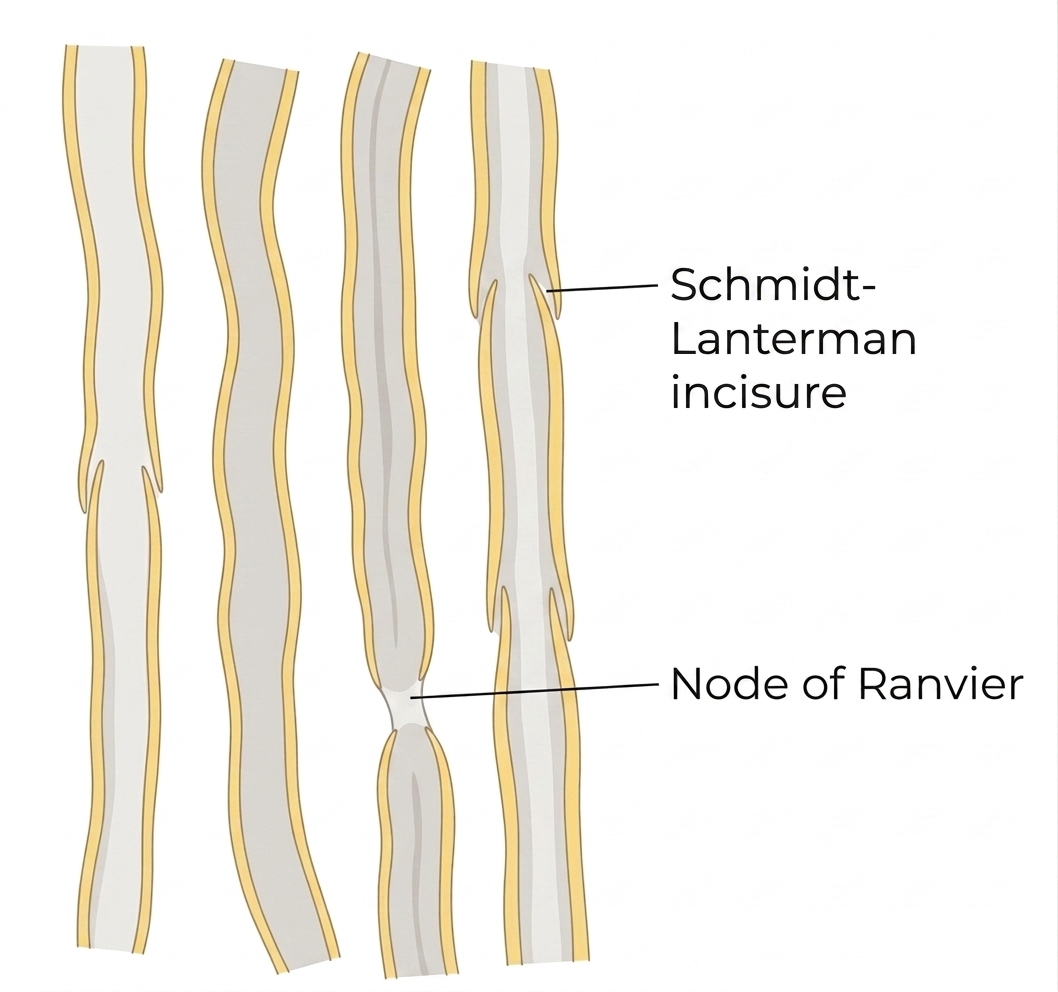
- Nodes of Ranvier — 1-2 μm gaps between adjacent Schwann cells where axon membrane is exposed; high density of voltage-gated Na+ channels (Nav1.6)
- Paranodal region — flanks the node; septate-like junctions between myelin terminal loops and axolemma; contains Caspr/contactin proteins
- Juxtaparanodal region — beneath compact myelin; high density of voltage-gated K+ channels (Kv1.1, Kv1.2)
- Saltatory conduction — action potential jumps node to node, greatly increasing velocity; demyelination disrupts this, causing conduction block or slowing
Anti-nodal/paranodal antibodies (anti-NF155, anti-CNTN1, anti-Caspr1) cause a CIDP-like neuropathy that is often refractory to IVIg but may respond to rituximab. Anti-ganglioside antibodies (anti-GM1 in multifocal motor neuropathy, anti-GQ1b in Miller Fisher syndrome) target gangliosides concentrated at the nodes of Ranvier. These are increasingly tested on boards.
Schwann Cells vs Oligodendrocytes
| Feature | Schwann Cell (PNS) | Oligodendrocyte (CNS) |
|---|---|---|
| Axons per cell | 1 myelinated axon per Schwann cell | Up to 40-50 axons per oligodendrocyte |
| Basement membrane | Present (aids regeneration) | Absent |
| Regeneration support | Excellent: forms bands of Bungner, produces neurotrophic factors (NGF, BDNF) | Poor: produces inhibitory factors (Nogo-A, MAG, OMgp) |
| Origin | Neural crest | Neuroepithelium (neural tube) |
| Key pathology | Schwannoma, GBS demyelination | Multiple sclerosis, PML |
Why do PNS nerves regenerate but CNS axons do not? Schwann cells have a basal lamina (forms guide tubes), produce neurotrophic factors, and clear debris rapidly. Oligodendrocytes lack a basal lamina, clear debris slowly, and produce myelin-associated inhibitory proteins (Nogo-A, MAG). This explains why peripheral nerve injuries can recover but spinal cord injuries generally cannot.
Continue reading — sign in
The full note has more clinical pearls, tables, and board-focused tips. Free account, no fee.