
Subcortical Nuclei (BG, Thalamus, Hypothalamus)
Subcortical Nuclei: Basal Ganglia, Thalamus & Hypothalamus
What You'll Learn
- Basal ganglia components — striatum (caudate + putamen), lentiform nucleus (putamen + globus pallidus [GPi + GPe]), STN, substantia nigra (SNc/SNr)
- Direct vs. indirect pathway — direct = facilitates movement (D1), indirect = inhibits movement (D2); dopamine excites D1 direct-pathway MSNs and inhibits D2 indirect-pathway MSNs → both effects reduce GPi/SNr braking → net facilitation
- Lesion-to-disorder mapping — SNc loss → Parkinson disease; caudate atrophy → Huntington disease; STN lesion → hemiballismus; putamen copper → Wilson disease
- Thalamic relay nuclei — VPL (body), VPM (face), VL (cerebellum → motor), VA (BG → motor), LGN (vision), MGN (hearing)
- Thalamic stroke syndromes — Dejerine-Roussy (thalamic pain), paramedian stroke (vertical gaze palsy + memory loss), artery of Percheron (bilateral)
- Hypothalamic nuclei — lateral = hunger, ventromedial = satiety, anterior = cooling, posterior = heating, suprachiasmatic = circadian, mammillary bodies = memory
- Internal capsule — anterior limb, genu, posterior limb; somatotopy; lacunar syndromes (pure motor hemiparesis, ataxic hemiparesis)
HighYield Pearls
- Direct pathway (D1, Gs): cortex → striatum → GPi/SNr (inhibited) → thalamus (disinhibited) → cortex → FACILITATES movement
- Indirect pathway (D2, Gi): cortex → striatum → GPe (inhibited) → STN (disinhibited) → GPi (excited) → thalamus (inhibited) → SUPPRESSES competing movement
- Hyperdirect pathway: cortex → STN directly — rapid “STOP” signal; bypasses striatum
- Parkinson disease: SNc dopaminergic loss → ↓ direct + ↑ indirect → hypokinetic (bradykinesia, rigidity, rest tremor)
- Huntington disease: loss of striatal medium spiny GABAergic neurons (indirect pathway first) → hyperkinetic chorea; caudate atrophy → boxcar ventricles
- Hemiballismus: contralateral STN lesion — classic metabolic mimic is nonketotic hyperglycemia (severe hyperglycemia without ketosis/acidosis) with striatal T1 hyperintensity
- Wilson disease: copper deposition in putamen → face of giant panda (midbrain) + double panda (pons) sign; Kayser-Fleischer rings
- Artery of Percheron: single thalamoperforator off one P1 → bilateral paramedian thalamic + midbrain infarct → coma + amnesia + vertical gaze palsy
- Dejerine-Roussy: VPL/VPM thalamic stroke → contralateral sensory loss followed by thalamic pain (burning dysesthesia)
- VL/VA thalamic nuclei — motor relay (cerebellum → VL; BG → VA); Vim of VL = DBS target for essential tremor
- Anterior thalamic nucleus — mammillothalamic tract terminus, Papez memory circuit; lesion → anterograde amnesia
- Mediodorsal nucleus — limbic/prefrontal relay; lesion → Korsakoff amnesia + confabulation (alcoholic thiamine deficiency)
- Reticular nucleus of thalamus — GABAergic shell that envelops thalamus; participates in thalamocortical oscillations that sustain 3-Hz spike-wave absence discharges
- Intralaminar/centromedian nucleus — arousal & nociception; DBS target for generalized epilepsy; lesion → altered mental status
- Hypothalamic lateral nucleus → hunger + arousal (orexin/hypocretin); lesion → anorexia; orexin loss → narcolepsy type 1
- Ventromedial nucleus → satiety; lesion → hyperphagia, obesity (Fröhlich/Babinski syndrome) + rage
- Anterior hypothalamus → cooling/heat dissipation (A/C = Anterior Cooling); lesion → hyperthermia
- Posterior hypothalamus → heat conservation + shivering; lesion → poikilothermia (cold-blooded)
- SCN → circadian rhythm (driven by retinohypothalamic input); VLPO (preoptic) → GABAergic sleep promotion
- PVN + SON → magnocellular → ADH + oxytocin to posterior pituitary; lesion → central diabetes insipidus
- Mammillary bodies → Papez memory; petechial hemorrhages in Wernicke-Korsakoff (thiamine deficiency)
- Klüver-Bucy syndrome — bilateral amygdala/anterior temporal lesion → hyperorality + hypersexuality + placidity + visual agnosia (HSV encephalitis)
- Internal capsule posterior limb — corticospinal tract (arm & leg); lacunar stroke → pure motor hemiparesis (face + arm + leg equally)
- Circumventricular organs (no BBB) — area postrema (vomiting), OVLT & SFO (osmoreception), median eminence, neurohypophysis, pineal
🔍 Quick ReferenceBG / circuits · Thalamic relay · Hypothalamus / lesion
BG / circuits
- “Face of the giant panda” midbrain + “double panda” pons on T2 → Wilson disease (putaminal copper)
- Unilateral flinging, large-amplitude proximal limb movements → hemiballismus (contralateral STN lesion)
- “Boxcar” lateral ventricles + caudate atrophy → Huntington disease (CAG repeat, chromosome 4)
- T1 striatal hyperintensity in a hyperglycemic patient with chorea → non-ketotic hyperglycemic hemichorea-hemiballismus
- Resting pill-rolling tremor + cogwheel rigidity + bradykinesia + asymmetric onset → Parkinson disease (SNc dopaminergic loss)
- Lewy bodies (α-synuclein) in SNc neurons → idiopathic Parkinson disease
- Kayser-Fleischer rings + low ceruloplasmin + young pt with dystonia/tremor → Wilson disease
- D1 = Gs (direct, facilitates) / D2 = Gi (indirect, inhibits) → dopamine net facilitates movement via striatum
- Mesolimbic VTA → NAc → reward / addiction / positive symptoms of schizophrenia
- Tuberoinfundibular (arcuate → pituitary) → DA inhibits prolactin; D2 blockade → hyperprolactinemia + galactorrhea
Thalamic relay nuclei
- VPL → body somatosensation (medial lemniscus + spinothalamic → S1)
- VPM → face somatosensation + taste (trigeminothalamic + solitary tract)
- VL → motor relay from cerebellum (dentate) → M1; Vim subnucleus = DBS target for essential tremor
- VA → motor relay from basal ganglia (GPi) → SMA/premotor
- LGN → vision (retina → optic radiations → V1); 6 layers, M/P streams
- MGN → audition (inferior colliculus → A1 transverse gyrus of Heschl)
- Anterior nucleus → Papez memory circuit (mammillothalamic tract input)
- Mediodorsal → limbic + prefrontal; lesion → Korsakoff amnesia + confabulation
- Pulvinar → parieto-temporo-occipital association; “pulvinar sign” on FLAIR → variant CJD
- Centromedian/intralaminar → arousal + nociception; DBS target for refractory generalized epilepsy
- Reticular nucleus → GABAergic shell; participates in thalamocortical oscillations that sustain 3-Hz spike-wave absence discharges
- Dejerine-Roussy syndrome → VPL/VPM stroke → contralateral thalamic pain + hemisensory loss
- Artery of Percheron infarct → bilateral paramedian thalami ± midbrain → coma, vertical gaze palsy, amnesia
Hypothalamus / lesion syndromes
- Lateral nucleus lesion → anorexia, wasting (“Lateral = Lean”); orexin/hypocretin loss → narcolepsy type 1 + cataplexy
- Ventromedial nucleus lesion → hyperphagia, obesity, rage (“VentroMedial = Very Much”); craniopharyngioma classic cause
- Anterior hypothalamus lesion → hyperthermia (loss of cooling; “A/C = Anterior Cooling”)
- Posterior hypothalamus lesion → poikilothermia / hypothermia (loss of heat conservation)
- SCN lesion → loss of circadian rhythm; receives retinohypothalamic input
- VLPO (preoptic) lesion → insomnia (loss of GABAergic sleep promotion); fatal familial insomnia targets thalamus
- PVN/SON lesion → central diabetes insipidus (ADH loss) ± SIADH from disinhibition
- Mammillary body petechial hemorrhages → Wernicke-Korsakoff (thiamine deficiency — alcoholics, bariatric, hyperemesis)
- Arcuate nucleus → POMC (satiety) + NPY/AgRP (hunger); leptin & ghrelin sensing; DA → tuberoinfundibular PRL inhibition
- Klüver-Bucy syndrome → bilateral amygdala → hyperorality + hypersexuality + placidity + visual agnosia (HSV encephalitis classic)
- Fröhlich syndrome (adiposogenital dystrophy) → ventromedial/infundibular lesion → obesity + hypogonadism in boys
- Diencephalic syndrome (Russell) → anterior hypothalamic glioma in child → profound emaciation despite normal intake
- Pituitary stalk transection → loss of DA tone → hyperprolactinemia (“stalk effect”)
Basal Ganglia Anatomy
Overview & Definitions
- Basal ganglia — collection of subcortical nuclei deep to cerebral cortex, lateral to the thalamus
- Primary role: motor control, procedural learning, habit formation, emotion, executive function
- The basal ganglia do NOT initiate movement — they modulate cortically initiated motor plans
Component Structures
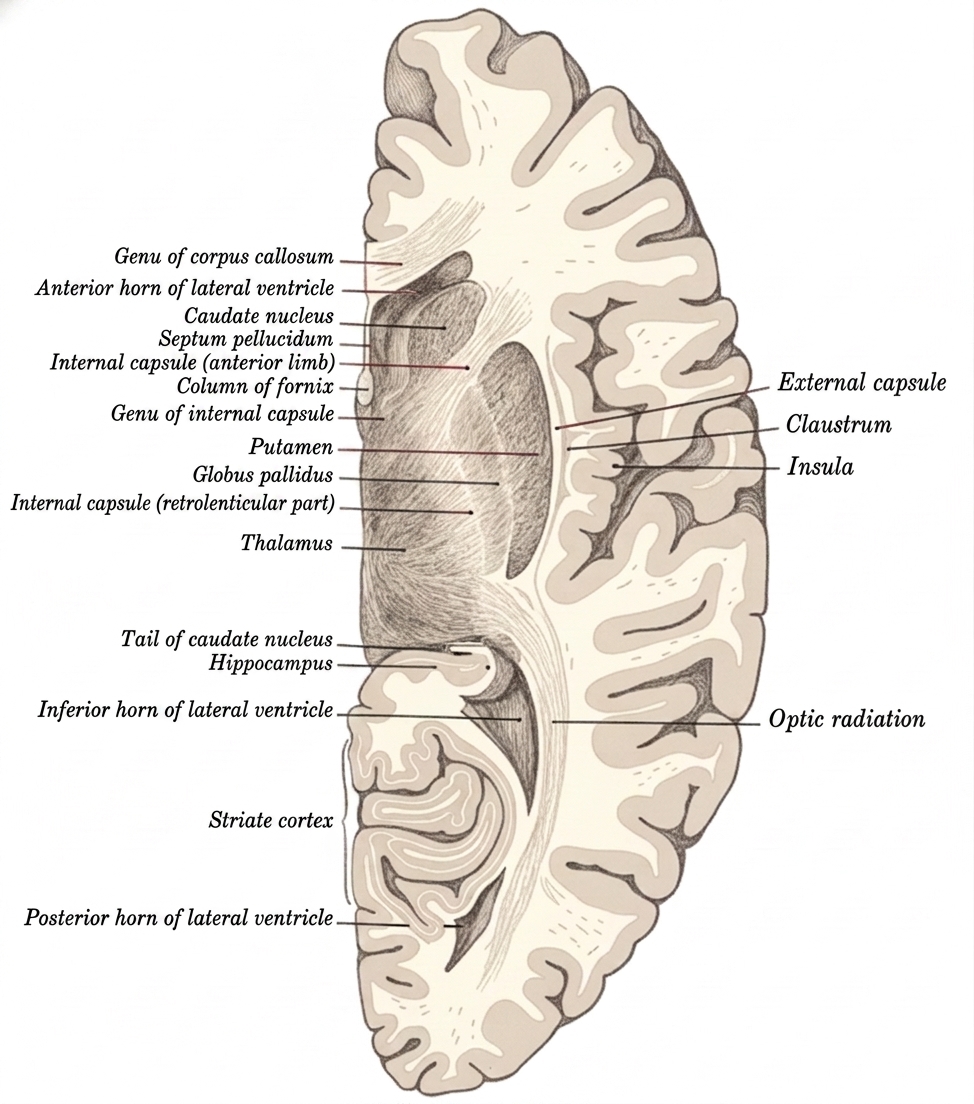
| Structure | Components | Role |
|---|---|---|
| Striatum | Caudate nucleus + Putamen | INPUT nucleus — receives cortical projections (glutamate); connected across internal capsule by cell bridges giving "striped" appearance |
| Lentiform nucleus | Putamen + Globus pallidus (GPi + GPe) | Anatomical grouping — lens-shaped structure lateral to the internal capsule |
| Globus pallidus externa (GPe) | — | Intermediate relay in the indirect pathway; GABAergic output to STN |
| Globus pallidus interna (GPi) | — | OUTPUT nucleus — tonically inhibits thalamus via GABA; DBS target |
| Subthalamic nucleus (STN) | — | Only excitatory (glutamatergic) nucleus in BG; drives GPi activity; DBS target for Parkinson disease |
| Substantia nigra pars compacta (SNc) | — | Source of dopamine to striatum (nigrostriatal pathway); lost in Parkinson disease |
| Substantia nigra pars reticulata (SNr) | — | OUTPUT nucleus (functionally equivalent to GPi); GABAergic inhibition of thalamus & superior colliculus |
Board Pearl
Striatum = INPUT; GPi/SNr = OUTPUT. The internal capsule separates the caudate (medial) from the lentiform nucleus (lateral). Striatal cell bridges crossing the internal capsule give it its "striped" name.
Spatial Relationships & Blood Supply
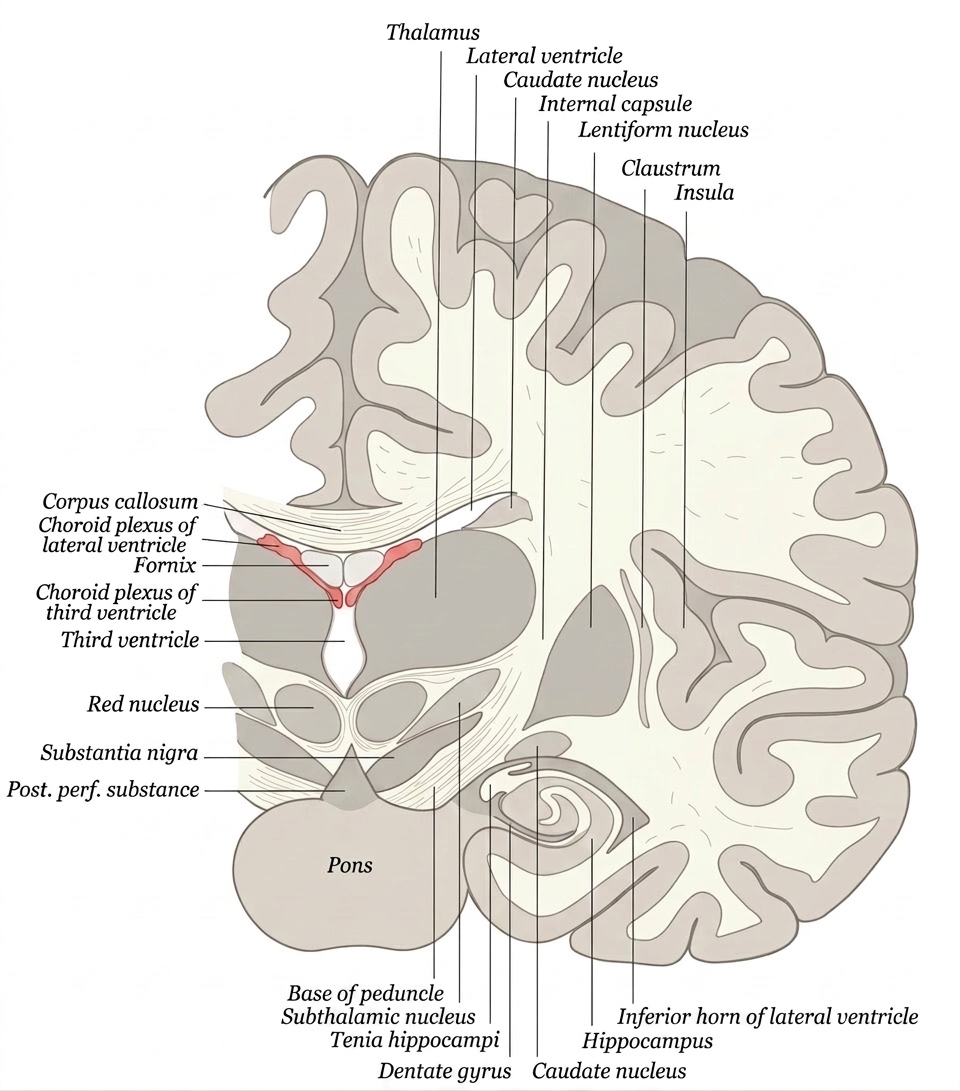
Spatial Organization (Medial → Lateral)
- Caudate nucleus — C-shaped, follows lateral ventricle (head, body, tail); head bulges into frontal horn
- Internal capsule — between caudate/thalamus (medially) and lentiform nucleus (laterally)
- Globus pallidus — medial portion of lentiform nucleus
- Putamen — lateral portion of lentiform nucleus
- External capsule — lateral to putamen
- Claustrum — thin gray matter between external and extreme capsules
- Extreme capsule — between claustrum and insular cortex
Blood Supply
- Lenticulostriate arteries (lateral branches of MCA M1) → putamen, globus pallidus, caudate head, internal capsule — most common site of hypertensive hemorrhage
- Recurrent artery of Heubner (from ACA) → caudate head, anterior limb of internal capsule, anterior putamen
- Anterior choroidal artery (from ICA) → posterior limb of internal capsule + optic tract + LGN + medial temporal lobe (uncus, hippocampus, amygdala) + medial globus pallidus (GPi)
Clinical Pearl
Hypertensive putaminal hemorrhage is the most common hypertensive intracerebral hemorrhage → rupture of lenticulostriate arteries → contralateral hemiparesis, hemisensory loss, hemianopia, and eyes deviate toward the lesion.
Continue reading — sign in
The full note has more clinical pearls, tables, and board-focused tips. Free account, no fee.