Cerebellum
Cerebellum
What Do You Need to Know?
- Gross anatomy — lobes (anterior, posterior, flocculonodular), deep cerebellar nuclei (dentate, emboliform, globose, fastigial), three peduncles and their connections
- Functional divisions — vestibulocerebellum, spinocerebellum, cerebrocerebellum → know inputs, outputs, functions, and lesion effects for each
- Cerebellar circuitry — Purkinje cells (GABAergic, only cortical output), climbing fibers (inferior olive only), mossy fibers, deep nuclei as final output
- Peduncle connections — SCP = mainly efferent, MCP = afferent only, ICP = mixed (mostly afferent)
- Blood supply — SCA, AICA, PICA territories; recognize cerebellar stroke syndromes and emergent complications (edema, hydrocephalus)
- Clinical signs — DANISH mnemonic (Dysdiadochokinesia, Ataxia, Nystagmus, Intention tremor, Slurred speech, Hypotonia); distinguish cerebellar from sensory ataxia
- Cerebellar syndromes — midline (vermis) vs. lateral (hemispheric), rostral vs. caudal vermis, cerebellar cognitive affective syndrome (Schmahmann)
- Cerebellar degenerations — alcoholic (anterior vermis), paraneoplastic (anti-Yo, anti-Hu), MSA-C, spinocerebellar ataxias, Friedreich ataxia
Gross Anatomy
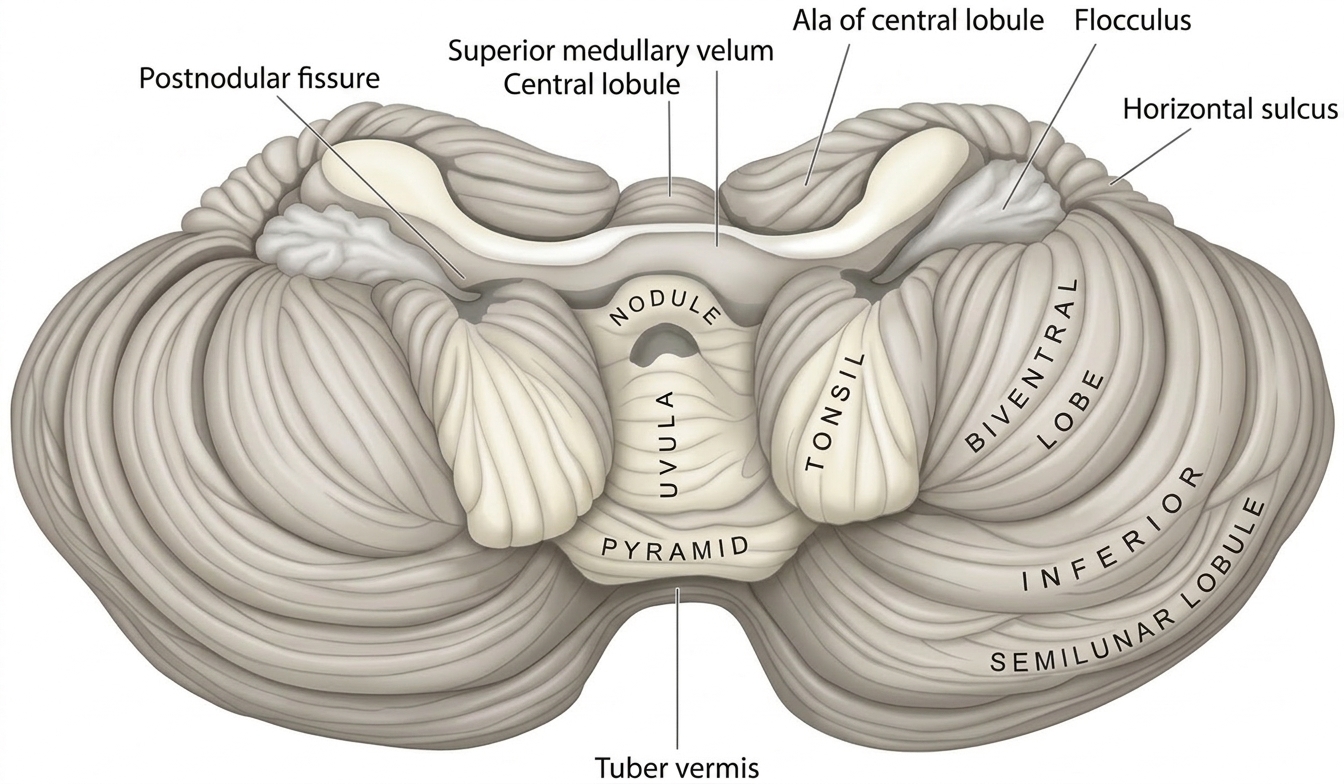
Lobes and Fissures
- Anterior lobe — rostral to the primary fissure; involved in gait and posture coordination (lower limbs preferentially)
- Posterior lobe — between primary and posterolateral fissures; largest lobe; motor planning, limb coordination, and cognitive/affective processing
- Flocculonodular lobe — caudal to the posterolateral fissure; phylogenetically oldest (archicerebellum); vestibular function, VOR, smooth pursuit
Vermis and Hemispheres
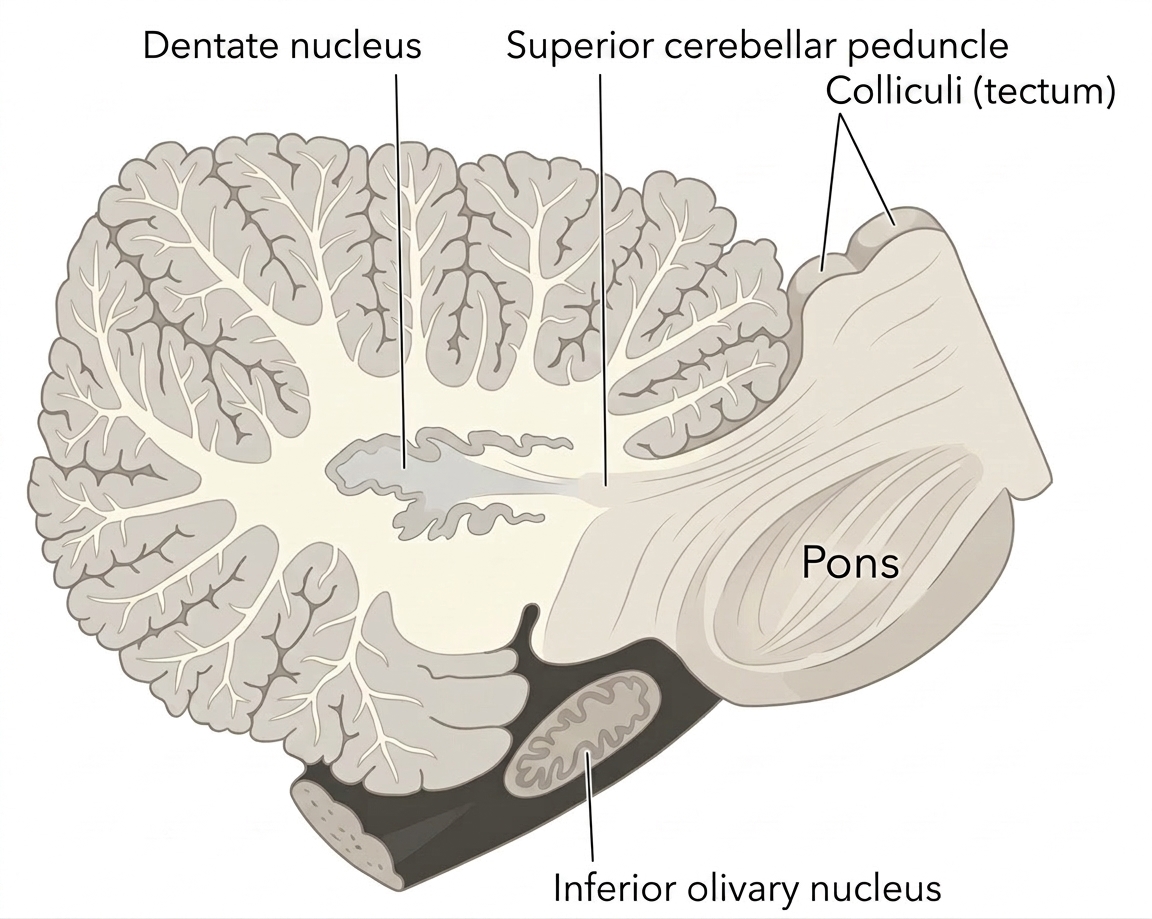
- Vermis — midline strip; controls axial/proximal musculature, posture, gait, and truncal stability
- Paravermis (intermediate zone) — flanks the vermis; distal limb coordination and error correction
- Lateral hemispheres — largest region; motor planning, timing, cognitive functions via dentate nucleus
Deep Cerebellar Nuclei
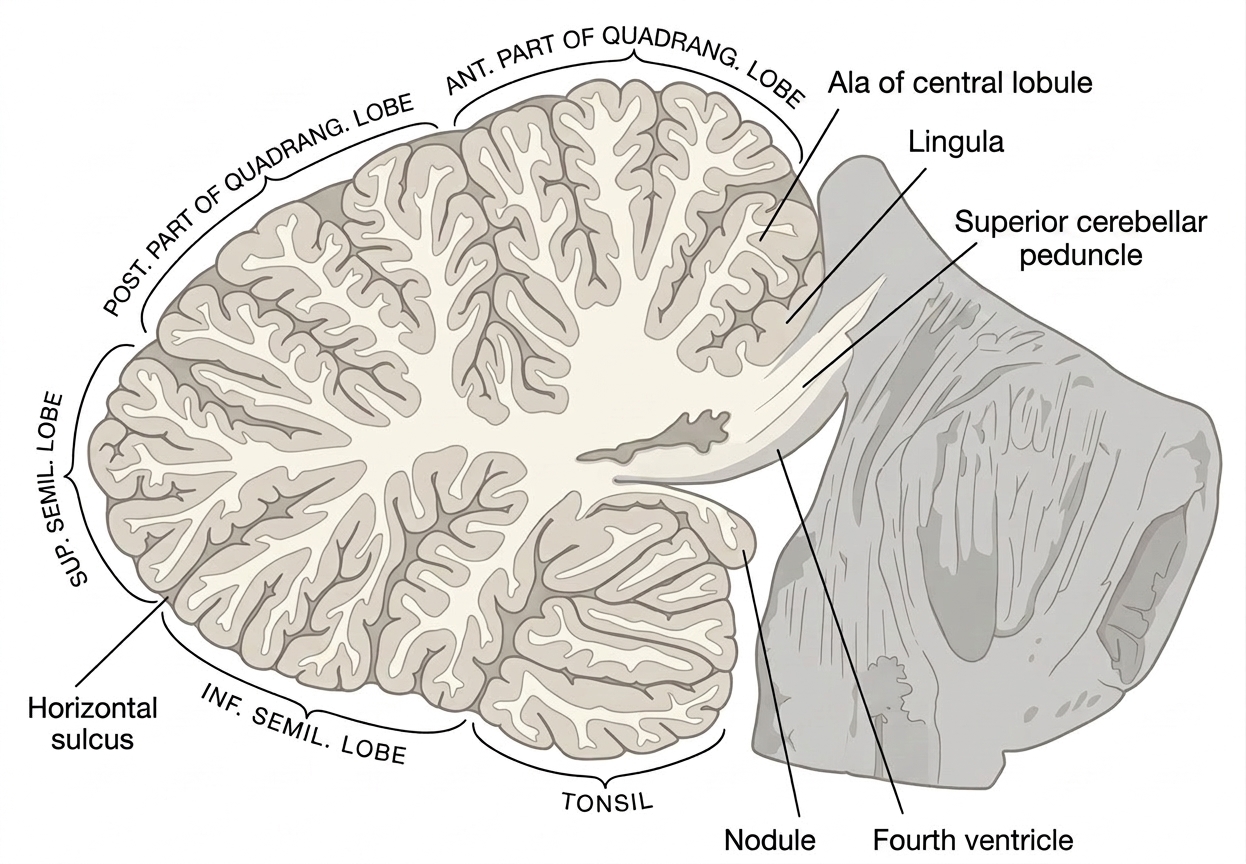
Mnemonic: "Don't Eat Greasy Foods" (lateral → medial)
| Nucleus | Position | Receives From | Projects To | Via Peduncle |
|---|---|---|---|---|
| Dentate | Most lateral (largest) | Lateral hemispheres (cerebrocerebellum) | VL thalamus → motor/premotor cortex; red nucleus | SCP |
| Emboliform | Intermediate | Paravermal zone (spinocerebellum) | Red nucleus; VL thalamus | SCP |
| Globose | Intermediate | |||
| Fastigial | Most medial | Vermis + flocculonodular lobe | Vestibular nuclei; reticular formation | ICP |
Emboliform + Globose = Interposed nucleus. The interposed nuclei serve the paravermal (intermediate) zone and project via the SCP to the red nucleus → rubrospinal tract. Fastigial is the only deep nucleus whose output exits through the ICP (not the SCP).
Cerebellar Peduncles — Overview
| Peduncle | Brainstem Level | Direction | Major Fiber Systems |
|---|---|---|---|
| Superior (SCP) | Midbrain | Mainly efferent (output) | Dentatorubrothalamic tract; ventral spinocerebellar tract (afferent exception) |
| Middle (MCP) | Pons | Afferent ONLY | Corticopontocerebellar fibers (largest peduncle) |
| Inferior (ICP) | Medulla | Mixed (mostly afferent) | Afferent: dorsal spinocerebellar, cuneocerebellar, olivocerebellar, vestibulocerebellar Efferent: cerebellovestibular, fastigioreticular |
MCP = AFFERENT ONLY. It is the largest peduncle and carries corticopontocerebellar fibers from the contralateral cerebral cortex. MCP atrophy or T2 hyperintensity on MRI is characteristic of MSA-C. SCP decussation occurs in the caudal midbrain — a lesion here causes contralateral cerebellar signs (unusual because most cerebellar lesions cause ipsilateral signs).
Functional Divisions
| Division | Region | Input | Deep Nucleus | Output Target | Function | Lesion Effect |
|---|---|---|---|---|---|---|
| Vestibulocerebellum (Archicerebellum) |
Flocculonodular lobe | Vestibular nuclei; direct vestibular afferents | Fastigial (+ some direct to vestibular nuclei) | Vestibular nuclei → vestibulospinal tract | Balance, equilibrium, VOR, smooth pursuit | Vertigo, nystagmus, imbalance; NO limb ataxia |
| Spinocerebellum (Paleocerebellum) |
Vermis + paravermal zone | Spinocerebellar tracts; visual, auditory info | Fastigial (vermis); Interposed (paravermal) | Vestibular nuclei, reticular formation (vermis); Red nucleus, VL thalamus (paravermal) | Posture, gait, truncal stability (vermis); Distal limb coordination (paravermal) | Vermis: truncal/gait ataxia, titubation Paravermal: ipsilateral limb ataxia, dysmetria |
| Cerebrocerebellum (Neocerebellum) |
Lateral hemispheres | Corticopontocerebellar fibers (motor, premotor, prefrontal, parietal cortex) | Dentate | VL thalamus → motor/premotor cortex | Motor planning, timing, cognitive functions, language, working memory | Ipsilateral limb ataxia, intention tremor, dysmetria, dysdiadochokinesia, CCAS |
- Truncal ataxia + wide-based gait, no limb dysmetria → Vermis
- Ipsilateral limb ataxia + dysmetria + intention tremor → Cerebellar hemisphere / paravermal zone
- Vertigo + nystagmus WITHOUT limb ataxia → Flocculonodular lobe
- Cognitive-affective changes + ataxia → Posterior lobe bilateral / CCAS
Cerebellar Circuitry
Cerebellar Cortex — Three Layers (Outer to Inner)
| Layer | Cell Types | Key Features |
|---|---|---|
| 1. Molecular layer (outermost) | Stellate cells, basket cells, Purkinje cell dendrites | Contains parallel fibers (granule cell axons); stellate and basket cells are inhibitory interneurons |
| 2. Purkinje cell layer | Purkinje cells (single row) | ONLY output neurons of the cerebellar cortex; GABAergic (inhibitory); largest neurons in the brain |
| 3. Granular layer (innermost) | Granule cells (excitatory), Golgi cells (inhibitory) | Granule cells are the most numerous neurons in the entire brain; receive mossy fiber input; send parallel fibers up to molecular layer |
Input Fibers to Cerebellar Cortex
Two Excitatory Afferent Systems
- Mossy fibers
- Origin — multiple sources: pontine nuclei, spinal cord, vestibular nuclei, reticular formation
- Synapse on granule cells in the granular layer → granule cell axons ascend as parallel fibers → excite Purkinje cell dendrites
- This is the major quantitative input pathway; each Purkinje cell receives input from ~200,000 parallel fibers
- Climbing fibers
- Origin — EXCLUSIVELY from the inferior olivary nucleus (contralateral)
- Climb along and wrap around Purkinje cell dendrites → powerful 1:1 excitation
- Each Purkinje cell receives only ONE climbing fiber, but that climbing fiber makes ~300 synaptic contacts
- Function — error detection and motor learning; drives long-term depression (LTD) of parallel fiber–Purkinje cell synapses
Climbing fibers = inferior olive ONLY. This is a near-universal board question. Mossy fibers = everything else. Each Purkinje cell gets ONE climbing fiber but ~200,000 parallel fibers. Climbing fiber discharge signals motor error → induces LTD at parallel fiber synapses → this is the cellular basis of cerebellar motor learning.
Output from Cerebellar Cortex
- Purkinje cells are the SOLE output of the cerebellar cortex
- Neurotransmitter: GABA (inhibitory)
- Target: deep cerebellar nuclei (and vestibular nuclei from flocculonodular lobe)
- Mechanism: Deep nuclei are tonically active (excitatory); Purkinje cells inhibit them → sculpt and modulate the timing/magnitude of cerebellar output
- Net effect: The cerebellar cortex is entirely inhibitory in its output; all excitatory output from the cerebellum comes from the deep nuclei
Deep Nuclei as Final Common Output
- Deep cerebellar nuclei receive excitatory collaterals from mossy fibers and climbing fibers (direct, bypassing cortex) plus inhibitory input from Purkinje cells
- Balance between these inputs determines the final output signal
- Deep nuclei project out of the cerebellum via the SCP (dentate, interposed nuclei) or ICP (fastigial nucleus)
- Mossy/climbing fibers enter cerebellar cortex (+ send collaterals directly to deep nuclei)
- Granule cells relay mossy fiber input via parallel fibers → excite Purkinje dendrites
- Climbing fibers powerfully excite Purkinje cells and signal errors
- Purkinje cells (GABAergic) inhibit deep cerebellar nuclei
- Deep nuclei send excitatory output via SCP or ICP to thalamus, red nucleus, vestibular nuclei, reticular formation
Key concept: The deep nuclei are the final common pathway — destruction of deep nuclei produces more severe deficits than cortical cerebellar lesions.
Cerebellar Peduncle Connections
Superior Cerebellar Peduncle (SCP) — Mainly Efferent
Efferent Pathways (Output)
- Dentatorubrothalamic tract — Dentate nucleus → SCP → decussates in caudal midbrain → contralateral red nucleus → VL thalamus → motor/premotor cortex
- This is the major cerebellar output pathway for voluntary movement coordination
- SCP decussation explains why each cerebellar hemisphere controls the ipsilateral body (cerebellum → crosses at SCP → motor cortex → crosses again at pyramidal decussation → net ipsilateral)
- Interpositorubral fibers — Interposed nuclei → SCP → red nucleus → rubrospinal tract
Afferent Pathway (Input — Exception)
- Ventral spinocerebellar tract — spinal border cells → crosses in spinal cord → ascends → enters cerebellum via SCP → crosses again within cerebellum → net ipsilateral representation
Middle Cerebellar Peduncle (MCP) — Afferent Only
- Corticopontocerebellar pathway — the SOLE fiber system in the MCP
- Route: Cerebral cortex (motor, premotor, prefrontal, parietal) → ipsilateral pontine nuclei → crosses midline in pons → enters contralateral cerebellum via MCP
- This means each cerebellar hemisphere receives input from the contralateral cerebral cortex
- Largest peduncle by volume; no efferent fibers
Inferior Cerebellar Peduncle (ICP) — Mixed, Mostly Afferent
Afferent Pathways (Input)
| Tract | Origin | Information | Target in Cerebellum |
|---|---|---|---|
| Dorsal spinocerebellar | Clarke's column (C8–L2) | Unconscious proprioception — lower limb/trunk | Vermis, paravermal zone |
| Cuneocerebellar | Accessory (lateral) cuneate nucleus | Unconscious proprioception — upper limb/neck | Vermis, paravermal zone |
| Olivocerebellar | Contralateral inferior olive | Error signals (ALL climbing fibers) | All cerebellar cortex |
| Vestibulocerebellar | Vestibular nuclei + direct VIII nerve afferents | Head position, balance, angular acceleration | Flocculonodular lobe, vermis |
| Reticulocerebellar | Lateral reticular nucleus | Integrated motor/sensory signals | Vermis |
| Trigeminocerebellar | Trigeminal nuclei | Proprioception from jaw | Vermis |
Efferent Pathways (Output)
- Fastigiovestibular — Fastigial nucleus → ICP → vestibular nuclei → vestibulospinal tract (posture, balance)
- Fastigioreticular — Fastigial nucleus → ICP → reticular formation → reticulospinal tract (gait, proximal tone)
- Cerebellovestibular — direct Purkinje cell projections from flocculonodular lobe → vestibular nuclei (only output that bypasses deep nuclei)
Spinocerebellar tract laterality: Dorsal spinocerebellar tract stays ipsilateral and enters via ICP. Ventral spinocerebellar tract crosses twice (net ipsilateral) and enters via SCP. Mnemonic: "Dorsal = Doesn't cross; enters ICP. Ventral = crosses Via SCP."
Blood Supply
Arterial Supply — Overview
| Artery | Origin | Cerebellar Territory | Brainstem Territory | Other Structures |
|---|---|---|---|---|
| SCA (Superior Cerebellar Artery) | Basilar artery (just proximal to bifurcation) | Superior surface of cerebellum, deep cerebellar nuclei, SCP | Upper pons, upper pontine tegmentum | CN V proximity; CN III between SCA and PCA |
| AICA (Anterior Inferior Cerebellar Artery) | Basilar artery (lower third) | Anterior inferior cerebellum, MCP, flocculus | Lateral lower pons | Gives off labyrinthine artery (CN VII, VIII); CPA region |
| PICA (Posterior Inferior Cerebellar Artery) | Vertebral artery | Posterior inferior cerebellum (tonsils, inferior vermis), ICP | Lateral medulla | Most variable cerebellar artery; can be hypoplastic/absent |
Cerebellar Stroke Syndromes by Vessel
PICA Territory Stroke
- Most common cerebellar stroke
- Cerebellar features: ipsilateral limb and gait ataxia, vertigo, nausea/vomiting
- Lateral medullary (Wallenberg) features:
- Ipsilateral: facial pain/temperature loss (spinal CN V), Horner syndrome, dysphagia/dysarthria/hoarseness (CN IX, X), ataxia
- Contralateral: body pain/temperature loss (spinothalamic tract)
- NO motor weakness (corticospinal tract spared)
- Key pattern: crossed sensory loss (ipsilateral face, contralateral body)
AICA Territory Stroke
- Distinguishing feature: CN VII + CN VIII involvement
- Ipsilateral peripheral facial palsy, hearing loss, tinnitus, vertigo
- Ipsilateral cerebellar ataxia, Horner syndrome
- Contralateral body pain/temperature loss
- May present as acute vertigo + unilateral hearing loss (labyrinthine artery occlusion)
SCA Territory Stroke
- Most severe ataxia of all cerebellar strokes (superior cerebellum + deep nuclei involved)
- Prominent ipsilateral limb ataxia, intention tremor, dysmetria
- Severe nausea and vomiting
- Ipsilateral Horner syndrome, sometimes CN V sensory loss
- Contralateral body pain/temperature loss
- Highest risk of cerebellar edema → fourth ventricle compression → obstructive hydrocephalus
| Feature | PICA | AICA | SCA |
|---|---|---|---|
| Frequency | Most common | Least common | Intermediate |
| Brainstem level | Lateral medulla | Lateral lower pons | Upper pons / midbrain |
| Cranial nerves | IX, X | VII, VIII | V (sometimes), IV (rare) |
| Distinguishing sign | Dysphagia, hoarseness, crossed sensory | Facial palsy + hearing loss | Severe ataxia, vomiting |
| Ataxia severity | Moderate | Moderate | Severe |
| Vertigo | Prominent | Present | Variable |
| Hearing loss | No | Yes | No |
Cerebellar stroke emergency: Any large cerebellar infarct or hemorrhage can produce life-threatening edema within 24–96 hours → compression of the fourth ventricle → obstructive hydrocephalus → brainstem compression and tonsillar herniation. Management: urgent suboccipital decompressive craniectomy. Ventriculostomy alone may precipitate upward herniation.
AICA = "7s and 8s" (CN VII + VIII involvement). PICA = "9s and 10s" (CN IX + X involvement). Hearing loss on a cerebellar stroke question → think AICA. Dysphagia and hoarseness → think PICA (Wallenberg).
Clinical Signs of Cerebellar Dysfunction
DANISH Mnemonic
| Letter | Sign | Description | Bedside Test |
|---|---|---|---|
| D | Dysdiadochokinesia | Inability to perform rapid alternating movements; irregular rhythm, variable amplitude | Rapid hand pronation/supination; foot tapping |
| A | Ataxia | Gait ataxia (vermis) — wide-based, staggering Limb ataxia (hemispheres) — incoordinate reaching Truncal ataxia (vermis) — cannot sit/stand unsupported |
Gait assessment, tandem walk, finger-to-nose, heel-to-shin |
| N | Nystagmus | Gaze-evoked nystagmus (most common cerebellar type) Downbeat nystagmus (cervicomedullary junction — Chiari, etc.) Saccadic pursuit |
Lateral gaze, upward/downward gaze; smooth pursuit testing |
| I | Intention tremor | Tremor amplitude increases as the limb approaches the target (opposite of rest tremor in PD) | Finger-to-nose; finger chase |
| S | Slurred / Scanning speech | Dysarthria with irregular rhythm, variable volume, staccato quality; "scanning" or explosive speech | Listen to spontaneous speech; repeat "British Constitution" or "Methodist Episcopal" |
| H | Hypotonia | Decreased muscle tone; pendular reflexes (DTRs swing back and forth); loss of check reflex (rebound phenomenon) | DTR testing, passive range of motion, rebound test |
Additional Cerebellar Signs
- Dysmetria — impaired judgment of distance/range of movement; hypermetria (overshoot) more common than hypometria
- Asynergia / Decomposition of movement — breakdown of complex multi-joint movements into sequential single-joint movements
- Titubation — rhythmic tremor of the head and/or trunk; characteristic of vermis lesions
- Saccadic dysmetria — overshoot (hypermetric) or undershoot (hypometric) of rapid eye movements
- Macrosaccadic oscillations — saccades that repeatedly overshoot the target, oscillating around the fixation point
- Rebound phenomenon (loss of check reflex) — inability to arrest a sudden opposing movement; arm flies back when resistance is released
Romberg test is NEGATIVE in pure cerebellar disease. Patients are unsteady with eyes BOTH open AND closed. A positive Romberg (stable eyes open, falls eyes closed) indicates sensory (proprioceptive) or vestibular dysfunction, NOT cerebellar. This distinction is tested frequently on boards.
- Cerebellar ataxia: Romberg negative; intention tremor; dysmetria; dysdiadochokinesia; normal proprioception; scanning speech
- Sensory ataxia: Romberg positive; pseudoathetosis; impaired proprioception/vibration; stomping gait; no dysarthria; worsens significantly with eyes closed
Cerebellar Syndromes
Midline (Vermis) vs. Lateral (Hemispheric) Syndromes
| Feature | Midline / Vermis Syndrome | Lateral / Hemispheric Syndrome |
|---|---|---|
| Structure affected | Vermis (+ flocculonodular lobe) | Cerebellar hemisphere |
| Predominant deficit | Gait and truncal ataxia, titubation | Ipsilateral limb ataxia, dysmetria, intention tremor |
| Speech | Usually spared or mildly affected | Scanning dysarthria |
| Eye findings | Nystagmus, saccadic dysmetria, impaired VOR | Less prominent ocular signs |
| Limb testing | Often normal finger-to-nose | Abnormal finger-to-nose, heel-to-shin (ipsilateral) |
| Laterality | Bilateral / axial | Ipsilateral to the lesion |
| Prototype etiologies | Alcoholic cerebellar degeneration, medulloblastoma (children) | Stroke, tumor (metastasis, hemangioblastoma), MS plaque |
Rostral vs. Caudal Vermis
- Rostral vermis (anterior lobe)
- Lower extremity > upper extremity ataxia
- Wide-based gait ataxia; relatively preserved arm coordination
- Classic pattern of alcoholic cerebellar degeneration
- Caudal vermis (posterior inferior)
- Truncal ataxia with severe imbalance; falls even while sitting
- Nystagmus; vestibulocerebellar dysfunction
- Classic lesion: medulloblastoma in children (arises from inferior medullary velum)
Pancerebellar Syndrome
- Diffuse involvement of all cerebellar structures → gait + limb + truncal ataxia + nystagmus + dysarthria
- Causes: paraneoplastic cerebellar degeneration, advanced hereditary ataxias, toxins (high-dose phenytoin, lithium), post-infectious cerebellitis
Cerebellar Cognitive Affective Syndrome (CCAS / Schmahmann Syndrome)
- Described by Jeremy Schmahmann (1998); caused by lesions of the posterior lobe (especially lobules VI–IX, bilateral)
- Four domains affected:
- Executive dysfunction — impaired planning, set-shifting, verbal fluency, working memory, abstract reasoning
- Visuospatial deficits — impaired visuospatial organization and memory
- Language changes — agrammatism, anomia, impaired prosody
- Personality/affect changes — blunting, disinhibition, or inappropriate behavior ("cerebellar affect"); emotional dysregulation
- Motor ataxia may be minimal if the anterior lobe is spared
- Increasingly recognized in posterior fossa strokes, tumor resections, and developmental cerebellar malformations
Cerebellar Cognitive Affective Syndrome: The cerebellum is NOT just a motor structure. Posterior lobe lesions (especially bilateral) cause executive dysfunction, visuospatial impairment, personality changes, and linguistic deficits — often WITHOUT prominent motor ataxia. This is a high-yield emerging concept on boards.
Cerebellar Degenerations
Alcoholic Cerebellar Degeneration
- Pathophysiology: direct ethanol toxicity + thiamine (B1) deficiency → selective Purkinje cell loss in the anterior superior vermis
- Clinical features:
- Gait ataxia is the most prominent and often only feature — wide-based, staggering
- Lower limb ataxia > upper limb (anterior lobe somatotopy: legs represented superiorly)
- Truncal instability
- Minimal dysarthria, nystagmus, or upper limb dysmetria (distinguishing feature)
- Onset: subacute over weeks to months, sometimes insidious over years
- MRI: atrophy of the superior vermis and anterior lobe
- Treatment: alcohol cessation, thiamine supplementation, nutritional rehabilitation
- Prognosis: stabilizes with abstinence; gait ataxia may partially improve, but full recovery is uncommon
Alcoholic cerebellar degeneration = anterior superior vermis. Board question clue: chronic alcoholic patient with wide-based gait ataxia, minimal arm involvement, and MRI showing selective superior vermis atrophy. Contrast with paraneoplastic, which causes pancerebellar syndrome.
Paraneoplastic Cerebellar Degeneration (PCD)
- Mechanism: immune-mediated destruction of Purkinje cells triggered by occult malignancy
- Onset: subacute (days to weeks) → progressive pancerebellar syndrome
- Often presents BEFORE cancer is diagnosed (by months to years)
- Clinical features: rapidly progressive gait + limb ataxia, dysarthria, nystagmus, diplopia; can become wheelchair-bound within weeks
- MRI: initially normal; later shows diffuse cerebellar atrophy
- CSF: may show lymphocytic pleocytosis, elevated protein, oligoclonal bands
| Antibody | Associated Cancer | Key Features |
|---|---|---|
| Anti-Yo (PCA-1) | Ovarian, breast carcinoma | Most common PCD antibody; almost exclusively in women; poor prognosis; targets Purkinje cell cytoplasm |
| Anti-Hu (ANNA-1) | Small cell lung cancer (SCLC) | Often with concurrent sensory neuropathy, encephalomyelitis, or limbic encephalitis |
| Anti-Tr (DNER) | Hodgkin lymphoma | Better prognosis; may improve with lymphoma treatment |
| Anti-VGCC (P/Q-type) | SCLC | Often overlaps with Lambert-Eaton myasthenic syndrome; may respond to immunotherapy |
| Anti-mGluR1 | Hodgkin lymphoma | Can be treatment-responsive |
| Anti-CV2 (CRMP5) | SCLC, thymoma | Ataxia + chorea + peripheral neuropathy; may involve optic neuritis |
- Workup: paraneoplastic antibody panel, CT chest/abdomen/pelvis, mammogram, pelvic ultrasound, whole-body PET-CT
- Treatment: treat the underlying malignancy first; immunotherapy (IVIG, steroids, plasma exchange, rituximab) — limited benefit for anti-Yo (irreversible Purkinje cell loss by the time of diagnosis)
Subacute cerebellar syndrome in an adult = think paraneoplastic. Key question pattern: middle-aged woman with rapidly progressive ataxia → check anti-Yo → search for ovarian/breast cancer. Remember that PCD often precedes cancer diagnosis — a negative initial cancer screen warrants repeat imaging every 3–6 months.
Multiple System Atrophy — Cerebellar Type (MSA-C)
- Pathology: alpha-synucleinopathy with glial cytoplasmic inclusions (GCIs) in oligodendroglia
- Previously called: sporadic olivopontocerebellar atrophy (OPCA)
- Triad: cerebellar ataxia + autonomic failure + parkinsonism
- Clinical features:
- Progressive cerebellar ataxia (gait, limb, speech)
- Autonomic failure: orthostatic hypotension, urinary retention/incontinence, erectile dysfunction
- Parkinsonism: rigidity, bradykinesia — poor levodopa response (key distinguishing feature from PD)
- Laryngeal stridor: vocal cord abductor paralysis (potentially life-threatening during sleep)
- MRI findings:
- "Hot cross bun" sign — cruciform T2 hyperintensity in the pons (loss of pontine neurons and transverse pontocerebellar fibers with preservation of pontine tegmentum)
- Cerebellar and pontine atrophy
- MCP T2 hyperintensity
- "Slit-like" putaminal hyperintensity with lateral putaminal rim sign (T2*)
- Prognosis: relentlessly progressive; median survival 6–10 years from symptom onset
"Hot cross bun" sign = MSA-C. This is a near-pathognomonic MRI finding. Board question pattern: progressive ataxia + orthostatic hypotension + levodopa-unresponsive parkinsonism + pontine "hot cross bun" sign → MSA-C. Remember: MSA is an alpha-synucleinopathy with GCIs, NOT Lewy bodies.
Spinocerebellar Ataxias (SCAs) — Overview
- Inheritance: autosomal dominant
- Over 48 subtypes identified; most are CAG trinucleotide repeat expansions encoding polyglutamine tracts
- Typical onset: 20s–40s (variable); exhibit anticipation (earlier onset in successive generations)
- Common to all: progressive cerebellar ataxia (gait, limb, speech); additional features vary by subtype
| SCA Type | Gene / Locus | Repeat Type | Distinguishing Features |
|---|---|---|---|
| SCA1 | ATXN1 (6p) | CAG | Ataxia + pyramidal signs + ophthalmoparesis; early bulbar involvement |
| SCA2 | ATXN2 (12q) | CAG | Ataxia + slow saccades (pathognomonic) + peripheral neuropathy; may present as parkinsonism |
| SCA3 (Machado-Joseph disease) | ATXN3 (14q) | CAG | Most common SCA worldwide; ataxia + "bulging eyes" + dystonia + parkinsonism + neuropathy; highly variable phenotype |
| SCA6 | CACNA1A (19p) | CAG (small) | Pure cerebellar ataxia; late onset (50s–60s); slow progression; allelic with EA2 and familial hemiplegic migraine type 1 |
| SCA7 | ATXN7 (3p) | CAG | Ataxia + progressive retinal degeneration (cone-rod dystrophy) → visual loss; only SCA with retinal involvement |
| SCA8 | ATXN8OS (13q) | CTG/CAG | Slowly progressive cerebellar ataxia; spasticity; sensory neuropathy |
| SCA17 | TBP (6q) | CAG | Ataxia + dementia + psychiatric features; "Huntington disease-like 4" phenotype |
High-yield SCA facts for boards: SCA3 (Machado-Joseph) = most common SCA. SCA2 = slow saccades. SCA7 = retinal degeneration (ONLY SCA with vision loss). SCA6 = pure cerebellar, late onset, CACNA1A gene (same gene as EA2 and FHM1). SCA17 = dementia (Huntington-like).
Friedreich Ataxia
- Inheritance: autosomal recessive — the most common inherited ataxia
- Gene: FXN (frataxin gene, chromosome 9q); GAA trinucleotide repeat expansion in intron 1
- Pathophysiology: reduced frataxin → impaired mitochondrial iron-sulfur cluster assembly → mitochondrial iron overload → oxidative damage
- Structures affected: dorsal root ganglia, posterior columns, spinocerebellar tracts, corticospinal tracts, cerebellar dentate nucleus, heart
- Onset: typically before age 25 (usually 8–15 years); diagnostic criteria require onset before 25
Clinical Features
- Progressive gait and limb ataxia (mixed cerebellar + sensory ataxia)
- Areflexia — absent DTRs (due to dorsal root ganglion and peripheral nerve involvement)
- Extensor plantar responses (Babinski sign) — despite areflexia (combined upper and lower motor neuron pathology)
- Proprioception and vibration loss (posterior columns)
- Dysarthria (scanning speech)
- Pes cavus (high-arched feet) and hammer toes
- Scoliosis (progressive, often requires surgical correction)
- Hypertrophic cardiomyopathy — leading cause of death; present in ~75% of patients
- Diabetes mellitus (~10–30%; due to pancreatic beta-cell dysfunction)
- Optic atrophy and hearing loss (variable)
Diagnosis and Management
- MRI: spinal cord atrophy (especially cervical); cerebellar atrophy appears later
- Genetic testing: GAA repeat expansion in FXN gene (homozygous expansion confirmatory)
- Echocardiogram: screen for hypertrophic cardiomyopathy at diagnosis and regularly
- HbA1c / glucose: screen for diabetes
- Treatment: supportive care; physical therapy; cardiac monitoring; omaveloxolone (Nrf2 activator; FDA-approved 2023 for Friedreich ataxia)
Friedreich ataxia = ataxia + areflexia + Babinski + cardiomyopathy + pes cavus. The combination of absent reflexes with extensor plantars is nearly pathognomonic — this reflects simultaneous peripheral neuropathy (areflexia) and corticospinal tract involvement (Babinski). Autosomal recessive, GAA repeat, frataxin deficiency. Cardiomyopathy is the #1 cause of death.
Other Important Causes of Cerebellar Degeneration
| Etiology | Mechanism | Key Clinical Features |
|---|---|---|
| Anti-GAD antibody ataxia | Autoimmune (anti-GAD65 targets cerebellar GABAergic synapses) | Cerebellar ataxia + stiff-person syndrome; strong association with type 1 DM and thyroid autoimmunity; very high GAD titers (>10,000 IU/mL) |
| Gluten ataxia | Anti-gliadin/transglutaminase antibodies cross-react with Purkinje cells | Ataxia +/- GI symptoms; may have no GI complaints; check anti-gliadin + anti-tTG; gluten-free diet may improve ataxia |
| Phenytoin toxicity | Direct Purkinje cell toxicity (usually level >30 mcg/mL) | Ataxia, nystagmus, dysarthria; usually reversible if recognized early; chronic use can cause irreversible atrophy |
| Chemotherapy-induced | Direct cerebellar toxicity (cytarabine, 5-FU, methotrexate) | Acute/subacute pancerebellar syndrome during treatment; cytarabine toxicity dose-related |
| Vitamin E deficiency | Ataxia with vitamin E deficiency (AVED); resembles Friedreich ataxia | Progressive spinocerebellar ataxia; areflexia; fat malabsorption states; check serum vitamin E level; treatable |
| Superficial siderosis | Chronic subarachnoid hemorrhage → hemosiderin deposits on cerebellar surface | Slowly progressive ataxia + sensorineural hearing loss; MRI: hemosiderin rim on cerebellum/brainstem (gradient echo/SWI) |
| Post-infectious cerebellitis | Post-viral immune-mediated (varicella most common in children) | Acute ataxia in children 2–4 weeks after viral illness; typically self-limited with full recovery |
| Ataxia-telangiectasia | ATM gene mutation; autosomal recessive; DNA repair defect | Progressive ataxia + oculocutaneous telangiectasias + immunodeficiency + cancer predisposition; elevated AFP |
When evaluating a new subacute (<12 weeks) progressive cerebellar syndrome in an adult, consider this workup:
- Paraneoplastic panel (anti-Yo, anti-Hu, anti-Tr, anti-VGCC, anti-CV2)
- Anti-GAD65 antibody
- Anti-gliadin and anti-tissue transglutaminase (gluten ataxia)
- Anti-thyroid antibodies (Hashimoto encephalopathy)
- Phenytoin/medication levels
- Vitamin E, B1, B12 levels
- MRI brain with gadolinium (stroke, tumor, MS, abscess)
- CT chest/abdomen/pelvis or PET-CT (occult malignancy)
- CSF analysis (infection, inflammation, cytology)
- Alcohol and toxin history
Differential Diagnosis of Ataxia by Time Course
| Time Course | Etiologies |
|---|---|
| Acute (minutes to hours) | Stroke (ischemic or hemorrhagic), drug intoxication (alcohol, phenytoin, benzodiazepines), Wernicke encephalopathy, basilar migraine |
| Subacute (days to weeks) | Paraneoplastic cerebellar degeneration, post-infectious cerebellitis, autoimmune (anti-GAD, anti-gliadin), MS, abscess, tumor (rapid growth) |
| Chronic progressive (months to years) | Hereditary ataxias (SCAs, Friedreich), MSA-C, alcoholic cerebellar degeneration, slow-growing tumors, superficial siderosis, vitamin deficiency |
| Episodic | Episodic ataxias (EA1 = KCNA1, EA2 = CACNA1A), basilar migraine, metabolic (aminoacidopathies, urea cycle in children) |
Summary — Localizing Cerebellar Lesions
| Clinical Finding | Localization | Typical Etiologies |
|---|---|---|
| Truncal ataxia, wide-based gait, titubation | Vermis | Alcoholic degeneration, medulloblastoma, MSA-C |
| Ipsilateral limb ataxia, dysmetria, intention tremor | Cerebellar hemisphere | Stroke, metastasis, MS plaque, hemangioblastoma |
| Vertigo, nystagmus, impaired VOR, NO limb ataxia | Flocculonodular lobe | Medulloblastoma (children), ependymoma |
| Pancerebellar (gait + limbs + speech + eyes) | Diffuse | Paraneoplastic, hereditary ataxias, toxins |
| Cognitive-affective changes + minimal ataxia | Posterior lobe (bilateral) | Posterior fossa stroke, tumor resection, CCAS |
References
- Blumenfeld H. Neuroanatomy Through Clinical Cases. 3rd ed. Sinauer Associates; 2021. Chapters 15, 18.
- Brazis PW, Masdeu JC, Biller J. Localization in Clinical Neurology. 8th ed. Wolters Kluwer; 2022. Chapter 13: The Cerebellum.
- Schmahmann JD. The cerebellar cognitive affective syndrome. Brain. 1998;121(4):561–579.
- Manto M, Mariotti C. Cerebellar ataxias: an update. Curr Opin Neurol. 2024;37(4):353–361.
- Ashizawa T, Xia G. Ataxia. Continuum (Minneap Minn). 2016;22(4):1208–1226.
- Gilman S. The spinocerebellar ataxias. Clin Neuropharmacol. 2000;23(6):296–303.
- Ropper AH, Samuels MA, Klein JP, Prasad S. Adams and Victor's Principles of Neurology. 12th ed. McGraw-Hill; 2023. Chapter 5: Incoordination and Other Disorders of Cerebellar Function.
- Fanciulli A, Wenning GK. Multiple-system atrophy. N Engl J Med. 2015;372(3):249–263.
- Lynch DR, Farmer JM, Chin RG, et al. Friedreich ataxia: effects of genetic understanding on clinical evaluation and therapy. Arch Neurol. 2002;59(5):743–747.
- Dalmau J, Rosenfeld MR. Paraneoplastic syndromes of the CNS. Lancet Neurol. 2008;7(4):327–340.