Basic Science Anatomy

Cerebral Cortex

Cerebral Cortex

What Do You Need to Know?

  • Six-layer neocortical organization — granular vs. agranular cortex and their functional significance
  • Key Brodmann areas and their clinical correlations (areas 4, 6, 8, 17, 22, 39, 40, 41/42, 44/45)
  • Frontal lobe syndromes: abulia, disinhibition, alien hand, frontal release signs
  • Parietal lobe syndromes: Gerstmann syndrome, hemispatial neglect, cortical sensory loss
  • Temporal lobe: hippocampal memory circuits, temporal lobe epilepsy semiology, auditory agnosia
  • Occipital lobe: visual field deficits by lesion site, cortical blindness, Anton and Balint syndromes
  • Complete aphasia classification — fluency, comprehension, repetition, naming, and lesion site for each type
  • Apraxia types (ideomotor, ideational, limb-kinetic) and agnosia types (visual, auditory, tactile, prosopagnosia, anosognosia)
  • Cortical localization: mapping clinical syndromes to specific lobe and gyrus
Cortical Organization

Six-Layer Neocortex
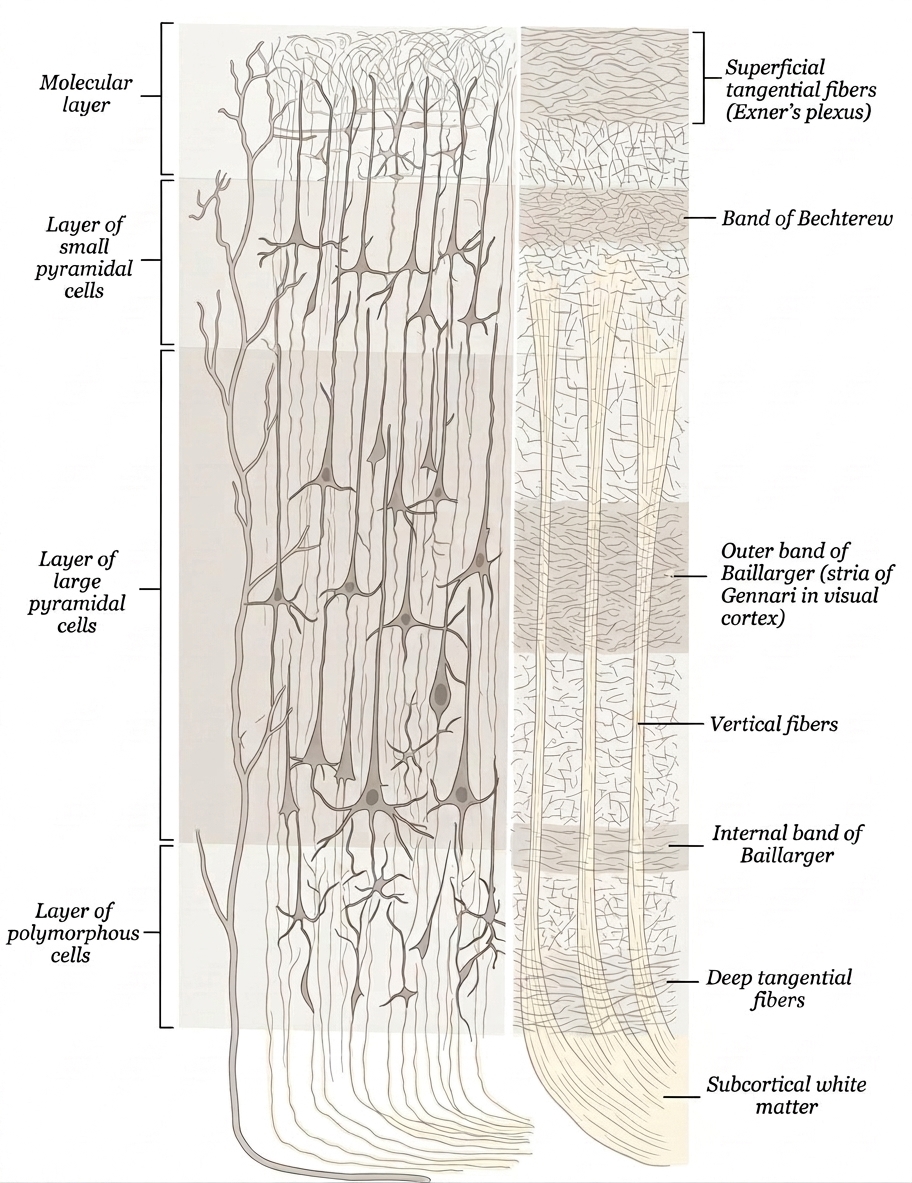
  • The neocortex (isocortex) comprises ~90% of the cerebral cortex and has a uniform 6-layer architecture
  • The remaining cortex is allocortex — 3-layered (hippocampus = archicortex; olfactory cortex = paleocortex)
Layer Name Predominant Cells Function / Connections
IMolecularFew neurons; dendrites, axons, gliaSynaptic integration zone
IIExternal granularSmall pyramidal & stellate cellsReceives corticocortical input
IIIExternal pyramidalMedium pyramidal cellsCorticocortical OUTPUT (association & commissural)
IVInternal granularStellate (granule) cellsThalamocortical INPUT — prominent in sensory cortex
VInternal pyramidalLarge pyramidal cells (Betz cells in M1)Subcortical OUTPUT — corticospinal, corticobulbar, corticostriatal
VIMultiform (fusiform)Mixed polymorphic cellsCorticothalamic OUTPUT (feedback to thalamus)

Granular vs. Agranular Cortex

Feature Granular Cortex Agranular Cortex
Layer IVThick, prominentThin or absent
Layer VThinThick, prominent (Betz cells)
LocationPrimary sensory cortices (S1, V1, A1)Primary motor cortex (M1), premotor
RationaleReceives abundant thalamic inputSends abundant subcortical output
Board Pearl
  • Layer IV = INPUT (thalamus → cortex), thick in sensory cortex. Layer V = OUTPUT (cortex → subcortical), thick in motor cortex.
  • Mnemonic: sensory cortex is granular (receives); motor cortex is agranular (sends)
  • Betz cells = giant pyramidal neurons in layer V of primary motor cortex — largest neurons in the CNS

Cortical Columns & Brodmann Areas

  • Cortical columns — functional units that span all 6 layers; neurons in a column share similar receptive fields and response properties
  • Best characterized in V1 (ocular dominance columns, orientation columns) and S1 (somatotopic columns)
  • Brodmann areas — 52 cytoarchitecturally distinct regions mapped by Korbinian Brodmann (1909); many correspond to functional areas
Brodmann Area Location Function
4Precentral gyrusPrimary motor cortex (M1)
6Anterior to area 4Premotor cortex & supplementary motor area (SMA)
8Posterior middle frontal gyrusFrontal eye fields (FEF)
3, 1, 2Postcentral gyrusPrimary somatosensory cortex (S1)
5, 7Superior parietal lobuleSomatosensory association cortex
17Calcarine cortexPrimary visual cortex (V1)
18, 19Surrounding area 17Visual association cortex (V2, V3)
22Posterior superior temporal gyrusWernicke’s area (language comprehension)
39Angular gyrusReading, calculation, semantic processing
40Supramarginal gyrusPhonological processing, praxis
41, 42Heschl’s gyrusPrimary auditory cortex
44, 45Inferior frontal gyrus (dominant)Broca’s area (speech production)
Frontal Lobe
  • Largest lobe — ~1/3 of cortical surface
  • Boundaries: anterior to central sulcus, superior to lateral (Sylvian) fissure
  • Blood supply: ACA (medial surface) + MCA (lateral surface)

Primary Motor Cortex (M1) — Brodmann Area 4

  • Location: precentral gyrus
  • Function: execution of voluntary contralateral movements
  • Contains Betz cells (giant pyramidal neurons, layer V) → origin of ~30% of corticospinal tract fibers
  • Motor homunculus — somatotopic organization:
    • Medial surface: lower extremity (foot, leg, hip) → ACA territory
    • Lateral convexity: upper extremity, face, tongue → MCA territory
    • Hand and face have disproportionately large cortical representation (fine motor control)
  • Output tracts: corticospinal (body) and corticobulbar (face/bulbar muscles)

Clinical Correlations

  • Lesion → contralateral UMN weakness: spasticity, hyperreflexia, extensor plantar response
  • ACA stroke → contralateral leg weakness (leg > arm)
  • MCA stroke → contralateral face and arm weakness (face/arm > leg)
  • Cortical lesion typically causes weakness that respects somatotopy, unlike internal capsule lesion (equal face/arm/leg)

Premotor & Supplementary Motor Areas — Brodmann Area 6

  • Premotor cortex (lateral area 6):
    • Motor planning for externally guided movements
    • Integrates visual and sensory input with motor output
    • Lesion → difficulty with visually guided reaching
  • Supplementary motor area (SMA, medial area 6):
    • Motor planning for internally generated sequences
    • Bimanual coordination, complex motor sequences
    • Lesion → alien hand syndrome (frontal variant), difficulty initiating movement, impaired sequencing
    • SMA seizures → bilateral tonic posturing, often mistaken for psychogenic events

Broca’s Area — Brodmann Areas 44 & 45

  • Location: inferior frontal gyrus (pars opercularis = area 44; pars triangularis = area 45) — dominant hemisphere
  • Function: speech production, motor programming of articulation, syntax/grammar
  • Lesion → Broca’s aphasia:
    • Non-fluent, effortful, telegraphic speech
    • Comprehension intact (for simple commands; may struggle with complex syntax)
    • Repetition impaired
    • Naming impaired
    • Often accompanied by right hemiparesis (adjacent motor strip involvement)
    • Patient is typically aware and frustrated

Frontal Eye Fields (FEF) — Brodmann Area 8

  • Location: posterior middle frontal gyrus
  • Function: initiates voluntary conjugate saccades to the contralateral side
Clinical Pearl
  • Destructive lesion (stroke) → eyes deviate TOWARD the lesion (away from the hemiparesis) — "eyes look at the lesion"
  • Irritative lesion (seizure) → eyes deviate AWAY from the lesion (toward the jerking limbs) — "eyes look at the seizure"
  • Exception: thalamic hemorrhage → eyes deviate AWAY from the lesion (wrong-way eyes)

Prefrontal Cortex

Dorsolateral Prefrontal Cortex (DLPFC)

  • Executive function: planning, organization, cognitive flexibility, working memory
  • Lesion → dysexecutive syndrome: poor planning, perseveration, impaired working memory, poor abstraction
  • Tested by: Wisconsin Card Sort Test, Trail Making B, digit span backward

Orbitofrontal Cortex (OFC)

  • Social behavior, judgment, impulse control, emotional regulation
  • Lesion → disinhibition syndrome: impulsivity, inappropriate social behavior, poor judgment, emotional lability
  • Classic example: Phineas Gage (OFC damaged by iron rod)
  • Also seen in: frontotemporal dementia (behavioral variant)

Medial Prefrontal / Anterior Cingulate Cortex

  • Motivation, initiation of behavior, emotional processing
  • Lesion → abulia (lack of will/initiative) or akinetic mutism (bilateral) — alert but no spontaneous speech or movement
  • Bilateral ACA infarction is a classic cause

Frontal Lobe Clinical Syndromes

Syndrome Localization Key Features
Broca’s aphasiaInferior frontal gyrus (dominant)Non-fluent speech, intact comprehension, impaired repetition
Dysexecutive syndromeDorsolateral PFCPoor planning, perseveration, impaired working memory
DisinhibitionOrbitofrontal cortexImpulsivity, poor social judgment, inappropriate behavior
Abulia / akinetic mutismMedial frontal / ACCApathy, decreased spontaneous behavior and speech
Alien hand syndromeSMA / medial frontal (also callosal)Involuntary, purposeful movements of the limb
Frontal release signsDiffuse frontal lobe dysfunctionGrasp, snout, palmomental, glabellar reflexes
Utilization behaviorBilateral frontal lobesCompulsive use of objects placed in front of patient
Board Pearl
  • Frontal release signs (primitive reflexes): grasp, snout, palmomental, glabellar (Myerson’s sign), rooting — suggest bilateral frontal lobe dysfunction (dementia, diffuse injury)
  • Alien hand syndrome has two variants: frontal (SMA/ACC → groping, grasping) and callosal (posterior corpus callosum → intermanual conflict)
  • A patient who is "alert but does nothing" → think abulia (bilateral medial frontal / ACA territory)
Parietal Lobe
  • Boundaries: central sulcus (anterior), parieto-occipital sulcus (posterior), lateral fissure (inferior)
  • Blood supply: MCA (lateral) + ACA (medial parasagittal strip)

Primary Somatosensory Cortex (S1) — Brodmann Areas 3, 1, 2

  • Location: postcentral gyrus
  • Function: processing of contralateral somatosensory information
  • Sensory homunculus: somatotopic map (medial = leg [ACA]; lateral = face/arm [MCA]); lips, tongue, and fingers have disproportionately large representation

Functional Sub-Areas of S1

Area Modality
3aProprioception (muscle spindle input)
3bCutaneous touch (main tactile processing area)
1Texture discrimination
2Size and shape (stereognosis)

Clinical — Cortical Sensory Loss

  • Cortical sensory modalities (impaired with parietal lesions):
    • Stereognosis — object identification by touch (loss = astereognosis)
    • Graphesthesia — recognition of numbers/letters traced on skin (loss = agraphesthesia)
    • Two-point discrimination
    • Sensory extinction on double simultaneous stimulation
  • Primary modalities preserved: pain, temperature, light touch, vibration (processed at thalamic level)
  • This dissociation (cortical modalities lost, primary modalities intact) is the hallmark of a cortical vs. thalamic or peripheral lesion

Somatosensory Association Cortex — Brodmann Areas 5 & 7

  • Location: superior parietal lobule
  • Functions: sensorimotor integration, visuospatial processing, body schema, hand-eye coordination
  • Lesion → optic ataxia (misreaching for visual targets), tactile agnosia, impaired spatial awareness

Supramarginal Gyrus — Brodmann Area 40

  • Location: inferior parietal lobule (wraps around posterior end of Sylvian fissure)
  • Functions: phonological processing, motor planning for skilled movements (praxis)
  • Dominant hemisphere lesion → conduction aphasia, ideomotor apraxia
  • Non-dominant hemisphere lesion → hemispatial neglect (often in conjunction with area 39/7)

Angular Gyrus — Brodmann Area 39

  • Location: inferior parietal lobule (wraps around posterior end of STS)
  • Functions: reading comprehension, writing, calculation, cross-modal semantic integration
  • Dominant hemisphere lesion → Gerstmann syndrome

Gerstmann Syndrome

  • Caused by lesion of the dominant (left) angular gyrus (area 39)
  • Tetrad:
    • Acalculia — inability to perform calculations
    • Agraphia — inability to write
    • Finger agnosia — inability to identify individual fingers
    • Left-right disorientation
  • Often accompanied by alexia with agraphia
  • Classic board question: "patient cannot do math, cannot write, confuses fingers, and confuses left-right" → dominant angular gyrus

Hemispatial Neglect

  • Definition: failure to attend to, report, or respond to stimuli on the side contralateral to a brain lesion, not explained by primary sensory/motor deficits
  • Most common and severe with RIGHT (non-dominant) parietal lesions (inferior parietal lobule, temporoparietal junction)
  • Also involves the right superior temporal gyrus, right frontal lobe, and subcortical structures
Clinical Pearl
  • Why is neglect worse with right-sided lesions? The right hemisphere attends to BOTH hemifields; the left hemisphere attends primarily to the right. A right parietal lesion → severe left neglect because the left hemisphere cannot compensate. A left parietal lesion → mild/no right neglect because the right hemisphere covers both sides.
  • Neglect subtypes: personal (body), peripersonal (reaching space), extrapersonal (far space)
  • Testing: line bisection (deviates toward lesion), cancellation tasks, clock drawing (numbers all on one side)

Parietal Lobe Syndromes Summary

Syndrome Hemisphere Key Features
Gerstmann syndromeDominant (angular gyrus)Acalculia, agraphia, finger agnosia, L-R disorientation
Hemispatial neglectNon-dominant (right parietal)Left-sided inattention; line bisection deviated right; clock drawing abnormal
Cortical sensory lossEitherLoss of stereognosis, graphesthesia, 2-point discrimination with intact primary modalities
Ideomotor apraxiaDominant (supramarginal gyrus)Cannot pantomime gestures to command; improves with actual objects
Constructional apraxiaNon-dominant (right parietal)Cannot copy drawings, construct shapes
AnosognosiaNon-dominant (right parietal)Denial or unawareness of neurological deficit (e.g., hemiplegia)
Optic ataxiaEither (superior parietal)Misreaching for objects under visual guidance
Temporal Lobe
  • Boundaries: inferior to lateral (Sylvian) fissure, anterior to occipital lobe
  • Blood supply: MCA (lateral surface), PCA (inferior/medial surface)

Primary Auditory Cortex — Brodmann Areas 41 & 42

  • Location: Heschl’s gyrus (transverse temporal gyrus) — located on the superior surface of the temporal lobe, hidden within the Sylvian fissure
  • Function: initial cortical processing of auditory information
  • Tonotopic organization: different sound frequencies mapped along the gyrus
  • Bilateral input: each ear projects to BOTH auditory cortices (unlike vision) → unilateral cortical lesion causes subtle hearing change, NOT deafness
  • Unilateral lesion → difficulty with sound localization, impaired auditory discrimination on contralateral side
  • Bilateral lesions → cortical deafness (rare)

Wernicke’s Area — Brodmann Area 22

  • Location: posterior superior temporal gyrus (dominant hemisphere)
  • Function: language comprehension (spoken and written)
  • Lesion → Wernicke’s aphasia:
    • Fluent speech — normal rate, rhythm, prosody, but content is empty
    • Comprehension severely impaired
    • Repetition impaired
    • Paraphasic errors: phonemic ("spork" for "fork") and semantic ("knife" for "fork")
    • Neologisms (made-up words) and jargon
    • Patient is typically unaware of deficit (anosognosia for language)

Auditory Agnosia & Word Deafness

  • Auditory agnosia: inability to recognize sounds despite intact hearing → bilateral auditory association cortex lesions
  • Pure word deafness: cannot comprehend spoken language but can read, write, and speak normally → bilateral lesions isolating Wernicke’s area from auditory input, or unilateral left temporal lesion disconnecting both auditory cortices from Wernicke’s area
  • Auditory verbal agnosia = pure word deafness (selective inability to comprehend spoken words)

Hippocampus & Memory

  • Location: medial temporal lobe (floor of inferior horn of lateral ventricle)
  • Function: memory consolidation (short-term → long-term); spatial navigation
  • Memory types processed:
    • Declarative (explicit) memory: episodic (personal events) and semantic (facts)
    • NOT procedural memory (handled by basal ganglia/cerebellum)
  • Bilateral hippocampal lesion → severe anterograde amnesia (cannot form new declarative memories)
  • Unilateral lesion: dominant (left) → verbal memory deficit; non-dominant (right) → visuospatial memory deficit
  • Classic cases: Patient H.M. (bilateral medial temporal lobectomy); herpes encephalitis (predilection for temporal lobes)

Amygdala

  • Location: anterior medial temporal lobe, anterior to hippocampus
  • Functions: emotional processing (especially fear conditioning), emotional memory, social cognition (reading facial expressions)
  • Bilateral lesion → Klüver-Bucy syndrome:
    • Hyperorality — tendency to examine objects with mouth
    • Hypersexuality
    • Placidity — loss of fear/aggression
    • Visual agnosia (psychic blindness)
    • Hypermetamorphosis — compulsive exploration of environment
  • Causes: herpes encephalitis, frontotemporal dementia, bilateral temporal lobectomy

Temporal Lobe Epilepsy (TLE)

  • Most common focal epilepsy in adults
  • Focus: mesial temporal structures (hippocampus, amygdala, parahippocampal gyrus)
  • Common pathology: hippocampal sclerosis (mesial temporal sclerosis)
  • Semiology:
    • Aura: rising epigastric sensation, déjà vu, jamais vu, fear/anxiety, olfactory/gustatory hallucinations, autonomic symptoms
    • Seizure: behavioral arrest → oroalimentary automatisms (lip smacking, chewing) → manual automatisms (fumbling, picking)
    • Post-ictal: confusion, amnesia, dysphasia (if dominant hemisphere)
  • Interictal personality traits (Geschwind syndrome): hypergraphia, hyperreligiosity, altered sexuality, viscosity (circumstantial interpersonal style)
Board Pearl
  • Temporal lobe epilepsy aura: epigastric rising sensation + déjà vu + fear + olfactory hallucinations = mesial temporal focus
  • Meyer’s loop (temporal optic radiation) lesion → contralateral superior quadrantanopia ("pie in the sky")
  • Klüver-Bucy syndrome = bilateral amygdala → board favorite for herpes encephalitis sequelae

Visual Field Deficit — Meyer’s Loop

  • Meyer’s loop carries inferior retinal fibers (representing the contralateral superior visual field) through the temporal lobe
  • Temporal lobe lesion → contralateral superior quadrantanopia ("pie in the sky")
  • Important in temporal lobe surgery planning (anterior temporal lobectomy for epilepsy)
Occipital Lobe
  • Boundaries: posterior to parieto-occipital sulcus
  • Blood supply: primarily PCA; macular cortex has dual supply (PCA + MCA branch) → explains macular sparing

Primary Visual Cortex (V1) — Brodmann Area 17

  • Location: banks of the calcarine sulcus (medial occipital surface)
  • Also called striate cortex (due to line of Gennari — a prominent myelinated stripe in layer IV)
  • Receives input from: lateral geniculate nucleus (LGN) of thalamus via optic radiation
  • Retinotopic organization:
    • Upper visual field → below calcarine sulcus (lingual gyrus)
    • Lower visual field → above calcarine sulcus (cuneus)
    • Central/macular vision → posterior pole (large cortical area = cortical magnification)
    • Peripheral vision → anterior calcarine cortex

Visual Field Deficits by Lesion Location

Lesion Site Visual Field Deficit Notes
Optic nerveMonocular vision loss (ipsilateral)Ipsilateral RAPD
Optic chiasm (central)Bitemporal hemianopiaPituitary adenoma, craniopharyngioma
Optic tractContralateral homonymous hemianopiaIncongruent; RAPD contralateral to lesion
Temporal lobe (Meyer’s loop)Contralateral superior quadrantanopia"Pie in the sky"
Parietal lobe (Baum’s loop)Contralateral inferior quadrantanopia"Pie on the floor"
Occipital lobe (complete V1)Contralateral homonymous hemianopia with macular sparingPCA stroke; dual macular supply
Occipital tip onlyContralateral homonymous hemianopic scotoma (central)Macular representation at posterior pole
Bilateral V1Cortical blindnessBilateral PCA infarction; intact pupillary reflexes

Visual Association Areas (V2–V5)

  • V2 (area 18) and V3 (area 19): secondary visual processing, border/contour detection
  • Two processing streams diverge from V1:

Dorsal Stream — "Where / How" Pathway

  • Route: V1 → V2 → V3 → V5/MT → posterior parietal cortex
  • Function: spatial location, motion perception, visually guided action
  • V5/MT = motion processing area
  • Lesion of V5 (bilateral) → akinetopsia (motion blindness — world seen as series of frozen frames)
  • Lesion of posterior parietal → optic ataxia (misreaching)

Ventral Stream — "What" Pathway

  • Route: V1 → V2 → V4 → inferior temporal cortex
  • Function: object recognition, face recognition, color processing
  • V4 = color processing area
  • Fusiform face area (ventral occipitotemporal) = face recognition
  • Lesion of V4 (bilateral) → achromatopsia (loss of color perception; world appears gray)
  • Lesion of fusiform face area (bilateral) → prosopagnosia
  • Lesion of ventral stream → visual object agnosia (cannot identify objects by sight; can identify by touch)

Occipital Lobe Syndromes

Syndrome Lesion Location Key Features
Cortical blindnessBilateral V1Complete vision loss; intact pupillary reflexes (retino-tectal pathway spared)
Anton syndromeBilateral V1 + visual associationCortical blindness + denial of blindness (confabulates visual experiences)
Balint syndromeBilateral parieto-occipital (watershed)Triad: simultanagnosia + optic ataxia + ocular apraxia
ProsopagnosiaBilateral fusiform gyrusCannot recognize faces; can recognize people by voice
AchromatopsiaBilateral V4Loss of color perception (distinct from retinal color blindness)
Visual agnosiaVentral occipitotemporal (bilateral)Cannot recognize objects by sight; can recognize by touch/sound
AkinetopsiaBilateral V5/MTCannot perceive motion
Riddoch phenomenonV1 lesion with spared V5Can perceive motion in the blind field despite cortical blindness
Board Pearl
  • Anton syndrome = cortical blindness + denial of blindness + confabulation. Bilateral PCA infarcts. Pupils are reactive (subcortical pathway intact).
  • Balint syndrome triad: (1) simultanagnosia — cannot perceive more than one object at a time; (2) optic ataxia — misreaching; (3) ocular apraxia — cannot voluntarily direct gaze. Bilateral parieto-occipital watershed infarcts are the classic cause.
  • Macular sparing in PCA stroke = dual blood supply from PCA and MCA to the occipital pole
Language & Aphasia

Language Network Overview

  • Broca’s area (areas 44/45) — speech production, motor programming
  • Wernicke’s area (area 22) — language comprehension
  • Arcuate fasciculus — white matter tract connecting Broca’s and Wernicke’s → critical for repetition
  • Angular gyrus (area 39) — reading, writing, semantic integration
  • Supramarginal gyrus (area 40) — phonological processing
  • Supplementary motor area — speech initiation
  • All are in the dominant hemisphere (left in ~95% of right-handers, ~70% of left-handers)

Aphasia Classification Table

Aphasia Type Fluency Comprehension Repetition Naming Lesion Site
Broca’sNon-fluentIntactImpairedImpairedInferior frontal gyrus (areas 44/45)
Wernicke’sFluentImpairedImpairedImpairedPosterior superior temporal gyrus (area 22)
ConductionFluentIntactSeverely impairedImpairedArcuate fasciculus (supramarginal gyrus region)
GlobalNon-fluentImpairedImpairedImpairedLarge perisylvian (MCA territory)
Transcortical motorNon-fluentIntactIntactImpairedAnterior/superior to Broca’s (SMA, mesial frontal)
Transcortical sensoryFluentImpairedIntactImpairedPosterior to Wernicke’s (temporo-parieto-occipital junction)
Mixed transcorticalNon-fluentImpairedIntactImpairedWatershed zone (isolates perisylvian area)
AnomicFluentIntactIntactImpairedVariable (angular gyrus, temporal pole); also residual aphasia
Board Pearl
  • Key distinguishing feature = REPETITION. If repetition is impaired → perisylvian lesion (Broca’s, Wernicke’s, conduction, global). If repetition is intact → extra-perisylvian lesion (transcortical motor, transcortical sensory, mixed transcortical, anomic).
  • Transcortical aphasias = intact repetition. Often caused by watershed infarcts (hypotensive episodes).
  • Conduction aphasia = fluent speech + intact comprehension + severely impaired repetition with phonemic paraphasias. Patient makes errors then tries to self-correct (conduit d’approche).
  • Anomic aphasia is the most common residual aphasia type during recovery from any aphasia.

Related Language and Disconnection Syndromes

Syndrome Definition Lesion Site
Alexia without agraphiaCannot read but CAN write (pure alexia; "word blindness")Left occipital cortex + splenium of corpus callosum (disconnects visual input from left angular gyrus)
Alexia with agraphiaCannot read AND cannot writeDominant angular gyrus (area 39)
Pure word deafnessCannot comprehend spoken language; reading, writing, and speech intactBilateral temporal or left temporal disconnecting auditory input from Wernicke’s
Apraxia of speechMotor programming of speech impaired (effortful, groping articulation); distinct from dysarthriaDominant premotor/insula
Clinical Pearl
  • Alexia without agraphia is a classic disconnection syndrome and a board favorite. The patient can write a sentence but then cannot read what they just wrote. Caused by left PCA stroke affecting left occipital cortex + splenium → right visual cortex cannot relay information to the left angular gyrus.
  • Global aphasia without hemiparesis → think emboli to both Broca’s and Wernicke’s territory (double embolic infarct sparing the motor strip).
Higher Cortical Functions

Apraxia

  • Definition: inability to perform learned, skilled motor acts despite intact motor strength, sensation, coordination, and comprehension
  • Testing: ask patient to pantomime actions (e.g., "show me how you would use a comb") → if failed, demonstrate and ask to imitate → if failed, give actual object
Apraxia Type Key Features Lesion Site
IdeomotorCannot pantomime to command; improves with imitation and actual object use. Spatial and temporal errors in gesture production.Dominant (left) parietal lobe (supramarginal gyrus), premotor cortex, or connecting white matter
IdeationalCannot perform multi-step sequences even with actual objects (e.g., making coffee). Conceptual breakdown of the action plan.Dominant (left) parietal lobe; commonly seen in Alzheimer’s disease and diffuse cortical disease
Limb-kineticLoss of fine motor dexterity and precision in a single limb (clumsy hand). Not simply weakness.Contralateral premotor or motor cortex
ConstructionalCannot draw, copy figures, or assemble blocks. Impaired spatial organization of components.Usually right (non-dominant) parietal lobe
DressingCannot orient clothing to bodyRight parietal lobe
Orobuccal (oral)Cannot perform oral movements to command (e.g., "blow out a candle")Dominant frontal operculum, insula
Clinical Pearl
  • Ideomotor vs. ideational: ideomotor = single-gesture failure to command ("show me how you salute"); ideational = multi-step sequence failure ("show me how you would make and mail a letter")
  • Sympathetic apraxia: left hand apraxia in a right-handed patient with a Broca’s area lesion — the left hemisphere motor programs cannot reach the right hemisphere via the damaged anterior corpus callosum

Agnosia

  • Definition: inability to recognize stimuli in a particular sensory modality despite intact primary sensory function
  • The key is that the patient can perceive the stimulus but cannot assign meaning to it
Agnosia Type Key Features Lesion Site
Visual object agnosiaCannot recognize objects by sight; CAN recognize by touch or sound. Subtypes: apperceptive (cannot form percept) vs. associative (can copy but cannot name)Bilateral occipitotemporal (ventral stream)
ProsopagnosiaCannot recognize familiar faces; CAN identify people by voice, gait, or other cues. Can perceive a face but cannot match to identity.Bilateral fusiform face area (right > left)
Auditory agnosiaCannot recognize sounds (environmental or verbal) despite intact hearingBilateral superior temporal (auditory association cortex)
Tactile agnosia (astereognosis)Cannot identify objects by touch alone despite intact sensationContralateral parietal lobe (areas 5, 7, or secondary somatosensory cortex)
AnosognosiaUnawareness or denial of neurological deficit (e.g., hemiplegia, hemianopia, aphasia)Right (non-dominant) parietal lobe; also right temporoparietal junction
AutotopagnosiaCannot localize or identify one’s own body partsDominant (left) parietal lobe
Finger agnosiaSpecific inability to identify fingers (component of Gerstmann syndrome)Dominant angular gyrus
Color agnosiaCannot name or associate colors despite intact color perceptionDominant occipitotemporal (distinct from achromatopsia)
TopographagnosiaCannot orient in familiar environments; loss of spatial/environmental recognitionRight parahippocampal/medial occipitotemporal

Anosognosia

  • Definition: unawareness or denial of a neurological deficit
  • Most commonly associated with right parietal lobe lesions (right MCA stroke)
  • Patient may deny hemiplegia, neglect the left side of the body, or deny blindness (Anton syndrome)
  • Clinical significance: anosognosia impairs rehabilitation participation, predicts worse functional outcomes, and is distinct from psychiatric denial
  • May be temporarily reversed by caloric vestibular stimulation (cold water in left ear)

Cerebral Dominance & Lateralization

Left Hemisphere (Dominant) Right Hemisphere (Non-Dominant)
  • Language (production and comprehension)
  • Calculation
  • Praxis (motor programs for skilled movements)
  • Logical/analytical reasoning
  • Sequential processing
  • Reading and writing
  • Visuospatial processing
  • Attention to BOTH hemifields
  • Prosody (emotional tone of speech)
  • Face recognition
  • Music appreciation
  • Holistic/gestalt processing
  • Emotional processing and body awareness
  • Language dominance by handedness:
    • Right-handers: ~96% left-dominant
    • Left-handers: ~70% left-dominant, ~15% right-dominant, ~15% bilateral
  • Wada test (intracarotid amobarbital): used to determine hemispheric language dominance pre-operatively → largely replaced by fMRI
Cortical Localization Summary

Key Syndromes by Lobe and Location

Lobe / Region Syndrome Key Localizing Features
FrontalBroca’s aphasiaNon-fluent speech, preserved comprehension, impaired repetition
Abulia / akinetic mutismLoss of drive/initiation; medial frontal / bilateral ACA
Disinhibition syndromeImpulsivity, poor social judgment; orbitofrontal
Dysexecutive syndromePoor planning, perseveration; dorsolateral PFC
Alien hand (frontal type)Involuntary grasping/groping; SMA / medial frontal
Frontal release signsGrasp, snout, palmomental reflexes; diffuse frontal
Contralateral gaze deviationEyes deviate toward lesion; FEF (area 8)
ParietalGerstmann syndromeAcalculia, agraphia, finger agnosia, L-R confusion; dominant angular gyrus
Hemispatial neglectLeft-sided inattention; right inferior parietal
Cortical sensory lossLoss of stereognosis, graphesthesia; postcentral gyrus
Ideomotor apraxiaCannot pantomime to command; dominant supramarginal gyrus
AnosognosiaDenial of deficit; right parietal
TemporalWernicke’s aphasiaFluent, empty speech, poor comprehension; dominant posterior STG
Anterograde amnesiaCannot form new memories; bilateral hippocampi
Klüver-Bucy syndromeHyperorality, hypersexuality, placidity; bilateral amygdala
TLE semiologyEpigastric aura, automatisms; mesial temporal
Superior quadrantanopia"Pie in the sky"; Meyer’s loop
OccipitalCortical blindnessVision loss + intact pupils; bilateral V1
Anton syndromeCortical blindness + denial; bilateral V1
Balint syndromeSimultanagnosia + optic ataxia + ocular apraxia; bilateral parieto-occipital
ProsopagnosiaCannot recognize faces; bilateral fusiform gyrus
AchromatopsiaLoss of color vision; bilateral V4
Multi-lobar / DisconnectionAlexia without agraphiaCannot read, can write; left occipital + splenium
Conduction aphasiaFluent, intact comprehension, severely impaired repetition; arcuate fasciculus
Transcortical aphasiasIntact repetition; watershed territories (extra-perisylvian)
Board Pearl
  • Dominant hemisphere lesion → language deficits (aphasia), apraxia, Gerstmann syndrome, alexia/agraphia
  • Non-dominant hemisphere lesion → hemispatial neglect, anosognosia, constructional apraxia, dressing apraxia, impaired prosody (aprosodia)
  • Bilateral lesions required for: cortical blindness, Anton syndrome, Balint syndrome, prosopagnosia, Klüver-Bucy syndrome, cortical deafness, achromatopsia, akinetopsia
  • Watershed (border zone) infarcts: ACA-MCA watershed → proximal arm weakness ("man in a barrel"), transcortical motor aphasia; MCA-PCA watershed → Balint syndrome, transcortical sensory aphasia

References

  • Ropper AH, Samuels MA, Klein JP, Prasad S. Adams and Victor’s Principles of Neurology. 12th ed. McGraw Hill; 2023.
  • Blumenfeld H. Neuroanatomy through Clinical Cases. 3rd ed. Sinauer Associates; 2021.
  • Brazis PW, Masdeu JC, Biller J. Localization in Clinical Neurology. 8th ed. Wolters Kluwer; 2021.
  • Aminoff MJ, Greenberg DA, Simon RP. Clinical Neurology. 11th ed. McGraw Hill; 2021.
  • Geschwind N. Disconnexion syndromes in animals and man. Brain. 1965;88(2):237–294.
  • Catani M, ffytche DH. The rises and falls of disconnection syndromes. Brain. 2005;128(10):2224–2239.
  • Mesulam MM. Large-scale neurocognitive networks and distributed processing for attention, language, and memory. Ann Neurol. 1990;28(5):597–613.