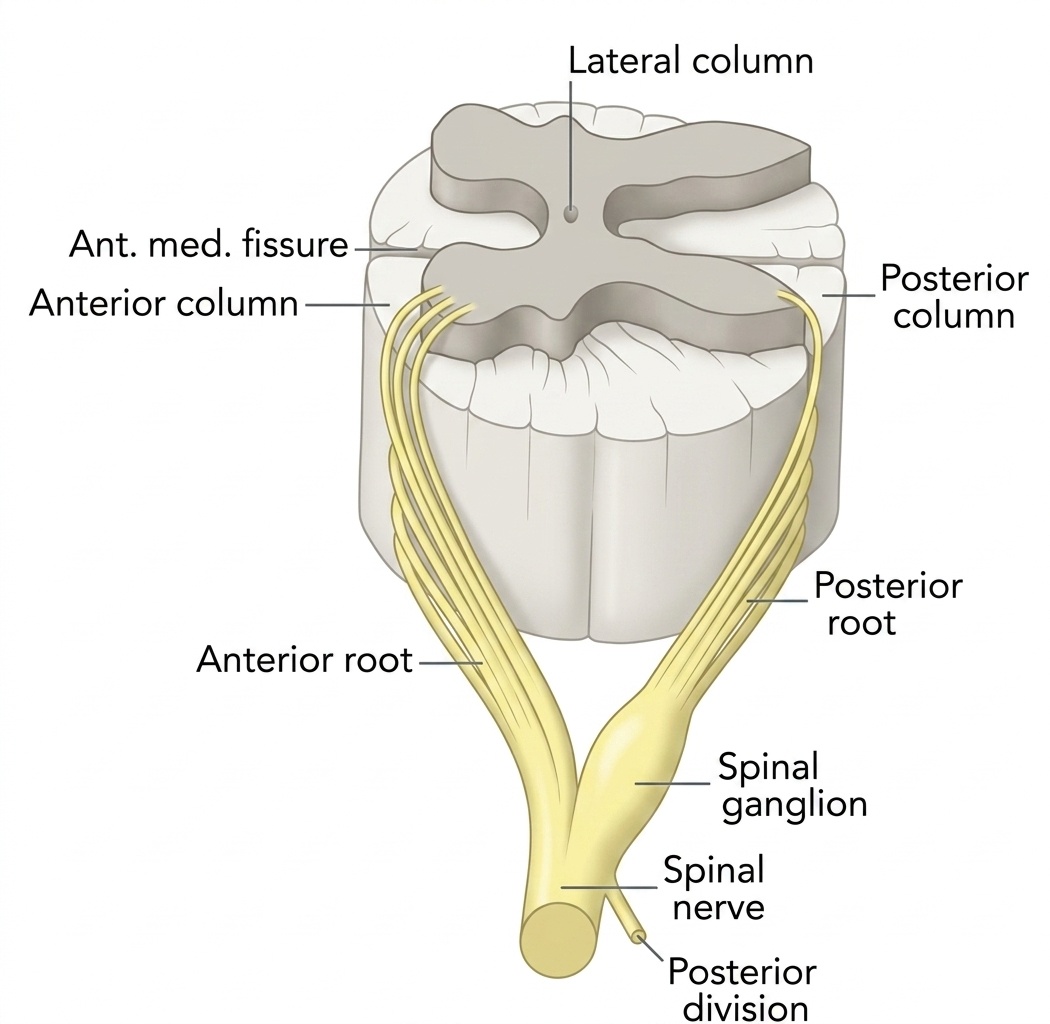
Spinal Cord
Spinal Cord
What Do You Need to Know?
- Gross anatomy — cord segments vs. vertebral levels, conus medullaris, cauda equina, cervical & lumbar enlargements
- Cross-sectional anatomy — gray matter horns, laminae of Rexed, white matter funiculi, somatotopic organization
- Ascending tracts — dorsal column–medial lemniscus pathway, spinothalamic tract, spinocerebellar tracts → know the modality, where each crosses, and what a lesion produces
- Descending tracts — lateral & anterior corticospinal, rubrospinal, vestibulospinal, reticulospinal → know crossing level and clinical significance
- Blood supply — anterior spinal artery (ventral 2/3), posterior spinal arteries (dorsal 1/3), artery of Adamkiewicz, watershed zones
- Spinal cord syndromes — complete transection, Brown-Séquard, anterior cord, posterior cord, central cord, conus medullaris vs. cauda equina
- Dermatomes, myotomes & reflexes — must-know levels for localization (C5–T1, L2–S1)
- Clinical localization — sensory level, UMN vs. LMN distinction, bladder physiology
Gross Anatomy
General Features
- Location: within the vertebral canal, extending from the foramen magnum to approximately the L1–L2 vertebral level in adults
- Length: ~45 cm in adults; surrounded by three meningeal layers (pia, arachnoid, dura)
- 31 pairs of spinal nerves: 8 cervical, 12 thoracic, 5 lumbar, 5 sacral, 1 coccygeal
- Note: C1–C7 nerves exit above their corresponding vertebrae; C8 exits below C7 vertebra; all thoracic/lumbar/sacral nerves exit below their corresponding vertebrae
Cord Segments vs. Vertebral Levels
- Because the spinal cord is shorter than the vertebral column, cord segments do not align with same-numbered vertebrae below the cervical region
- Rule of thumb:
- Upper cervical → cord segment ≈ vertebral level
- Lower cervical → add 1 (e.g., C7 vertebra houses C8 cord segment)
- Upper thoracic → add 2
- Lower thoracic → add 3
- T10–T12 vertebral levels → lumbar cord segments
- L1 vertebra → sacral cord segments and conus
When ordering spinal MRI, the radiologist reports vertebral levels, but the neurologist must convert to cord segments for clinical correlation. A T10 vertebral lesion may affect L1–L3 cord segments → the clinical examination will show deficits referable to L1–L3, not T10.
Cervical & Lumbar Enlargements
- Cervical enlargement (C5–T1): expanded gray matter for upper extremity motor and sensory innervation → brachial plexus origin
- Lumbar enlargement (L2–S3): expanded gray matter for lower extremity innervation → lumbosacral plexus origin
- These enlargements have proportionally more gray matter relative to white matter compared to thoracic levels
Conus Medullaris, Cauda Equina & Filum Terminale
- Conus medullaris: tapered terminal end of the spinal cord, typically at L1–L2 vertebral level
- Cauda equina: collection of lumbar and sacral nerve roots descending below the conus within the thecal sac → peripheral nerves, not spinal cord
- Filum terminale: slender filament of pia mater extending from the conus to the coccyx; anchors the cord
- Tethered cord: abnormally low-lying conus (below L2–L3 in adults) → progressive neurological deterioration with growth or traction
Lumbar puncture is performed at L3–L4 or L4–L5 because the spinal cord has already ended at L1–L2. The needle passes through cauda equina nerve roots (which float aside) → minimal risk of cord injury. This is the anatomic basis for safe LP.
Regional Characteristics — Summary Table
| Region | Key Anatomic Features | Clinical Relevance |
|---|---|---|
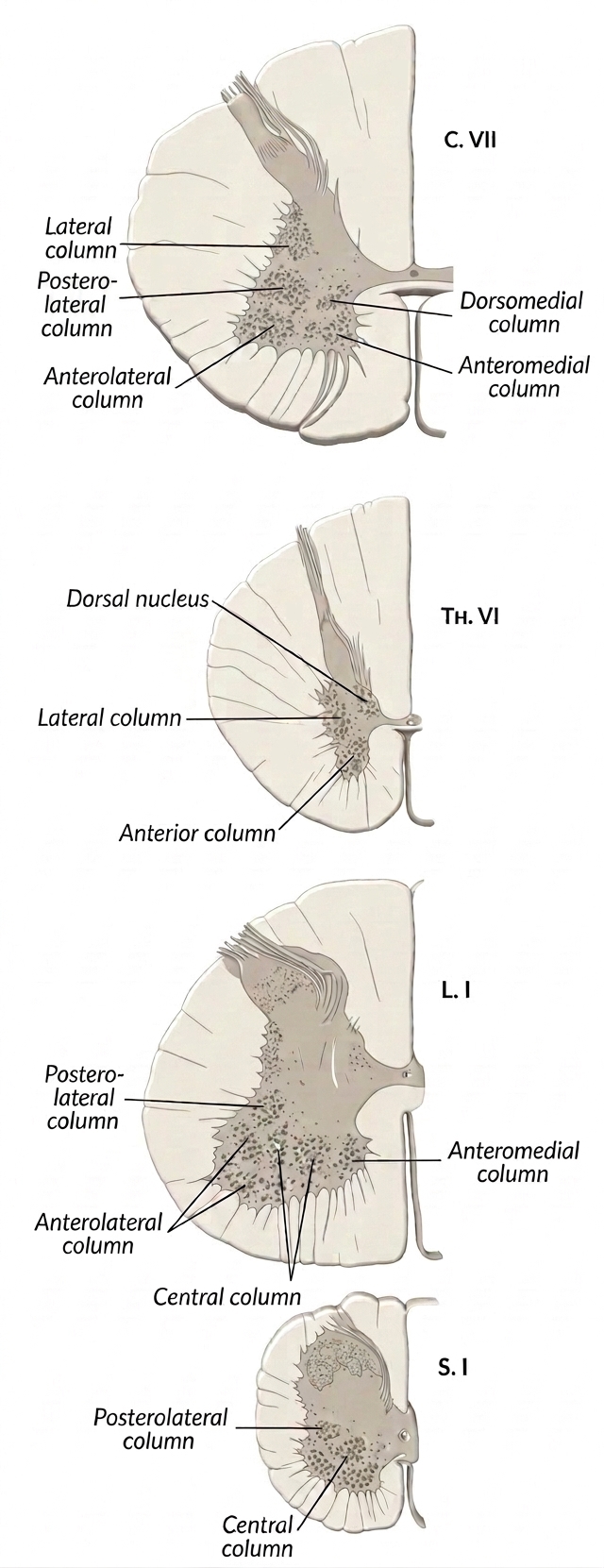
| Cervical | Large white matter volume; prominent anterior horns at C5–T1; lateral horn at C8–T1 (ciliospinal center) | Cervical spondylotic myelopathy (most common); central cord syndrome; C8–T1 lesion → Horner syndrome |
| Thoracic | Small anterior horns; intermediolateral cell column (IML) T1–L2 = sympathetic preganglionic neurons; Clarke’s nucleus (T1–L2) | Thoracic myelopathy from disc, epidural abscess; IML lesions → autonomic dysfunction; watershed zone vulnerability |
| Lumbar | Less white matter; large anterior horns; no IML column below L2 | ALS, poliomyelitis → LMN signs; lumbosacral radiculopathy |
| Sacral | Mostly gray matter; S2–S4 parasympathetic outflow (nucleus of Onuf → external urethral & anal sphincters) | Conus medullaris syndrome → early bladder/bowel/sexual dysfunction, saddle anesthesia |
Cross-Sectional Anatomy
Gray Matter Organization
Horns
- Anterior (ventral) horn: contains alpha motor neurons (LMNs) and gamma motor neurons → skeletal muscle innervation
- Somatotopy: medial motor neurons → axial/proximal muscles; lateral motor neurons → distal/extremity muscles
- Flexor motor neurons are dorsal; extensor motor neurons are ventral within the horn
- Posterior (dorsal) horn: sensory processing — receives primary afferent fibers carrying pain, temperature, touch, proprioception
- Lateral horn: present only at T1–L2 (sympathetic) and S2–S4 (parasympathetic) → autonomic preganglionic neurons
Laminae of Rexed
| Lamina | Location | Function / Content | Clinical Significance |
|---|---|---|---|
| I (Marginal zone) | Tip of dorsal horn | Nociceptive neurons; receives A-delta and C fibers | Pain processing; target of spinothalamic tract neurons |
| II (Substantia gelatinosa) | Dorsal horn | Pain modulation; high concentration of opioid receptors; gate control theory site | Spinal opioid analgesia; syringomyelia damages crossing fibers here |
| III–IV (Nucleus proprius) | Dorsal horn | Receives light touch and proprioceptive input | Contributes to spinothalamic and spinocerebellar pathways |
| V–VI | Base of dorsal horn / intermediate zone | Wide dynamic range neurons; receives converging input (visceral + somatic) | Basis of referred pain (viscerosomatic convergence) |
| VII (Intermediate zone) | Intermediate gray | Contains Clarke’s nucleus (T1–L2), IML column; interneurons | Clarke’s nucleus → posterior spinocerebellar tract; IML → sympathetic outflow |
| VIII | Ventral horn (medial) | Interneurons modulating motor output; receives reticulospinal, vestibulospinal input | Modulation of posture and axial muscle tone |
| IX | Ventral horn (motor neuron pools) | Alpha and gamma motor neurons → LMNs | ALS, polio, SMA → LMN degeneration; somatotopic organization (medial = axial, lateral = distal) |
| X | Surrounding central canal | Decussating axons; central gray matter | Syringomyelia expands central canal → disrupts crossing spinothalamic fibers |
White Matter Organization
Funiculi (Columns)
- Posterior funiculus (dorsal columns): between posterior median septum and posterolateral sulcus
- Fasciculus gracilis (medial) — lower extremity (below T6); present at all levels
- Fasciculus cuneatus (lateral) — upper extremity (above T6); present only above T6
- Lateral funiculus: between posterolateral and anterolateral sulci
- Contains lateral corticospinal tract, rubrospinal tract, posterior & anterior spinocerebellar tracts, lateral spinothalamic tract
- Anterior funiculus: between anterolateral sulcus and anterior median fissure
- Contains anterior corticospinal tract, vestibulospinal tract, reticulospinal tract, anterior spinothalamic tract, tectospinal tract
Central Canal & Anterior White Commissure
- Central canal: remnant of neural tube lumen, lined by ependymal cells; runs through lamina X
- Anterior white commissure: located ventral to the central canal → site where spinothalamic tract axons decussate
- Syringomyelia: expansion of a cavity (syrinx) around the central canal → disrupts crossing fibers in the anterior white commissure → bilateral suspended (cape-like) loss of pain & temperature with preserved dorsal column function
Syringomyelia destroys crossing spinothalamic fibers at the anterior white commissure. This produces a “dissociated sensory loss” — loss of pain/temperature in a cape-like distribution, with preserved vibration and proprioception. Always think Chiari I malformation as the most common underlying cause.
Major Ascending Tracts
Dorsal Column–Medial Lemniscus (DCML) Pathway
- Modality: vibration, proprioception (joint position sense), fine/discriminative touch, two-point discrimination
- First-order neuron: dorsal root ganglion → enters cord via medial division of dorsal root → ascends ipsilaterally in dorsal columns
- Somatotopy in cord:
- Fasciculus gracilis (medial) = lower body (sacral/lumbar) — “G for Ground”
- Fasciculus cuneatus (lateral) = upper body (thoracic/cervical) — present only above T6
- Second-order neuron: synapse in nucleus gracilis / nucleus cuneatus in the caudal medulla → axons decussate as internal arcuate fibers → form the medial lemniscus
- Third-order neuron: VPL nucleus of thalamus → primary somatosensory cortex
- Crosses at: caudal medulla (NOT in the spinal cord)
- Cord lesion produces: ipsilateral loss of vibration, proprioception, and fine touch below the level
Spinothalamic Tract (STT)
- Modality: pain, temperature, crude touch
- First-order neuron: dorsal root ganglion → enters cord via lateral division of dorsal root → may ascend/descend 1–2 segments in Lissauer’s tract → synapses in dorsal horn (laminae I, II, V)
- Second-order neuron: crosses in the anterior white commissure (over 1–2 segments) → ascends contralaterally in the anterolateral funiculus
- Somatotopy in cord: fibers added medially as you ascend → sacral fibers are lateral (outermost), cervical fibers are medial (innermost)
- Third-order neuron: VPL nucleus of thalamus → primary somatosensory cortex
- Crosses at: spinal cord level (anterior white commissure), 1–2 segments above entry
- Cord lesion produces: contralateral loss of pain & temperature beginning ~1–2 levels below the lesion
Sacral fibers are laminated laterally in the STT. An extramedullary compressive lesion (e.g., meningioma) affects sacral fibers first → sacral-sparing pattern is absent. An intramedullary lesion (e.g., syrinx, ependymoma) expands from the center → sacral sparing occurs because sacral fibers are outermost. This distinction helps differentiate intramedullary vs. extramedullary lesions on exam.
Spinocerebellar Tracts
- Posterior (dorsal) spinocerebellar tract:
- Modality: unconscious proprioception from lower extremity
- First-order neuron: DRG → synapse in Clarke’s nucleus (C8–L2)
- Second-order neuron: ascends ipsilaterally in lateral funiculus → enters cerebellum via inferior cerebellar peduncle
- Does NOT cross
- Anterior (ventral) spinocerebellar tract:
- Modality: unconscious proprioception from lower extremity (Golgi tendon organs)
- Crosses twice (at cord level, then again in cerebellum) → effectively ipsilateral
- Enters cerebellum via superior cerebellar peduncle
- Cuneocerebellar tract: equivalent of posterior spinocerebellar tract for upper extremity (from lateral cuneate nucleus in medulla) → ipsilateral, enters via inferior cerebellar peduncle
Ascending Tracts — Master Comparison Table
| Tract | Modality | Crosses At | Side of Cord | Three-Neuron Pathway |
|---|---|---|---|---|
| Fasciculus gracilis | Vibration, proprioception, fine touch (lower body) | Caudal medulla | Ipsilateral (posterior funiculus, medial) | DRG → nucleus gracilis → VPL thalamus → S1 cortex |
| Fasciculus cuneatus | Vibration, proprioception, fine touch (upper body) | Caudal medulla | Ipsilateral (posterior funiculus, lateral) | DRG → nucleus cuneatus → VPL thalamus → S1 cortex |
| Lateral spinothalamic | Pain and temperature | Spinal cord (anterior white commissure, 1–2 segments above entry) | Contralateral (lateral funiculus) | DRG → dorsal horn → VPL thalamus → S1 cortex |
| Anterior spinothalamic | Crude touch, pressure | Spinal cord (anterior white commissure) | Contralateral (anterior funiculus) | DRG → dorsal horn → VPL thalamus → S1 cortex |
| Posterior spinocerebellar | Unconscious proprioception (lower body) | Does not cross | Ipsilateral (lateral funiculus) | DRG → Clarke’s nucleus → cerebellum (via ICP) |
| Anterior spinocerebellar | Unconscious proprioception (lower body) | Crosses twice (cord + cerebellum) → ipsilateral net | Contralateral then ipsilateral | DRG → dorsal horn → cerebellum (via SCP) |
Major Descending Tracts
Lateral Corticospinal Tract (LCST)
- Origin: primary motor cortex (Brodmann area 4), premotor cortex, supplementary motor area → ~30% from precentral gyrus, ~30% from postcentral gyrus, rest from premotor/SMA
- Course: corona radiata → posterior limb of internal capsule → cerebral peduncle → basis pontis → medullary pyramid → decussation at pyramidal decussation (caudal medulla) → lateral funiculus of spinal cord
- Represents: ~85–90% of corticospinal fibers
- Function: voluntary fine motor control of distal extremity muscles
- Somatotopy in cord: cervical fibers medial, sacral fibers lateral
- Cord lesion: ipsilateral UMN signs below the level — weakness, spasticity, hyperreflexia, Babinski sign
Anterior Corticospinal Tract (ACST)
- Represents: ~10–15% of corticospinal fibers that do NOT cross at the pyramidal decussation
- Course: descends ipsilaterally in anterior funiculus → most fibers cross at the segmental level via anterior white commissure before synapsing
- Function: axial and proximal muscle control (bilateral innervation to trunk)
- Clinical significance: explains why trunk muscles are relatively spared in unilateral cortical/capsular strokes
Rubrospinal Tract
- Origin: red nucleus (midbrain) → crosses immediately (ventral tegmental decussation) → descends in lateral funiculus, just anterior to lateral CST
- Function: facilitates flexor motor neurons of upper extremity
- Clinical significance: relatively minor in humans; decorticate posture (flexion of arms) may involve rubrospinal influence when corticospinal tract is interrupted above the red nucleus
Vestibulospinal Tracts
- Lateral vestibulospinal tract:
- Origin: lateral vestibular nucleus (Deiters’ nucleus)
- Descends ipsilaterally in anterior funiculus
- Function: facilitates extensor (antigravity) muscles & inhibits flexors → postural control
- Medial vestibulospinal tract:
- Origin: medial vestibular nucleus
- Descends bilaterally in medial longitudinal fasciculus (MLF) → primarily to cervical levels
- Function: head and neck postural reflexes
- Clinical significance: decerebrate posture (extension of all four limbs) → unopposed vestibulospinal and reticulospinal extensor activity when lesion is below the red nucleus but above the vestibular nuclei
Reticulospinal Tracts
- Pontine (medial) reticulospinal tract:
- Origin: pontine reticular formation → descends ipsilaterally in anterior funiculus
- Function: facilitates extensors, inhibits flexors → antigravity support
- Medullary (lateral) reticulospinal tract:
- Origin: medullary reticular formation → descends bilaterally in lateral funiculus
- Function: facilitates flexors, inhibits extensors
- Clinical significance: modulates muscle tone, posture, locomotion; contributes to spasticity patterns after UMN lesions
Descending Tracts — Master Comparison Table
| Tract | Origin | Function | Crosses At | Location in Cord |
|---|---|---|---|---|
| Lateral corticospinal | Motor cortex | Voluntary fine motor (distal extremities) | Pyramidal decussation (caudal medulla) | Lateral funiculus (contralateral) |
| Anterior corticospinal | Motor cortex | Axial/proximal muscles | Segmental level (anterior white commissure) | Anterior funiculus (ipsilateral then crosses) |
| Rubrospinal | Red nucleus | Facilitates upper limb flexors | Ventral tegmental decussation (midbrain) | Lateral funiculus (contralateral) |
| Lateral vestibulospinal | Lateral vestibular nucleus | Facilitates extensors (antigravity) | Does not cross | Anterior funiculus (ipsilateral) |
| Medial vestibulospinal | Medial vestibular nucleus | Head/neck posture | Bilateral | Anterior funiculus (bilateral, cervical) |
| Pontine reticulospinal | Pontine reticular formation | Facilitates extensors | Does not cross (ipsilateral) | Anterior funiculus |
| Medullary reticulospinal | Medullary reticular formation | Facilitates flexors | Bilateral | Lateral funiculus |
Decorticate posture (arm flexion, leg extension) → lesion above the red nucleus; corticospinal tract interrupted but rubrospinal tract intact → upper limb flexion preserved.
Decerebrate posture (extension of all limbs) → lesion below the red nucleus (midbrain/pons) → unopposed vestibulospinal extensor drive.
Decerebrate carries a worse prognosis than decorticate.
Blood Supply
Anterior Spinal Artery (ASA)
- Origin: formed by union of branches from both vertebral arteries at the level of the foramen magnum
- Course: descends along the anterior median fissure of the spinal cord
- Territory: supplies the anterior two-thirds of the spinal cord:
- Anterior horns (LMNs)
- Lateral corticospinal tracts
- Spinothalamic tracts
- Anterior white commissure
- Base of dorsal horns
- Spares: dorsal columns and most of the posterior horns
Posterior Spinal Arteries (PSA)
- Origin: paired arteries from vertebral arteries or PICA
- Course: descend along the posterolateral sulci; form a pial plexus (arterial vasocorona) on the cord surface
- Territory: supplies the posterior one-third of the spinal cord:
- Dorsal columns (fasciculus gracilis and cuneatus)
- Posterior horns (dorsal horn sensory processing)
- PSA infarction is rare because of rich anastomotic plexus
Radicular Arteries & Artery of Adamkiewicz
- Radicular (segmental medullary) arteries: branches from aorta, intercostal, and lumbar arteries that reinforce the ASA and PSA at various levels
- Artery of Adamkiewicz (arteria radicularis magna):
- The single largest radicular artery; critical for lower thoracic and lumbosacral cord perfusion
- Typically arises from the left side (~75% of cases) at levels T9–T12 (range: T8–L2)
- Enters the spinal canal, joins the ASA
- Has a characteristic “hairpin turn” (ascending limb then descending limb) visible on spinal angiography
- Clinical significance: aortic surgery, aortic cross-clamping, aortic dissection, or severe hypotension can compromise this artery → spinal cord infarction
Watershed Zones
- The spinal cord has two main watershed zones vulnerable to hypoperfusion:
- Mid-thoracic cord (T4–T8): fewest radicular arteries → “watershed” between upper cervical supply and lower thoracic (Adamkiewicz) supply
- Peripheral zone at each segment: border zone between centrifugal (sulcal/central) and centripetal (pial) arteries
- Clinical significance: global hypotension can cause mid-thoracic cord infarction; often presents as bilateral leg weakness with sensory level at ~T4–T8
Spinal Cord Infarction Patterns
| Syndrome | Artery | Structures Affected | Clinical Presentation |
|---|---|---|---|
| ASA syndrome | Anterior spinal artery | Anterior horns, CST, STT, autonomic tracts | Bilateral motor paralysis below level; bilateral pain/temp loss; preserved vibration/proprioception; acute urinary retention |
| PSA syndrome | Posterior spinal arteries | Dorsal columns, posterior horns | Loss of vibration & proprioception; sensory ataxia; positive Romberg; motor spared; rare |
| Central artery (sulcal) infarct | Sulcal branches of ASA | Unilateral anterior cord | May mimic Brown-Séquard pattern; partial motor and sensory loss |
| Transverse infarct | Complete vascular compromise | Entire cord cross-section | Complete transection syndrome; usually from aortic catastrophe |
In young patients with acute spinal cord infarction and no aortic disease, consider fibrocartilaginous embolism (disc material embolizing to spinal arteries). It often follows minor trauma or Valsalva maneuver. MRI shows cord infarction, and disc pathology may be subtle. Diagnosis is often clinical/by exclusion.
Spinal cord infarction is a feared complication of aortic repair (open or endovascular). Risk is highest when cross-clamping involves the T8–L2 segment (territory of artery of Adamkiewicz). Presents as flaccid paraplegia (initially from spinal shock) that later evolves to spastic paraplegia. Vibration/proprioception may be preserved (ASA territory) → classic ASA syndrome.
Spinal Cord Syndromes
Complete Transection
- Loss of ALL motor and sensory function below the level
- Initially presents as spinal shock: flaccid paralysis, areflexia, loss of all sensation, urinary retention, loss of autonomic function below the level
- Over days to weeks → spinal shock resolves → UMN signs emerge: spasticity, hyperreflexia, Babinski, spastic bladder (detrusor hyperreflexia)
- At the level of lesion: LMN signs in the affected segment (atrophy, fasciculations, areflexia)
- Causes: trauma, transverse myelitis, complete vascular occlusion, epidural abscess/hematoma
Brown-Séquard Syndrome (Hemisection)
- Ipsilateral to lesion (below):
- UMN weakness (lateral CST) → spasticity, hyperreflexia, Babinski
- Loss of vibration & proprioception (dorsal columns)
- Contralateral to lesion (1–2 levels below):
- Loss of pain & temperature (spinothalamic tract)
- At the level of lesion (ipsilateral):
- LMN signs in the segment (if anterior horn involved)
- Ipsilateral band of anesthesia (segmental sensory loss)
- Causes: penetrating trauma (most classic), tumor, MS, radiation myelopathy
- Prognosis: best among incomplete cord syndromes; often significant recovery
Anterior Cord Syndrome
- Mechanism: anterior spinal artery occlusion or anterior cord compression
- Affected: anterior two-thirds of cord → CST + STT + anterior horns
- Presents as:
- Bilateral motor paralysis below the level (CST)
- Bilateral loss of pain & temperature (STT)
- PRESERVED vibration & proprioception (dorsal columns spared)
- Bladder dysfunction (autonomic tracts)
- Causes: ASA occlusion, aortic pathology, burst fracture with anterior compression, disc herniation
- Prognosis: poorest of incomplete syndromes (<10–20% motor recovery)
Posterior Cord Syndrome
- Affected: dorsal columns (posterior funiculi)
- Presents as:
- Loss of vibration & proprioception
- Sensory ataxia (wide-based gait, positive Romberg)
- Motor strength preserved
- Pain & temperature preserved
- Causes:
- Vitamin B12 deficiency (subacute combined degeneration — also involves lateral CST)
- Tabes dorsalis (tertiary syphilis)
- Nitrous oxide toxicity (inactivates B12)
- Copper deficiency
- Posterior spinal artery infarct (rare)
- Friedreich ataxia
B12 deficiency = dorsal columns + lateral CST (hence “combined”). Presents with sensory ataxia (posterior columns) PLUS UMN signs in the legs (lateral CST involvement). Peripheral neuropathy can also be present → the combination of absent ankle jerks (LMN/neuropathy) with upgoing toes (UMN/CST) is classic. Always check methylmalonic acid (most sensitive) and homocysteine.
Central Cord Syndrome
- Mechanism: hyperextension injury in a patient with pre-existing cervical spondylosis (elderly); or syringomyelia (younger)
- Pathophysiology: damage to the central portion of the cord → medially located cervical CST fibers (arm representation) are most affected
- Presents as:
- Upper extremity weakness >> lower extremity weakness (“man-in-a-barrel” pattern when severe)
- Variable sensory loss — may have bilateral cape-like loss of pain/temp (disrupted crossing STT fibers)
- Bladder dysfunction (variable)
- Lower extremities may be near-normal
- Recovery pattern: legs recover first, then bladder, then arms, then hands (hands last and worst)
- Note: does NOT require fracture; can occur with hyperextension alone in a stenotic canal
Conus Medullaris vs. Cauda Equina Syndrome
| Feature | Conus Medullaris | Cauda Equina |
|---|---|---|
| Anatomy | Terminal spinal cord (S3–S5 segments, at L1–L2 vertebra) | Lumbosacral nerve roots below the conus (peripheral nerves) |
| Type of lesion | Upper AND lower motor neuron (mixed) | Pure LMN (peripheral nerve roots) |
| Onset | Sudden, often symmetric | Gradual, often asymmetric |
| Pain | Less prominent; bilateral, dull, perineumal | Severe radicular pain; unilateral or asymmetric |
| Weakness | Symmetric; may have UMN signs if epiconus involved | Asymmetric; pure LMN (flaccid, areflexic) |
| Sensory loss | Saddle anesthesia (perianal S3–S5); bilateral and symmetric | Asymmetric, dermatomal; may include saddle area |
| Bladder/Bowel | Early and prominent; areflexic bladder (overflow incontinence) | Late; variable retention or incontinence |
| Sexual dysfunction | Early; erectile dysfunction | Less common early |
| Reflexes | Bulbocavernosus and ankle jerk absent; may have Babinski if epiconus | Reduced/absent in affected roots |
| Common causes | Intramedullary tumors (ependymoma), infarction, demyelination | Disc herniation (large central), tumor (schwannoma, metastasis), abscess, spinal stenosis |
New-onset urinary retention + saddle anesthesia + bilateral leg weakness/radiculopathy = suspect cauda equina syndrome. This requires emergent MRI and surgical decompression (ideally within 24–48 hours). Delayed intervention leads to permanent bladder, bowel, and sexual dysfunction. Always ask about urinary retention in any patient with acute low back pain and bilateral leg symptoms.
Spinal Cord Syndromes — Comprehensive Comparison Table
| Syndrome | Motor | Pain/Temp | Vibration/Proprioception | Bladder | Key Causes |
|---|---|---|---|---|---|
| Complete transection | Bilateral paralysis below level | Bilateral loss below level | Bilateral loss below level | Yes (retention → spastic) | Trauma, transverse myelitis |
| Brown-Séquard | Ipsilateral UMN weakness | Contralateral loss (1–2 levels below) | Ipsilateral loss | Rare | Penetrating trauma, MS, tumor |
| Anterior cord | Bilateral paralysis below level | Bilateral loss below level | Preserved | Yes | ASA infarction, aortic surgery |
| Posterior cord | Preserved | Preserved | Bilateral loss | No (usually) | B12 deficiency, tabes dorsalis, N2O |
| Central cord | Arms >> legs | Cape-like bilateral loss (variable) | Variable (often preserved) | Variable | Hyperextension + spondylosis, syrinx |
| Conus medullaris | Symmetric (LMN + UMN) | Saddle distribution | Variable | Early and prominent | Ependymoma, infarction |
| Cauda equina | Asymmetric LMN | Asymmetric, dermatomal | Variable | Late | Disc herniation, tumor, abscess |
Key Dermatomes & Myotomes
Critical Dermatomal Landmarks
| Level | Dermatome Landmark | Key Myotome (Muscle / Action) | Reflex |
|---|---|---|---|
| C5 | Lateral arm (regimental badge area) | Deltoid, biceps (shoulder abduction, elbow flexion) | Biceps reflex (C5–C6) |
| C6 | Lateral forearm, thumb, index finger | Wrist extensors (extensor carpi radialis) | Brachioradialis reflex (C5–C6) |
| C7 | Middle finger | Triceps, wrist flexors, finger extensors (elbow extension) | Triceps reflex (C7–C8) |
| C8 | Ring and little finger, medial forearm | Finger flexors (FDP), hand intrinsics (grip) | Finger flexor reflex (C8) |
| T1 | Medial arm | Hand intrinsics (interossei, lumbricals) | None commonly tested |
| T4 | Nipple line | — | — |
| T10 | Umbilicus | Abdominal muscles | Beevor sign (T10 lesion → umbilicus moves superiorly with sit-up) |
| L2 | Anterior thigh (upper) | Iliopsoas (hip flexion) | Cremasteric reflex (L1–L2) |
| L3 | Anterior thigh (middle/medial knee) | Quadriceps (knee extension) | Patellar reflex (L3–L4) |
| L4 | Medial leg (shin) | Tibialis anterior (ankle dorsiflexion) | Patellar reflex (L3–L4) |
| L5 | Dorsum of foot, great toe | Extensor hallucis longus (great toe extension), hip abductors (gluteus medius) | Medial hamstring reflex (L5) — often absent/difficult |
| S1 | Lateral foot, sole, posterior calf | Gastrocnemius/soleus (ankle plantarflexion), hip extensors (gluteus maximus) | Ankle (Achilles) reflex (S1–S2) |
| S2–S4 | Perianal region (saddle area) | Bladder detrusor, anal sphincter | Bulbocavernosus reflex (S2–S4); Anal wink (S2–S4) |
High-Yield Reflexes by Level
| Reflex | Cord Level | Key Points |
|---|---|---|
| Biceps | C5–C6 | Musculocutaneous nerve; test with arm slightly flexed |
| Brachioradialis | C5–C6 | Radial nerve; tap styloid process of radius |
| Triceps | C7–C8 | Radial nerve; most reliable reflex for C7 |
| Finger flexors | C8–T1 | Median nerve; Hoffmann sign tests this pathway (UMN sign if pathologically brisk) |
| Patellar (knee jerk) | L3–L4 | Femoral nerve; most reliable reflex for L3–L4 |
| Achilles (ankle jerk) | S1–S2 | Tibial nerve; loss common in S1 radiculopathy and diabetic neuropathy |
| Plantar response | S1 (afferent), L4–S2 (efferent) | Babinski sign (extensor plantar) = UMN lesion; most important UMN sign |
| Bulbocavernosus | S2–S4 | Tests sacral arc integrity; first reflex to return after spinal shock |
| Anal wink | S2–S4 | Tests external anal sphincter; absent = sacral segment or root dysfunction |
| Cremasteric | L1–L2 | Stroking inner thigh → ipsilateral testicular elevation; absent = L1–L2 or UMN lesion above |
Inverted radial reflex: tapping brachioradialis (C5–C6) produces finger flexion instead of elbow flexion. This indicates a lesion at C5–C6 (destroying the reflex arc) with concomitant compression of the cord below → spread of UMN hyperreflexia to C8–T1 finger flexors. This is a classic sign of cervical myelopathy.
Beevor sign: when a patient with a T10 cord lesion performs a sit-up, the umbilicus deviates superiorly because the upper abdominal muscles (T7–T9) are intact while the lower ones (T10–T12) are weak. This is also seen in facioscapulohumeral muscular dystrophy (FSHD) due to selective lower abdominal muscle weakness.
Clinical Localization
The Sensory Level
- Definition: the most caudal dermatome with normal sensation; abnormal sensation begins at the level below
- Pin prick and temperature are most useful (test spinothalamic tract, which crosses 1–2 segments above entry)
- Interpretation:
- Sensory level at T6 → cord or root lesion at approximately T4–T6 (allowing for the 1–2 segment crossing of STT)
- Always compare MRI findings with the clinical sensory level for accurate localization
- Suspended sensory level: loss of sensation in a band (e.g., C4–T2) with normal sensation above and below → think intramedullary lesion (syringomyelia, intramedullary tumor)
UMN vs. LMN Signs at Different Levels
| Feature | Upper Motor Neuron (UMN) | Lower Motor Neuron (LMN) |
|---|---|---|
| Location of lesion | Cortex, internal capsule, brainstem, or spinal cord (corticospinal tract) | Anterior horn cell, nerve root, plexus, or peripheral nerve |
| Weakness pattern | Pyramidal pattern (extensors in UE, flexors in LE) | Follows root or nerve distribution |
| Tone | Increased (spasticity, clasp-knife) | Decreased (flaccid) |
| Reflexes | Hyperreflexia | Hyporeflexia / areflexia |
| Babinski | Present (extensor plantar) | Absent (flexor plantar or no response) |
| Atrophy | Mild, late (disuse atrophy) | Early, prominent (denervation atrophy) |
| Fasciculations | Absent | Present |
| Clonus | May be present | Absent |
Localizing by Level — Key Patterns
- High cervical (C1–C4):
- Quadriplegia (UMN all four limbs)
- C3–C5 → diaphragm paralysis (phrenic nerve) → respiratory failure
- May have Horner syndrome (if descending sympathetic tract involved)
- Cervical enlargement (C5–T1):
- LMN signs in upper extremities (at level) + UMN signs in lower extremities (below level)
- Specific myotomal weakness helps localize the exact segment
- C8–T1 lesion → hand intrinsic wasting + Horner syndrome (disrupted ciliospinal center)
- Thoracic cord (T1–T12):
- Normal upper extremities
- UMN signs in lower extremities (spastic paraplegia)
- Sensory level on the trunk (use dermatomal landmarks: T4 = nipple, T10 = umbilicus)
- T1–L2 → sympathetic column involvement possible
- Lumbar enlargement (L2–S3):
- LMN signs in lower extremities (at level, may mimic peripheral lesion)
- May also have UMN signs below if cord segments below are intact and compressed rather than destroyed
- Conus medullaris (S3–S5):
- Saddle anesthesia, early bladder/bowel/sexual dysfunction
- May have minimal motor deficit in legs
Bladder Involvement in Cord Lesions
- Normal micturition:
- Pontine micturition center (PMC / Barrington’s nucleus) coordinates detrusor contraction + sphincter relaxation
- S2–S4 parasympathetic → detrusor contraction (muscarinic M3 receptors)
- T11–L2 sympathetic → detrusor relaxation (beta-adrenergic) + internal sphincter contraction (alpha-adrenergic) → urine storage
- S2–S4 somatic (pudendal nerve) → external urethral sphincter (voluntary control)
- UMN bladder (suprasacral cord lesion):
- Loss of voluntary control; detrusor hyperreflexia (spastic/overactive bladder)
- Detrusor-sphincter dyssynergia → simultaneous detrusor contraction and sphincter contraction → high post-void residual, risk of reflux and hydronephrosis
- Urgency, frequency, incontinence
- LMN bladder (conus or cauda equina lesion):
- Areflexic/atonic bladder → overflow incontinence, large post-void residual
- Absent bulbocavernosus reflex
- May require intermittent catheterization
Spinal shock is the temporary loss of all spinal cord function below an acute lesion. It produces flaccid paralysis, areflexia, and atonic bladder — mimicking an LMN pattern even though the lesion is in the cord. It lasts days to weeks. The bulbocavernosus reflex is the first reflex to return (signaling the end of spinal shock). After resolution, UMN signs (spasticity, hyperreflexia, Babinski) emerge below the level.
Quick Localization Algorithm
- Step 1: Is there a sensory level? → If yes, suspect spinal cord (not brain or peripheral nerve)
- Step 2: UMN signs below + LMN signs at a specific level? → Cord lesion at that level
- Step 3: Bilateral vs. unilateral? → Determines complete vs. hemisection vs. other syndrome
- Step 4: Which modalities are affected?
- Pain/temp lost + vibration preserved → anterior cord
- Vibration lost + pain/temp preserved → posterior cord
- Ipsilateral motor + ipsilateral vibration + contralateral pain/temp → Brown-Séquard
- Arms >> legs → central cord
- Step 5: Early bladder involvement? → Conus medullaris; late or absent → cauda equina or other
When you see a patient with LMN signs at one level (e.g., areflexia, atrophy in C5–C6 myotome) and UMN signs below (spastic legs, hyperreflexia, Babinski) → the lesion is in the spinal cord at the level of the LMN findings. This is the hallmark of myelopathy. A pure brain lesion does not produce LMN signs. A pure peripheral lesion does not produce UMN signs. Only a cord lesion produces both.
Lhermitte sign: an electric shock-like sensation radiating down the spine or into the limbs upon neck flexion. It indicates posterior column irritation in the cervical spinal cord. Classic causes: multiple sclerosis (most common association), cervical spondylotic myelopathy, B12 deficiency, radiation myelopathy, cisplatin toxicity. It is a sign, not a diagnosis — but it strongly points to cervical cord pathology.
References
- Blumenfeld H. Neuroanatomy through Clinical Cases. 3rd ed. Sinauer Associates; 2021.
- Brazis PW, Masdeu JC, Biller J. Localization in Clinical Neurology. 8th ed. Wolters Kluwer; 2022.
- Ropper AH, Samuels MA, Klein JP, Prasad S. Adams and Victor’s Principles of Neurology. 12th ed. McGraw-Hill; 2023.
- Netter FH. Atlas of Human Anatomy. 7th ed. Elsevier; 2019.
- Aminoff MJ, Greenberg DA, Simon RP. Clinical Neurology. 11th ed. McGraw-Hill; 2021.
- Waxman SG. Clinical Neuroanatomy. 29th ed. McGraw-Hill; 2020.
- Daroff RB, Jankovic J, Mazziotta JC, Pomeroy SL. Bradley and Daroff’s Neurology in Clinical Practice. 8th ed. Elsevier; 2022.
- Continuum (Minneap Minn). Spinal Cord Disorders. American Academy of Neurology; 2021.