Basic Science Anatomy

Subcortical Nuclei (BG, Thalamus, Hypothalamus)

Subcortical Nuclei: Basal Ganglia, Thalamus & Hypothalamus

What Do You Need to Know?

  • Basal ganglia components — striatum (caudate + putamen), lentiform nucleus (putamen + GP), GPi/GPe, STN, substantia nigra (SNpc/SNpr)
  • Direct vs. indirect pathway — direct = facilitates movement (D1), indirect = inhibits movement (D2); dopamine activates both → net facilitation
  • Lesion-to-disorder mapping — SNpc loss → Parkinson disease; caudate atrophy → Huntington disease; STN lesion → hemiballismus; putamen copper → Wilson disease
  • Thalamic relay nuclei — VPL (body), VPM (face), VL (cerebellum → motor), VA (BG → motor), LGN (vision), MGN (hearing)
  • Thalamic stroke syndromes — Dejerine-Roussy (thalamic pain), paramedian stroke (vertical gaze palsy + memory loss), artery of Percheron (bilateral)
  • Hypothalamic nuclei — lateral = hunger, ventromedial = satiety, anterior = cooling, posterior = heating, suprachiasmatic = circadian, mammillary bodies = memory
  • Internal capsule — anterior limb, genu, posterior limb; somatotopy; lacunar syndromes (pure motor hemiparesis, ataxic hemiparesis)
Basal Ganglia Anatomy

Overview & Definitions

  • Basal ganglia — collection of subcortical nuclei deep to cerebral cortex, lateral to the thalamus
  • Primary role: motor control, procedural learning, habit formation, emotion, executive function
  • The basal ganglia do NOT initiate movement — they modulate cortically initiated motor plans

Component Structures
Structure Components Role
Striatum Caudate nucleus + Putamen INPUT nucleus — receives cortical projections (glutamate); connected across internal capsule by cell bridges giving "striped" appearance
Lentiform nucleus Putamen + Globus pallidus (GP) Anatomical grouping — lens-shaped structure lateral to the internal capsule
Globus pallidus externa (GPe) Intermediate relay in the indirect pathway; GABAergic output to STN
Globus pallidus interna (GPi) OUTPUT nucleus — tonically inhibits thalamus via GABA; DBS target
Subthalamic nucleus (STN) Only excitatory (glutamatergic) nucleus in BG; drives GPi activity; DBS target for Parkinson disease
Substantia nigra pars compacta (SNpc) Source of dopamine to striatum (nigrostriatal pathway); lost in Parkinson disease
Substantia nigra pars reticulata (SNpr) OUTPUT nucleus (functionally equivalent to GPi); GABAergic inhibition of thalamus & superior colliculus
Board Pearl

Striatum = INPUT; GPi/SNpr = OUTPUT. The internal capsule separates the caudate (medial) from the lentiform nucleus (lateral). Striatal cell bridges crossing the internal capsule give it its "striped" name.

Spatial Relationships & Blood Supply
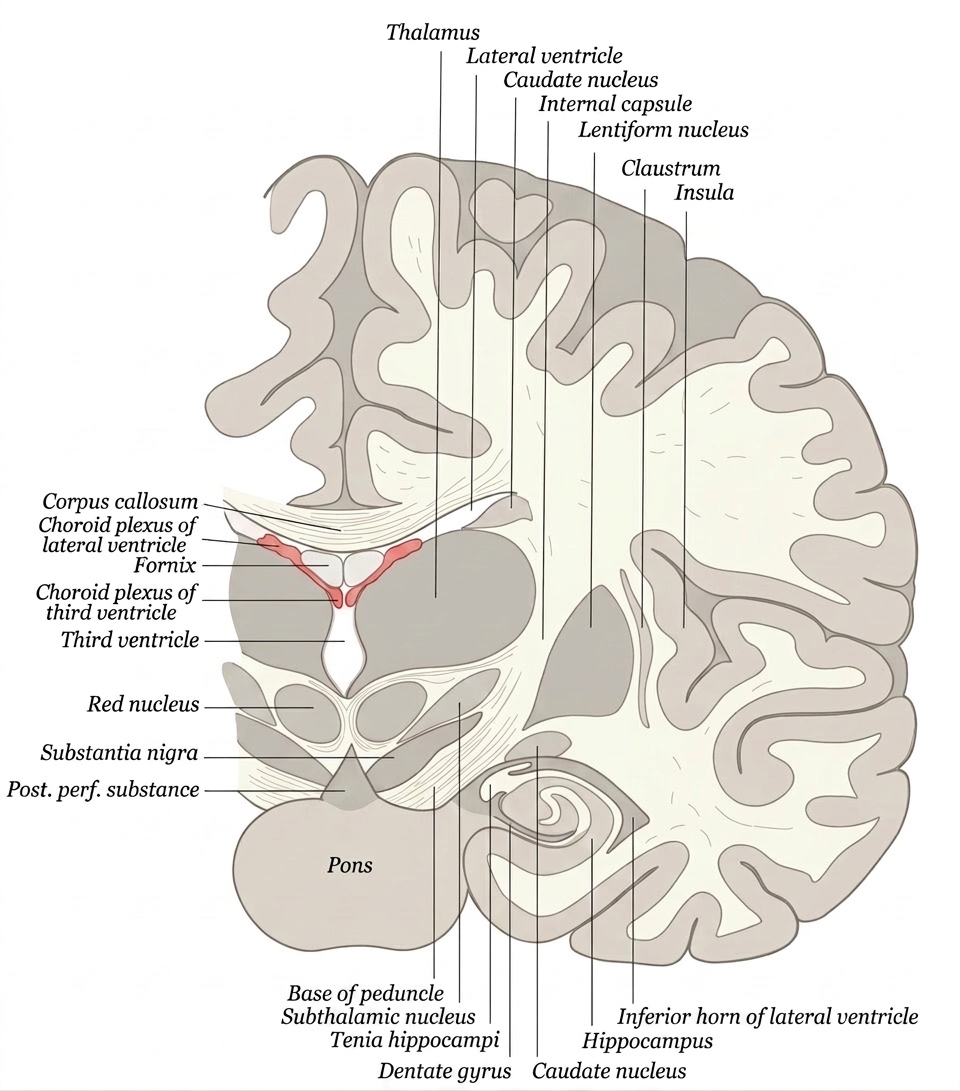
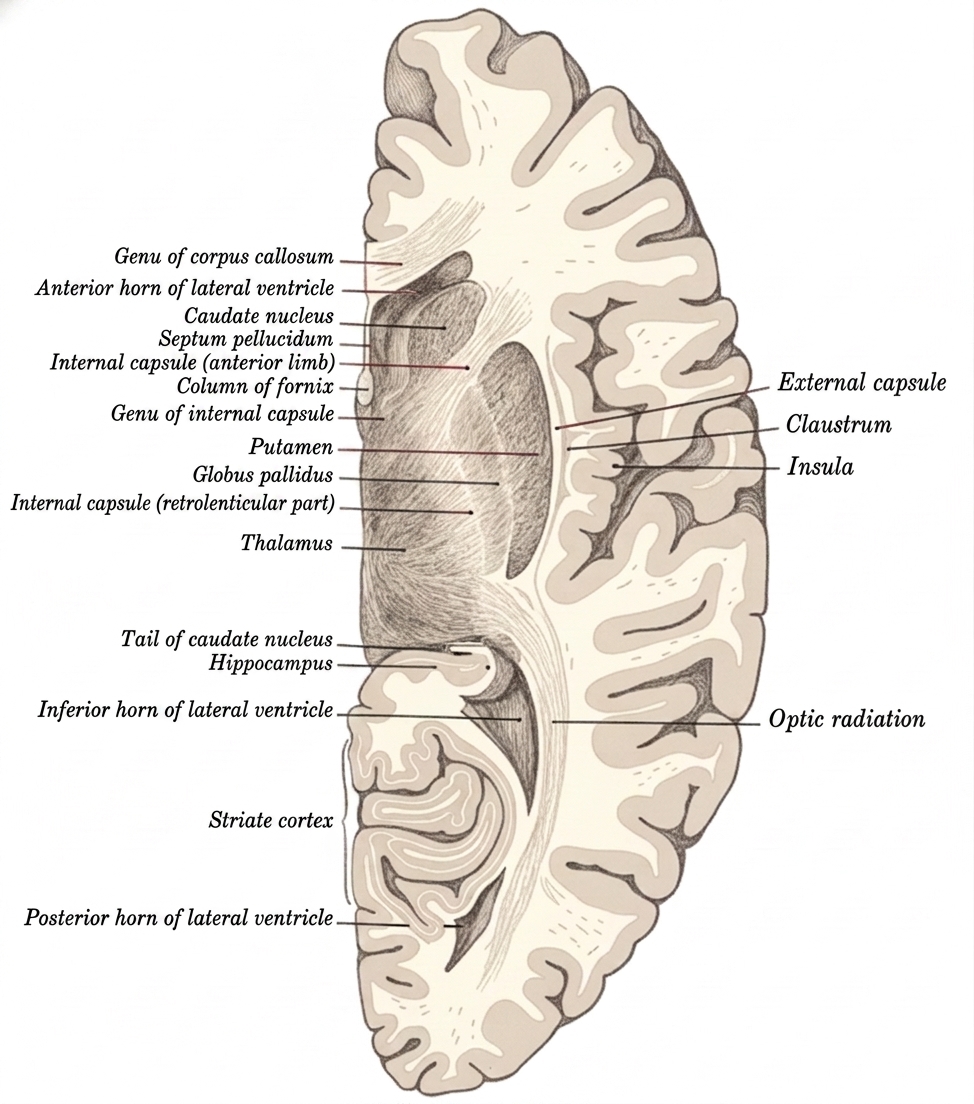
Spatial Organization (Medial → Lateral)

  • Caudate nucleus — C-shaped, follows lateral ventricle (head, body, tail); head bulges into frontal horn
  • Internal capsule — between caudate/thalamus (medially) and lentiform nucleus (laterally)
  • Globus pallidus — medial portion of lentiform nucleus
  • Putamen — lateral portion of lentiform nucleus
  • External capsule — lateral to putamen
  • Claustrum — thin gray matter between external and extreme capsules
  • Extreme capsule — between claustrum and insular cortex

Blood Supply

  • Lenticulostriate arteries (lateral branches of MCA M1) → putamen, globus pallidus, caudate head, internal capsule — most common site of hypertensive hemorrhage
  • Recurrent artery of Heubner (from ACA) → caudate head, anterior limb of internal capsule, anterior putamen
  • Anterior choroidal artery (from ICA) → GPi, posterior limb of internal capsule, optic tract
Clinical Pearl

Hypertensive putaminal hemorrhage is the most common hypertensive intracerebral hemorrhage → rupture of lenticulostriate arteries → contralateral hemiparesis, hemisensory loss, hemianopia, and eyes deviate toward the lesion.

Basal Ganglia Circuitry

Direct Pathway (GO Pathway) — Facilitates Movement

  • Cortex → excites Striatum (glutamate)
  • Striatum → inhibits GPi/SNpr (GABA, substance P, dynorphin)
  • GPi/SNpr releases inhibition on Thalamus (less GABA output)
  • Thalamus → excites Cortex (glutamate)
  • Net effect: disinhibition of thalamus → increased cortical drive → movement facilitated
  • Dopamine effect: D1 receptors on direct pathway neurons → dopamine excites the direct pathway → promotes movement
  • Mnemonic: "D1 = Direct = Do it"

Indirect Pathway (STOP Pathway) — Inhibits Movement

  • Cortex → excites Striatum (glutamate)
  • Striatum → inhibits GPe (GABA, enkephalin)
  • GPe releases inhibition on STN (less GABA output)
  • STN → excites GPi/SNpr (glutamate)
  • GPi/SNpr → inhibits Thalamus (increased GABA output)
  • Net effect: increased thalamic inhibition → less cortical drive → movement suppressed
  • Dopamine effect: D2 receptors on indirect pathway neurons → dopamine inhibits the indirect pathway → reduces suppression → net facilitation of movement
  • Mnemonic: "D2 = inDirect = Don't do it (inhibits the inhibitor)"

Hyperdirect Pathway

  • Route: Cortex → STN → GPi (bypasses striatum entirely)
  • Function: rapid, global suppression of motor programs — acts as an "emergency brake"
  • Speed: fastest of the three pathways because it skips the striatal relay
  • Clinical relevance: implicated in impulse control, response inhibition, and OCD pathophysiology

Neurotransmitter Summary

Neurotransmitter Source → Target Effect
Dopamine SNpc → Striatum (nigrostriatal pathway) D1 = excitatory (direct pathway); D2 = inhibitory (indirect pathway); both facilitate movement
GABA Striatum, GPe, GPi, SNpr Inhibitory; main neurotransmitter of BG output nuclei (GPi, SNpr)
Glutamate Cortex → Striatum; STN → GPi/SNpr Excitatory; STN is the only excitatory BG nucleus
Acetylcholine Striatal cholinergic interneurons Opposes dopamine in striatum; relatively increased in Parkinson disease → rationale for anticholinergics

Direct vs. Indirect Pathway Comparison

Feature Direct Pathway Indirect Pathway
Function Facilitates movement (GO) Inhibits movement (STOP)
Dopamine receptor D1 (excitatory on MSNs) D2 (inhibitory on MSNs)
Effect of dopamine Activates pathway → more movement Inhibits pathway → less suppression → more movement
Co-transmitters Substance P, dynorphin Enkephalin
In Parkinson disease (low DA) Underactive → less movement facilitation Overactive → excess movement suppression
In Huntington disease (early) Preserved initially Lost early (indirect MSNs degenerate first) → chorea
Board Pearl

Both pathways produce the same net effect from dopamine: D1 activation of direct pathway + D2 inhibition of indirect pathway → both facilitate movement. Loss of dopamine (Parkinson disease) → underactive direct + overactive indirect → increased GPi output → bradykinesia and rigidity.

Basal Ganglia Disorders

Hypokinetic vs. Hyperkinetic Framework

Type GPi/SNpr Output Thalamic Activity Examples
Hypokinetic Increased (excess inhibition) Decreased Parkinson disease, parkinsonism (MSA, PSP, CBD, DLB)
Hyperkinetic Decreased (insufficient inhibition) Increased Huntington disease, hemiballismus, chorea, dystonia

Parkinson Disease

  • Pathology: loss of dopaminergic neurons in SNpc; Lewy bodies (alpha-synuclein aggregates)
  • Mechanism: dopamine loss → underactive direct pathway + overactive indirect pathway → increased GPi output → excessive thalamic inhibition → bradykinesia
  • Cardinal features (TRAP):
    • Tremor — resting, "pill-rolling," 4–6 Hz, asymmetric onset
    • Rigidity — cogwheel (rigidity + superimposed tremor) or lead-pipe
    • Akinesia / bradykinesia — decrement on repetitive movements, required for diagnosis
    • Postural instability — late feature, poor prognostic sign
  • Other motor features: masked facies, hypophonia, micrographia, shuffling gait, reduced arm swing, festination, en bloc turning
  • Non-motor features: anosmia (early), REM sleep behavior disorder, constipation, depression, dementia (late), orthostatic hypotension
  • Treatment targets: levodopa/carbidopa (dopamine precursor), dopamine agonists (pramipexole, ropinirole), MAO-B inhibitors (rasagiline, selegiline), COMT inhibitors (entacapone), DBS of STN or GPi

Huntington Disease

  • Genetics: CAG trinucleotide repeat expansion in huntingtin gene (chromosome 4p16.3); autosomal dominant; anticipation (earlier onset with successive generations)
  • Pathology: loss of striatal medium spiny neurons — indirect pathway neurons (enkephalin+) degenerate first
  • Mechanism:
    • Early: indirect pathway loss → decreased GPi output → chorea (hyperkinetic)
    • Late: both pathways lost → rigidity and bradykinesia (Westphal variant if juvenile onset)
  • Clinical triad: chorea + psychiatric symptoms (depression, irritability, psychosis) + cognitive decline (subcortical dementia)
  • Imaging: caudate atrophy → "box-car" ventricles (enlarged frontal horns); also putaminal and cortical atrophy
  • Treatment of chorea: VMAT2 inhibitors (tetrabenazine, deutetrabenazine, valbenazine) — deplete presynaptic dopamine

Hemiballismus

  • Definition: violent, large-amplitude, flinging movements of proximal limb (unilateral)
  • Lesion: contralateral subthalamic nucleus (STN)
  • Mechanism: STN normally excites GPi (glutamate) → STN lesion → reduced GPi output → thalamic disinhibition → excessive movement
  • Etiology: lacunar stroke (most common), nonketotic hyperglycemia (second most common — T1 hyperintensity on MRI), tumor, demyelination
  • Prognosis: often self-limited; treatment with dopamine receptor blockers or tetrabenazine if persistent

Wilson Disease

  • Genetics: autosomal recessive; mutations in ATP7B gene (chromosome 13) → impaired biliary copper excretion
  • Pathology: copper accumulation in putamen (primary BG target), globus pallidus, liver, cornea
  • Neurological features: wing-beating tremor, dystonia, parkinsonism, dysarthria, drooling, psychiatric symptoms
  • Key findings: Kayser-Fleischer rings (corneal copper deposits), low ceruloplasmin, elevated 24-hour urine copper
  • MRI: "face of the giant panda" sign (midbrain); T2 hyperintensity in putamen and caudate
  • Treatment: copper chelation (penicillamine, trientine), zinc supplementation (blocks gut absorption)

Dystonia

  • Definition: sustained or intermittent muscle contractions → twisting, repetitive movements, abnormal postures
  • Pathophysiology: loss of surround inhibition in BG circuits; abnormal sensorimotor integration
  • Classification: focal (cervical dystonia, blepharospasm, writer's cramp), segmental, generalized (DYT1/TOR1A mutation)
  • Treatment: botulinum toxin (focal), anticholinergics (trihexyphenidyl, especially young patients), GPi DBS (generalized)

Disorder-to-Structure Comparison Table

Disorder Structure Affected Movement Type Key Mechanism
Parkinson disease SNpc (dopamine neurons) Hypokinetic (bradykinesia, rigidity, tremor) Increased GPi output → thalamic inhibition
Huntington disease Striatum (caudate > putamen) Hyperkinetic (chorea early, rigidity late) Indirect pathway loss → decreased GPi output
Hemiballismus Subthalamic nucleus (STN) Hyperkinetic (violent flinging) Lost excitatory drive to GPi → thalamic disinhibition
Wilson disease Putamen > GP Mixed (tremor, dystonia, parkinsonism) Copper-mediated neuronal toxicity
DYT1 dystonia BG circuits (functional) Hyperkinetic (sustained postures) Loss of surround inhibition
Sydenham chorea Striatum (autoimmune) Hyperkinetic (chorea) Anti-BG antibodies (post-streptococcal)
Kernicterus Globus pallidus, STN Hyperkinetic (choreoathetosis, dystonia) Bilirubin toxicity to BG neurons
Board Pearl

Hemiballismus = STN lesion (contralateral, usually lacunar stroke). Most dramatic movement disorder. Second most common cause: nonketotic hyperglycemia — look for T1-hyperintense basal ganglia on MRI. DBS target in Parkinson disease = STN (stimulation restores excitatory drive to GPi).

Thalamus Anatomy

General Organization

  • Location: paired ovoid structures forming the lateral walls of the 3rd ventricle
  • Function: "gateway to the cortex" — relay and processing station for virtually all sensory, motor, and limbic information (exception: olfaction bypasses thalamus)
  • Internal medullary lamina: Y-shaped white matter band dividing thalamus into anterior, medial, and lateral nuclear groups
  • Intralaminar nuclei: embedded within the lamina (centromedian [CM], parafascicular [PF]) → arousal, attention, pain
  • Reticular nucleus: thin shell around lateral thalamus; does NOT project to cortex — only inhibitory output that gates thalamic relay

Blood Supply

Artery Parent Vessel Territory
Tuberothalamic (polar) PComm Anterior thalamus (anterior nucleus, VA, VL anterior) — absent in ~30% (replaced by paramedian)
Paramedian (thalamoperforating) P1 segment of PCA Medial thalamus (MD, intralaminar nuclei) — artery of Percheron = single trunk supplying both sides
Thalamogeniculate P2 segment of PCA Inferolateral thalamus (VPL, VPM, VL posterior)
Posterior choroidal P2 segment of PCA Posterior thalamus (pulvinar, LGN, MGN)

Thalamic Relay Nuclei (Specific Nuclei)

Nucleus Input Cortical Output Function Mnemonic
VPL (Ventral Posterolateral) Medial lemniscus + spinothalamic tract (BODY) Primary somatosensory cortex (S1) Body sensation (touch, pain, proprioception) VPL = body (L = Limbs)
VPM (Ventral Posteromedial) Trigeminothalamic tract + taste (FACE) Primary somatosensory cortex (S1) Face sensation, taste VPM = face (M = Mouth)
VL (Ventral Lateral) Cerebellum (dentate nucleus via SCP) Primary motor cortex (M1) Motor coordination & execution VL = cerebelLum
VA (Ventral Anterior) Basal ganglia (GPi, SNpr) Premotor & prefrontal cortex Motor planning VA = basal gAnglia
LGN (Lateral Geniculate Nucleus) Optic tract (retinal ganglion cells) Primary visual cortex (V1) via optic radiations Vision LGN = Light
MGN (Medial Geniculate Nucleus) Inferior colliculus (auditory pathway) Primary auditory cortex (A1) Hearing MGN = Music

Association & Limbic Nuclei

Nucleus Connections Function
Anterior nucleus Mammillary bodies (via mammillothalamic tract) → cingulate gyrus Part of Papez circuit; memory, emotion
Mediodorsal (MD) Amygdala, prefrontal cortex, olfactory cortex Executive function, emotion, memory; damaged in Wernicke-Korsakoff
Pulvinar Parietal, temporal, occipital association cortices Visual attention, language processing, multimodal sensory integration; largest thalamic nucleus
Lateral dorsal (LD) Hippocampus → cingulate gyrus Spatial memory, emotion
Lateral posterior (LP) Parietal association cortex Higher-order sensory integration

Nonspecific & Modulatory Nuclei

Nucleus Function Key Features
Intralaminar nuclei (CM, PF) Arousal, attention, pain processing Project diffusely to cortex AND to striatum; CM nucleus is a DBS target for pain
Reticular nucleus Gates thalamic relay to cortex Does NOT project to cortex; provides only inhibitory (GABAergic) modulation; role in sleep spindle generation
Board Pearl

VPL = body, VPM = face (M = Mouth). LGN = Light (vision), MGN = Music (hearing). VL receives cerebellar input; VA receives BG input. Olfaction is the ONLY sensory modality that does NOT relay through the thalamus.

Thalamic Syndromes

Dejerine-Roussy Syndrome (Thalamic Pain Syndrome)

  • Lesion: VPL/VPM region (posterolateral thalamic infarct, usually thalamogeniculate artery territory)
  • Acute phase:
    • Contralateral hemianesthesia (all modalities)
    • Mild contralateral hemiparesis (may occur if internal capsule is involved)
    • Hemiataxia (proprioceptive loss)
  • Chronic phase (weeks to months later):
    • Central post-stroke pain (CPSP) — severe, burning, poorly localized contralateral pain
    • Allodynia — pain from normally innocuous stimuli (light touch)
    • Hyperpathia — exaggerated, prolonged pain response
    • Spontaneous paroxysmal pain episodes
  • Treatment: tricyclics (amitriptyline), gabapentin, pregabalin, lamotrigine; often refractory

Paramedian Thalamic Stroke

  • Territory: paramedian (thalamoperforating) arteries from P1 segment of PCA
  • Nuclei affected: mediodorsal (MD), intralaminar nuclei
  • Clinical features:
    • Decreased arousal / hypersomnolence (intralaminar nuclei damage)
    • Memory impairment (MD nucleus → prefrontal circuit disruption)
    • Vertical gaze palsy (involvement of riMLF and posterior commissure fibers)
    • Behavioral changes: apathy, confabulation, "thalamic dementia"
  • Artery of Percheron variant: single arterial trunk from one P1 supplying bilateral paramedian thalami → occlusion causes bilateral thalamic infarction — "butterfly" pattern on MRI DWI

Thalamic Stroke Syndromes by Vascular Territory

Vascular Territory Nuclei Involved Clinical Features
Anterior (tuberothalamic) Anterior nucleus, VA, VL (anterior) Executive dysfunction, apathy, personality change, superimposed memory impairment, contralateral neglect (right-sided strokes)
Paramedian (thalamoperforating) MD, intralaminar nuclei Decreased arousal, memory loss, vertical gaze palsy; if bilateral (Percheron) → coma, "top of basilar" phenotype
Inferolateral (thalamogeniculate) VPL, VPM, VL (posterior) Pure sensory stroke → Dejerine-Roussy; hemisensory loss; hemiataxia
Posterior (posterior choroidal) Pulvinar, LGN, MGN Homonymous quadrantanopia or hemianopia (LGN), hemisensory loss, thalamic aphasia (dominant hemisphere), visual neglect

Other Thalamic Syndromes

  • Thalamic aphasia: fluent aphasia-like syndrome from dominant (usually left) pulvinar/posterior thalamic lesion; semantic paraphasias, reduced verbal output but preserved repetition
  • Thalamic neglect: contralateral hemispatial neglect from right-sided thalamic strokes (pulvinar or anterior territory)
  • Thalamic dementia: progressive cognitive decline from bilateral thalamic damage (vascular, prion disease [fatal familial insomnia], or tumor)
  • Thalamic hand: dystonic posturing of contralateral hand (wrist flexion, MCP hyperextension, finger flexion) — "thalamic fist"
Board Pearl

Bilateral paramedian thalamic infarcts (artery of Percheron occlusion) → vertical gaze palsy + memory loss + decreased arousal/coma. Classic "butterfly" appearance on DWI. Always think of this with bilateral thalamic lesions and a "top of basilar" presentation.

Clinical Pearl

Pure sensory stroke (isolated hemisensory loss with no motor or visual deficits) localizes to the VPL/VPM thalamus (thalamogeniculate territory). This is a classic lacunar syndrome. May later evolve into Dejerine-Roussy thalamic pain syndrome weeks after the acute event.

Hypothalamus

General Organization

  • Location: forms the floor and inferior lateral walls of the 3rd ventricle; lies below the thalamus (separated by the hypothalamic sulcus)
  • Boundaries:
    • Anterior: lamina terminalis, optic chiasm
    • Posterior: mammillary bodies
    • Superior: hypothalamic sulcus
    • Inferior: infundibulum (pituitary stalk), tuber cinereum, median eminence
  • Function: master regulator of homeostasis — temperature, hunger/satiety, thirst, circadian rhythm, autonomic nervous system, pituitary hormonal control, emotion/behavior

Anatomical Divisions

Region Location Key Nuclei
Anterior (supraoptic) Above the optic chiasm Supraoptic nucleus, paraventricular nucleus, suprachiasmatic nucleus (SCN), preoptic area
Middle (tuberal) At the level of the tuber cinereum Ventromedial nucleus, dorsomedial nucleus, arcuate (infundibular) nucleus, lateral hypothalamic area
Posterior (mammillary) At the mammillary bodies Mammillary bodies, posterior hypothalamic nucleus

Hypothalamic Nuclei & Functions

Nucleus Region Function Lesion Effect
Suprachiasmatic (SCN) Anterior Master circadian pacemaker; receives direct retinal input via retinohypothalamic tract Loss of circadian rhythm; disrupted sleep-wake cycle
Supraoptic Anterior Synthesizes ADH (vasopressin) → transported to posterior pituitary Central diabetes insipidus
Paraventricular Anterior Produces oxytocin + ADH; magnocellular → posterior pituitary; parvocellular → CRH, TRH release Central diabetes insipidus; impaired stress response
Preoptic / Anterior Anterior Cooling center (parasympathetic) — triggers vasodilation, sweating; also involved in GnRH release and sexual behavior Hyperthermia (loss of heat dissipation)
Lateral hypothalamic area Lateral (tuberal) Hunger / feeding center; produces orexin (hypocretin) for wakefulness; arousal Anorexia, weight loss, decreased arousal
Ventromedial nucleus Middle (tuberal) Satiety center; also involved in defensive/aggressive behavior Hyperphagia, obesity, savage behavior (VMH syndrome)
Dorsomedial nucleus Middle (tuberal) Circadian feeding rhythms; emotional behavior; blood pressure regulation Obesity, irritability
Arcuate (infundibular) Middle (tuberal) Produces dopamine (tuberoinfundibular pathway → inhibits prolactin); also GHRH, GnRH, POMC/NPY for appetite regulation Hyperprolactinemia; dysregulated growth hormone
Posterior hypothalamic nucleus Posterior Heating center (sympathetic) — triggers vasoconstriction, shivering, piloerection Poikilothermia (body temp matches environment)
Mammillary bodies Posterior Memory consolidation; part of Papez circuit (receives hippocampal input via fornix → sends to anterior thalamus via mammillothalamic tract) Wernicke-Korsakoff syndrome (confabulation, amnesia)
Board Pearl

Lateral = hunger (destroy Lateral → Lean). Ventromedial = satiety (destroy VM → Very Much eating). Anterior = cooling (A/C = Air Conditioning). Posterior = heating (the furnace is in the back). SCN = clock (Suprachiasmatic = circadian). These mnemonics are perennial board favorites.

Major Hypothalamic Connections

  • Fornix: hippocampus → mammillary bodies (memory circuit)
  • Mammillothalamic tract: mammillary bodies → anterior thalamic nucleus (Papez circuit continuation)
  • Medial forebrain bundle: connects septal nuclei, hypothalamus, and brainstem tegmentum; part of reward/pleasure pathway
  • Hypothalamohypophyseal tract: supraoptic + paraventricular nuclei → posterior pituitary (transports ADH and oxytocin)
  • Tuberoinfundibular tract: arcuate nucleus → median eminence (releases dopamine and releasing/inhibiting hormones into portal system)
  • Dorsal longitudinal fasciculus: hypothalamus → brainstem autonomic nuclei (PAG, dorsal vagal nucleus, nucleus ambiguus)
  • Stria terminalis: amygdala → hypothalamus (emotional and fear-related inputs)

Autonomic Control

  • Anterior / medial hypothalamus: parasympathetic (rest and digest) — decreases heart rate, blood pressure; promotes digestion
  • Posterior / lateral hypothalamus: sympathetic (fight or flight) — increases heart rate, blood pressure, pupillary dilation
  • Descending pathways: via dorsal longitudinal fasciculus and reticulospinal tract to brainstem and spinal cord intermediolateral cell column

Pituitary Control

Posterior Pituitary (Neurohypophysis)

  • Direct neural connection via hypothalamohypophyseal tract (axonal transport)
  • ADH (vasopressin): from supraoptic & paraventricular nuclei → water reabsorption in collecting ducts
  • Oxytocin: from paraventricular nucleus → uterine contraction, milk let-down

Anterior Pituitary (Adenohypophysis)

  • Controlled indirectly via hypophyseal portal system (releasing/inhibiting hormones)
  • Releasing hormones: CRH (ACTH), TRH (TSH, prolactin), GnRH (LH, FSH), GHRH (GH)
  • Inhibiting hormones: dopamine (inhibits prolactin — most important), somatostatin (inhibits GH, TSH)
Clinical Pearl

Dopamine tonically inhibits prolactin release. Any process that disrupts the pituitary stalk (stalk effect) — tumor, surgery, trauma — removes dopamine delivery to the anterior pituitary → hyperprolactinemia. This is why prolactin rises with pituitary stalk compression, NOT because of prolactin-secreting cells.

Hypothalamic Disorders

Diabetes Insipidus (Central)

  • Lesion: supraoptic/paraventricular nuclei or pituitary stalk → decreased ADH production or delivery
  • Features: polyuria (massive dilute urine, low specific gravity), polydipsia, hypernatremia, serum hyperosmolality
  • Etiologies: pituitary surgery, craniopharyngioma, Langerhans cell histiocytosis, sarcoidosis, traumatic brain injury, idiopathic
  • Diagnosis: water deprivation test → urine fails to concentrate; responds to exogenous desmopressin (DDAVP)
  • Triphasic response (post-surgical): DI (days 1–5) → SIADH (days 5–10, as stored ADH is released from dying neurons) → permanent DI (if >80% neurons destroyed)

SIADH (Syndrome of Inappropriate ADH Secretion)

  • Mechanism: excessive ADH release → free water retention → dilutional hyponatremia
  • Features: hyponatremia, low serum osmolality, inappropriately concentrated urine, euvolemic
  • Neurological causes: subarachnoid hemorrhage, meningitis/encephalitis, traumatic brain injury, CNS tumors, Guillain-Barre syndrome
  • Treatment: fluid restriction, salt tablets; severe/symptomatic → hypertonic saline (3%); chronic → vaptans (tolvaptan)
  • Danger: rapid correction of hyponatremia → osmotic demyelination syndrome (ODS) — central pontine myelinolysis

Wernicke-Korsakoff Syndrome

  • Pathology: thiamine (vitamin B1) deficiency → hemorrhagic necrosis of mammillary bodies, periaqueductal gray, medial thalamus (MD nucleus), and tectal plate
  • Wernicke encephalopathy (acute triad):
    • Encephalopathy (confusion, decreased alertness)
    • Oculomotor dysfunction (nystagmus, CN VI palsy, conjugate gaze palsy)
    • Ataxia (gait > limb)
    • Classic triad present in only ~16% of cases — always maintain high clinical suspicion
  • Korsakoff syndrome (chronic):
    • Anterograde amnesia (inability to form new memories) — mammillary body and MD thalamic damage
    • Confabulation (unintentional fabrication of memories)
    • Often irreversible once established
  • Treatment: IV thiamine BEFORE glucose (glucose loading without thiamine can precipitate or worsen Wernicke encephalopathy)

Hypothalamic Obesity

  • Lesion: ventromedial hypothalamus (satiety center destruction)
  • Most common cause: craniopharyngioma (Rathke's pouch remnant) — compresses hypothalamus from below
  • Features: intractable hyperphagia, rapid weight gain, often accompanied by hypopituitarism and visual field defects
  • Other causes: hypothalamic glioma, surgical damage, radiation, infiltrative disease (sarcoidosis, LCH)

Other Hypothalamic Disorders

Disorder Lesion / Mechanism Key Features
Narcolepsy type 1 Loss of orexin (hypocretin) neurons in lateral hypothalamus (autoimmune) Excessive daytime sleepiness, cataplexy, sleep paralysis, hypnagogic hallucinations; low CSF orexin
Temperature dysregulation Anterior lesion → hyperthermia; posterior lesion → poikilothermia Paroxysmal hypothermia (Shapiro syndrome: episodic hypothermia + agenesis of corpus callosum)
Kallmann syndrome Failure of GnRH neuron migration from olfactory placode Hypogonadotropic hypogonadism + anosmia; absent/hypoplastic olfactory bulbs on MRI
Precocious puberty (central) Hypothalamic hamartoma (ectopic GnRH secretion) Early puberty; gelastic (laughing) seizures; pedunculated mass at tuber cinereum
Diencephalic syndrome Hypothalamic/optic pathway glioma (usually pilocytic astrocytoma in children) Emaciation despite normal/increased caloric intake; euphoria; nystagmus; usually <2 years old
Board Pearl

Craniopharyngioma (Rathke's pouch remnant) — calcified suprasellar mass that compresses hypothalamus and optic chiasm → bitemporal hemianopia + hypopituitarism + diabetes insipidus + hypothalamic obesity. Bimodal age distribution: children (5–14 years) and adults (50–74 years). Adamantinomatous subtype has calcification and cystic "motor oil" fluid.

Internal Capsule

Anatomy

  • Definition: white matter tract between caudate/thalamus (medially) and lentiform nucleus (laterally)
  • Shape: V-shaped (with apex = genu) on axial imaging; opens laterally
  • Key relationship: the most clinically important subcortical white matter structure — damage causes dense, contralateral neurological deficits

Segments & Contents

Segment Location Contents Blood Supply
Anterior limb Between caudate head and lentiform nucleus Frontopontine fibers; anterior thalamic radiation (thalamus ↔ prefrontal cortex); caudate projections Recurrent artery of Heubner (ACA); lenticulostriate arteries (MCA)
Genu Apex of the V-shape; between anterior and posterior limbs Corticobulbar fibers (motor to cranial nerve nuclei) Lenticulostriate arteries (MCA)
Posterior limb Between thalamus and lentiform nucleus Corticospinal tract (somatotopy: arm anterior, leg posterior); sensory radiations (thalamus → S1); optic radiation origin Lenticulostriate arteries (MCA); anterior choroidal artery (ICA)
Retrolenticular part Behind lentiform nucleus Optic radiations (LGN → V1); parieto-occipito-pontine fibers Anterior choroidal artery
Sublenticular part Below lentiform nucleus Auditory radiations (MGN → A1); temporal corticopontine fibers Anterior choroidal artery

Somatotopic Organization of Posterior Limb

  • Anterior portion: head/face & upper extremity (corticospinal fibers)
  • Posterior portion: trunk and lower extremity
  • Sensory radiations: posterior to motor fibers (VPL/VPM → S1)
  • Because fibers are densely packed, even small lesions can produce profound deficits

Lacunar Stroke Syndromes of the Internal Capsule

Lacunar Syndrome Location Clinical Features Mechanism
Pure motor hemiparesis Posterior limb (most common) or basis pontis Contralateral face, arm, and leg weakness (equal severity); NO sensory loss, NO visual field cut, NO cortical signs Corticospinal tract infarction; lenticulostriate artery occlusion
Pure sensory stroke VPL/VPM thalamus (not truly internal capsule, but often grouped) Contralateral hemisensory loss (all modalities); NO motor deficit Thalamogeniculate artery occlusion
Sensorimotor stroke Posterior limb + adjacent thalamus (or thalamocapsular junction) Combined contralateral hemiparesis + hemisensory loss Lenticulostriate or anterior choroidal artery occlusion
Ataxic hemiparesis Posterior limb (or basis pontis) Contralateral weakness + ipsilateral (or contralateral) cerebellar-type ataxia; leg usually worse than arm Disruption of corticopontocerebellar fibers + corticospinal tract
Dysarthria-clumsy hand syndrome Genu or anterior posterior limb (or basis pontis) Dysarthria, dysphagia, contralateral hand weakness and clumsiness Corticobulbar + corticospinal involvement
Board Pearl

Pure motor hemiparesis is the single most common lacunar syndrome. The key distinguishing feature from a cortical stroke: face, arm, and leg are equally affected (no cortical pattern), and there are NO cortical signs (no aphasia, neglect, hemianopia, or seizures). Most common site: posterior limb of internal capsule (lenticulostriate territory).

Clinical Pearl

Anterior choroidal artery syndrome: occlusion produces a triad of (1) contralateral hemiparesis (posterior limb), (2) hemisensory loss (lateral thalamus), and (3) homonymous hemianopia (lateral geniculate nucleus / optic tract). This mimics a large MCA stroke but is actually a small-vessel territory infarct.

High-Yield Summary & Integration

Movement Disorder Localization Quick Reference

If You See... Think This Structure... Think This Disorder...
Resting tremor + rigidity + bradykinesia SNpc (dopamine loss) Parkinson disease
Chorea + caudate atrophy + family history Striatum (caudate head) Huntington disease
Violent flinging of proximal limb Contralateral STN Hemiballismus
Wing-beating tremor + liver disease + KF rings Putamen (copper deposition) Wilson disease
Choreoathetosis + jaundice history Globus pallidus / STN Kernicterus
Sustained postures + task-specific BG circuits (functional) Dystonia
Chorea + childhood + post-strep Striatum (autoimmune) Sydenham chorea

Hypothalamic Functions Quick Reference

Function Nucleus Mnemonic / Key Fact
Hunger Lateral hypothalamus Lateral = lean when destroyed; produces orexin
Satiety Ventromedial nucleus VM = Very Much eating when destroyed
Cooling Anterior / preoptic A/C = Air Conditioning; parasympathetic
Heating Posterior hypothalamus Furnace is in the back; sympathetic
Circadian rhythm Suprachiasmatic (SCN) SCN = Clock; receives retinal input
ADH production Supraoptic + paraventricular Damage → central DI
Prolactin inhibition Arcuate nucleus Dopamine = prolactin inhibitory factor
Memory Mammillary bodies Papez circuit; Wernicke-Korsakoff
Wakefulness Lateral hypothalamus (orexin) Orexin loss → narcolepsy type 1

Thalamic Nuclei Quick Reference

Mnemonic Nucleus Input → Output
VPL = body (L = Limbs) Ventral Posterolateral Medial lemniscus + STT → S1
VPM = face (M = Mouth) Ventral Posteromedial Trigeminal + taste → S1
LGN = Light Lateral Geniculate Optic tract → V1
MGN = Music Medial Geniculate Inferior colliculus → A1
VL = cerebelLum Ventral Lateral Cerebellum (dentate) → M1
VA = basal gAnglia Ventral Anterior GPi / SNpr → premotor, prefrontal
AN = Papez / memory Anterior Nucleus Mammillary bodies → cingulate
MD = executive Mediodorsal Amygdala → prefrontal cortex

Red Flags — Subcortical Lesion Emergencies

Urgent / Emergent Recognition
  • Acute hemiballismus: usually STN lacunar stroke → urgent neuroimaging; also consider nonketotic hyperglycemia (check glucose!)
  • Rapidly progressive parkinsonism: consider atypical parkinsonian disorders (MSA, PSP, CBD) or structural lesion; Parkinson disease progresses slowly
  • Bilateral thalamic lesions + decreased arousal: artery of Percheron stroke (top of basilar presentation) → urgent MRI with DWI
  • Hypothalamic syndrome + bitemporal hemianopia: craniopharyngioma or pituitary apoplexy → urgent endocrine evaluation and imaging
  • Confusion + ophthalmoplegia + ataxia: Wernicke encephalopathy → give IV thiamine IMMEDIATELY, BEFORE glucose
  • Young patient with movement disorder + liver disease: always rule out Wilson disease (ATP7B) — it is treatable!
  • Dense hemiparesis with no cortical signs: lacunar stroke of posterior limb of internal capsule — may benefit from acute intervention
  • Acute severe hyponatremia (Na <120) with seizures: consider SIADH from CNS pathology; correct cautiously to avoid ODS

References

  • Blumenfeld H. Neuroanatomy through Clinical Cases. 3rd ed. Sinauer Associates; 2021.
  • Brazis PW, Masdeu JC, Biller J. Localization in Clinical Neurology. 7th ed. Wolters Kluwer; 2016.
  • Haines DE. Fundamental Neuroscience for Basic and Clinical Applications. 5th ed. Elsevier; 2018.
  • Netter FH. Atlas of Human Anatomy. 7th ed. Elsevier; 2019.
  • Ropper AH, Samuels MA, Klein JP, Prasad S. Adams and Victor's Principles of Neurology. 12th ed. McGraw-Hill; 2023.
  • Schmahmann JD. Vascular syndromes of the thalamus. Stroke. 2003;34(9):2264-2278.
  • DeLong MR, Wichmann T. Basal ganglia circuits as targets for neuromodulation in Parkinson disease. JAMA Neurol. 2015;72(11):1354-1360.
  • Benarroch EE. Hypothalamus and neuroendocrine disorders. Continuum (Minneap Minn). 2020;26(6):1588-1613.
  • American Academy of Neurology. Continuum: Lifelong Learning in Neurology — Movement Disorders Volume. 2022;28(5).