Peripheral Nerves and Muscles
Peripheral Nerves & Muscles
What Do You Need to Know?
- Peripheral nerve connective tissue layers (endoneurium, perineurium, epineurium), blood-nerve barrier, myelination, saltatory conduction, and nerve injury classification (Seddon/Sunderland)
- Brachial plexus anatomy from roots to terminal branches, and classic injury patterns (Erb-Duchenne, Klumpke, Parsonage-Turner, thoracic outlet syndrome)
- Each major upper limb nerve (axillary, musculocutaneous, radial, median, ulnar): roots, muscles, sensory territory, and classic lesion presentations
- Upper limb dermatome landmarks (C5-T1) and reflex assignments
- Lumbar and sacral plexus anatomy with each major lower limb nerve (femoral, obturator, sciatic, tibial, common fibular, superior/inferior gluteal): roots, muscles, sensory territory, and classic lesions
- Lower limb dermatome landmarks (L1-S5), including saddle area and cauda equina vs conus medullaris distinction
- Neuromuscular junction anatomy, ACh release mechanism (SNARE complex), nicotinic receptor structure, presynaptic vs postsynaptic disorders (Lambert-Eaton vs myasthenia gravis vs botulism)
- Sarcomere structure (A-band, I-band, H-zone), excitation-contraction coupling (DHPR, RyR1), muscle fiber types (type I vs type II), motor unit concept and Henneman size principle
- Myopathy vs neuropathy distinction, UMN vs LMN signs, fasciculations vs fibrillations, and EMG/NCS patterns (demyelinating vs axonal, neuropathic vs myopathic MUAPs)
- Clinical localization: radiculopathy vs plexopathy vs mononeuropathy vs polyneuropathy; foot drop differential (L5 vs peroneal); carpal tunnel vs C6-7 radiculopathy; mononeuropathy multiplex causes
1. Peripheral Nerve Structure
Connective Tissue Layers
- Endoneurium — surrounds individual axons and their Schwann cells; composed of longitudinal collagen fibrils; contains capillaries; continuous with the pia mater centrally
- Perineurium — surrounds fascicles (bundles of axons); concentric layers of flattened perineurial cells joined by tight junctions; forms the blood-nerve barrier; continuous with the arachnoid mater centrally; most important layer for maintaining intrafascicular pressure and immunologic protection
- Epineurium — outermost sheath surrounding the entire nerve trunk; composed of collagen and adipose tissue; continuous with the dura mater centrally; contains the vasa nervorum (blood supply to the nerve)
- Mesoneurium — loose connective tissue that suspends the nerve, allowing gliding during joint movement
Perineurium = blood-nerve barrier (analogous to arachnoid). This is the key layer in Seddon/Sunderland classifications. Vasculitic neuropathy disrupts the vasa nervorum in the epineurium, causing ischemic axonal damage. The perineurium provides immunologic protection to nerve fascicles. A nerve that loses perineurial integrity (Sunderland grade III+) has much worse prognosis for spontaneous recovery.
Nerve Injury Classification
| Seddon | Sunderland | Structure Damaged | Conduction | Recovery |
|---|---|---|---|---|
| Neurapraxia | Grade I | Myelin only (focal demyelination); axon intact | Conduction block at lesion; distal conduction preserved | Complete; weeks to months |
| Axonotmesis | Grade II | Axon disrupted; endoneurium intact | No conduction across or distal (after Wallerian degeneration) | Good; ~1 mm/day regrowth |
| Axonotmesis (severe) | Grade III | Axon + endoneurium disrupted; perineurium intact | No conduction | Variable; aberrant regeneration possible |
| Grade IV | Axon + endoneurium + perineurium disrupted; epineurium intact | No conduction | Poor; neuroma-in-continuity; surgery often needed | |
| Neurotmesis | Grade V | Complete transection of entire nerve | No conduction | No recovery without surgical repair |
Wallerian Degeneration and Regeneration
- Wallerian degeneration occurs distal to any axonal injury site:
- Axon and myelin distal to injury degenerate within 3-5 days
- Schwann cells proliferate and form bands of Bungner (guide tubes for regeneration)
- Macrophages clear debris, which is essential for regeneration
- Fibrillation potentials appear on EMG at ~2-3 weeks (indicates denervation)
- Nerve regeneration rate: ~1 mm/day (~1 inch/month) — classic boards number; proximal muscles reinnervate before distal muscles
- Chromatolysis — cell body response to axonal injury: nucleus moves peripherally, Nissl substance disperses, protein synthesis shifts to repair mode
- Advancing Tinel sign — tingling at the front of regenerating axons; indicates active regeneration
NCS/EMG timing matters: Perform NCS/EMG at least 10-14 days after injury to distinguish neurapraxia (conduction block with preserved distal CMAP) from axonotmesis (reduced/absent distal CMAP). Fibrillations on EMG take 2-3 weeks to develop. Testing too early may miss axonal loss and give falsely reassuring results.
Myelinated vs Unmyelinated Fibers
| Feature | Myelinated (A-fibers) | Unmyelinated (C-fibers) |
|---|---|---|
| Schwann cell | 1 Schwann cell per internode (1:1 ratio) | Multiple axons embedded in one Schwann cell (Remak bundles) |
| Conduction | Saltatory conduction — node to node | Continuous conduction — slow |
| Velocity | 5-120 m/s (proportional to diameter) | 0.5-2 m/s |
| Function | Motor (A-alpha), proprioception (A-alpha/beta), touch (A-beta), fast pain/temperature (A-delta) | Slow/burning pain, temperature, autonomic postganglionic |
| Clinical vulnerability | Demyelinating neuropathies (GBS, CIDP) cause slowed conduction and conduction block | Small fiber neuropathy causes burning pain and autonomic dysfunction; normal NCS |
Nerve Fiber Classification
| Fiber Type | Diameter | Velocity | Myelinated? | Function |
|---|---|---|---|---|
| A-alpha | 12-20 μm | 70-120 m/s | Yes (heavy) | Motor (alpha motor neuron), proprioception (Ia, Ib afferents) |
| A-beta | 5-12 μm | 30-70 m/s | Yes | Touch, pressure, vibration (II afferents) |
| A-gamma | 3-8 μm | 15-30 m/s | Yes | Muscle spindle motor (gamma motor neuron) |
| A-delta | 1-5 μm | 5-30 m/s | Yes (thin) | Sharp/fast pain, temperature |
| B | 1-3 μm | 3-15 m/s | Yes (thin) | Preganglionic autonomic |
| C | 0.3-1.3 μm | 0.5-2 m/s | No | Dull/slow pain, temperature, postganglionic autonomic |
Nodes of Ranvier and Saltatory Conduction
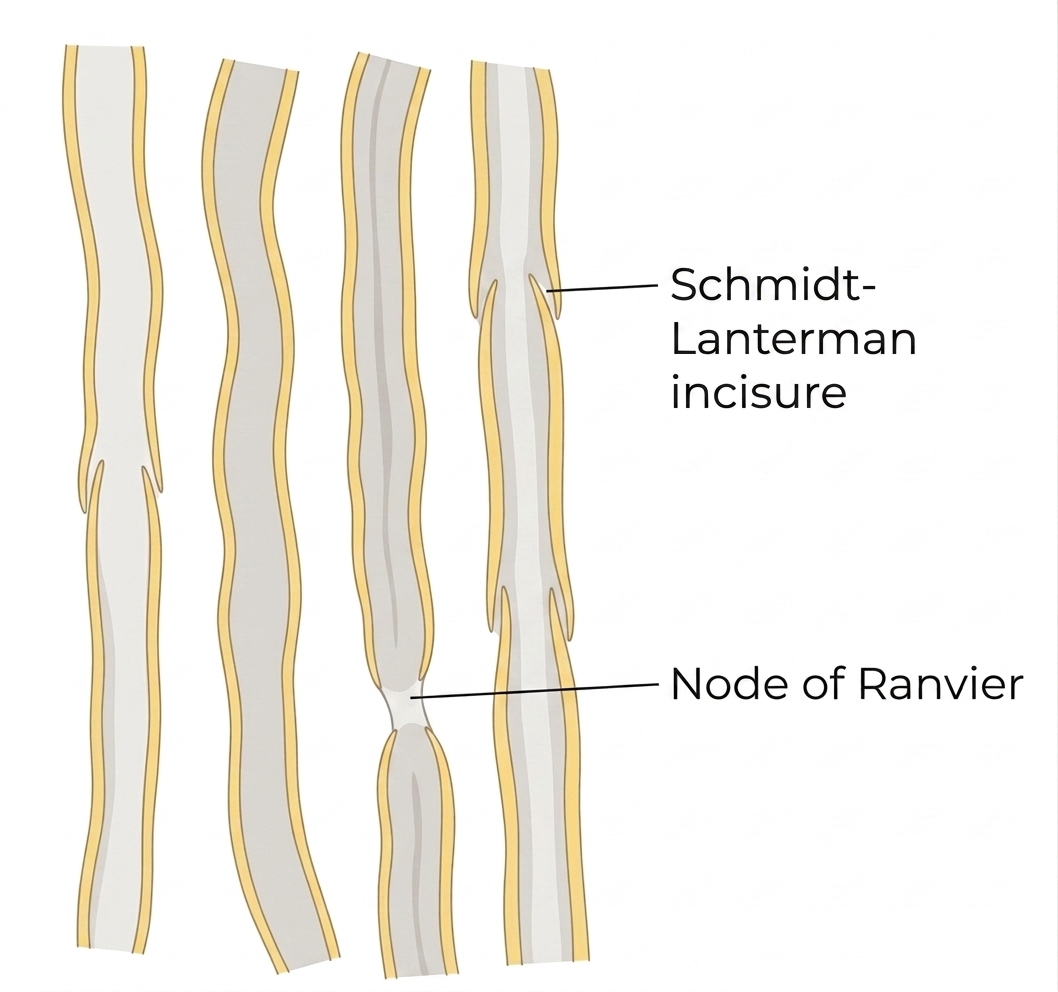
- Nodes of Ranvier — 1-2 μm gaps between adjacent Schwann cells where axon membrane is exposed; high density of voltage-gated Na+ channels (Nav1.6)
- Paranodal region — flanks the node; septate-like junctions between myelin terminal loops and axolemma; contains Caspr/contactin proteins
- Juxtaparanodal region — beneath compact myelin; high density of voltage-gated K+ channels (Kv1.1, Kv1.2)
- Saltatory conduction — action potential jumps node to node, greatly increasing velocity; demyelination disrupts this, causing conduction block or slowing
Anti-nodal/paranodal antibodies (anti-NF155, anti-CNTN1, anti-Caspr1) cause a CIDP-like neuropathy that is often refractory to IVIg but may respond to rituximab. Anti-ganglioside antibodies (anti-GM1 in multifocal motor neuropathy, anti-GQ1b in Miller Fisher syndrome) target gangliosides concentrated at the nodes of Ranvier. These are increasingly tested on boards.
Schwann Cells vs Oligodendrocytes
| Feature | Schwann Cell (PNS) | Oligodendrocyte (CNS) |
|---|---|---|
| Axons per cell | 1 myelinated axon per Schwann cell | Up to 40-50 axons per oligodendrocyte |
| Basement membrane | Present (aids regeneration) | Absent |
| Regeneration support | Excellent: forms bands of Bungner, produces neurotrophic factors (NGF, BDNF) | Poor: produces inhibitory factors (Nogo-A, MAG, OMgp) |
| Origin | Neural crest | Neuroepithelium (neural tube) |
| Key pathology | Schwannoma, GBS demyelination | Multiple sclerosis, PML |
Why do PNS nerves regenerate but CNS axons do not? Schwann cells have a basal lamina (forms guide tubes), produce neurotrophic factors, and clear debris rapidly. Oligodendrocytes lack a basal lamina, clear debris slowly, and produce myelin-associated inhibitory proteins (Nogo-A, MAG). This explains why peripheral nerve injuries can recover but spinal cord injuries generally cannot.
2. Upper Limb Nerves
Brachial Plexus Anatomy
The brachial plexus (C5-T1 ventral rami) supplies the entire upper limb. It is organized in five levels.
Mnemonic: "Robert Taylor Drinks Cold Beer" = Roots, Trunks, Divisions, Cords, Branches
| Level | Components | Location | Key Points |
|---|---|---|---|
| Roots | C5, C6, C7, C8, T1 ventral rami | Between anterior and middle scalene muscles | Long thoracic nerve (C5-7) and dorsal scapular nerve (C5) arise directly from roots |
| Trunks | Upper (C5-6), Middle (C7), Lower (C8-T1) | Posterior triangle of neck (supraclavicular) | Suprascapular nerve arises from upper trunk (Erb point) |
| Divisions | Each trunk splits into anterior and posterior (6 total) | Behind the clavicle | Anterior = flexor compartment; Posterior = extensor compartment |
| Cords | Lateral (ant. upper + middle), Posterior (all 3 posterior), Medial (ant. lower) | Infraclavicular; named by position relative to axillary artery | Named by relationship to 2nd part of axillary artery |
| Branches | Terminal branches to the upper limb | Axilla and arm | See individual nerve details below |
Cord Branches Summary
- Lateral cord (C5-7): Lateral pectoral nerve, Musculocutaneous nerve, Lateral contribution to median nerve
- Medial cord (C8-T1): Medial pectoral nerve, Medial cutaneous nerves of arm and forearm, Ulnar nerve, Medial contribution to median nerve
- Posterior cord (C5-T1): Upper subscapular, Thoracodorsal, Lower subscapular, Axillary nerve, Radial nerve. Mnemonic: STAR = Subscapular, Thoracodorsal, Axillary, Radial
Axillary Nerve (C5-C6)
Origin and Course
- Terminal branch of the posterior cord; passes through the quadrangular space
Motor
- Deltoid (shoulder abduction 15-90 degrees), teres minor (external rotation)
Sensory
- "Regimental badge" area — lateral shoulder and proximal arm
Classic Lesion
- Anterior shoulder dislocation, fracture of surgical neck of humerus
- Findings: cannot abduct shoulder beyond 15 degrees, numbness over lateral deltoid, deltoid atrophy
Musculocutaneous Nerve (C5-C7)
Origin
- Terminal branch of the lateral cord; pierces the coracobrachialis muscle (unique identifier)
Motor
- Coracobrachialis (shoulder flexion/adduction), biceps brachii (elbow flexion, supination), brachialis (primary elbow flexor)
Sensory
- Continues as the lateral cutaneous nerve of the forearm — lateral forearm from elbow to wrist
Classic Lesion
- Upper arm trauma (rare in isolation); weakened elbow flexion and supination; loss of biceps reflex (C5-6)
Radial Nerve (C5-T1)
Origin and Course
- Largest terminal branch of the posterior cord; winds posteriorly around mid-shaft humerus in the spiral (radial) groove
- Enters forearm anterior to lateral epicondyle; divides into superficial (sensory) and deep (posterior interosseous nerve / PIN) branches
Motor
- Arm: Triceps (elbow extension), anconeus, brachioradialis, ECRL
- Forearm (PIN): Supinator, ECRB, EDC, ECU, APL, EPL/EPB, extensor indicis proprius (EIP)
Sensory
- Posterior arm and forearm (via posterior cutaneous nerves)
- Superficial branch: dorsum of hand (radial 3.5 digits, first dorsal web space)
Classic Lesions
- Spiral groove ("Saturday night palsy"): Arm draped over chair, mid-shaft humerus fracture; wrist drop + finger drop; triceps SPARED (branch exits above groove); brachioradialis reflex absent; sensory loss dorsum of hand
- Posterior interosseous nerve (PIN): Compression in supinator (arcade of Frohse); finger drop WITHOUT wrist drop (ECRL spared); wrist deviates radially on extension; no sensory loss (pure motor)
- Wartenberg syndrome: Superficial radial nerve compression at wrist; numbness/pain over dorsal radial hand; no motor loss
Radial nerve palsy vs C7 radiculopathy: In radial nerve palsy at the spiral groove, triceps is spared and triceps reflex is preserved. In C7 radiculopathy, triceps is weak, triceps reflex is diminished, and there is often neck pain radiating down the arm. Both cause wrist drop, but the reflex and triceps strength distinguish them.
Median Nerve (C5-T1)
Origin and Course
- Formed by lateral head (from lateral cord, C5-7) and medial head (from medial cord, C8-T1)
- No branches in the arm; enters forearm between two heads of pronator teres; enters hand through carpal tunnel
Motor
- Forearm: Pronator teres, FCR, palmaris longus, FDS (finger flexion at PIPs)
- Anterior interosseous nerve (AIN): FDP to digits 2-3, FPL (thumb IP flexion), pronator quadratus — pure motor, no sensory
- Hand (recurrent motor branch): LOAF muscles = Lumbricals 1-2, Opponens pollicis, Abductor pollicis brevis (APB), Flexor pollicis brevis (superficial head)
Sensory
- Palmar surface: Thumb, index, middle, and radial half of ring finger (3.5 digits)
- Dorsal surface: Dorsal tips of same fingers (distal phalanges)
- Palmar cutaneous branch arises PROXIMAL to the carpal tunnel — thenar palm sensation is spared in carpal tunnel syndrome
Classic Lesions
- Carpal tunnel syndrome: Most common mononeuropathy overall; numbness/tingling in median digits (especially nocturnal); late: APB weakness and thenar atrophy; positive Tinel and Phalen signs; palmar cutaneous branch spared
- Pronator syndrome: Compression at pronator teres; aching forearm + median numbness including palm (palmar cutaneous branch involved, unlike CTS)
- AIN syndrome (Kiloh-Nevin): Cannot make an "OK" sign (loss of FPL + FDP to index); no sensory loss; often part of Parsonage-Turner syndrome
- High median nerve lesion: "Hand of benediction" — when attempting to make a fist, digits 2-3 remain extended (FDS, FDP 2-3 paralyzed); also lose pronation and wrist flexion
"Hand of benediction" vs "Claw hand" — a common board trap: Hand of benediction (median nerve, proximal lesion) = inability to flex digits 2-3 when attempting to make a fist. Ulnar claw hand = hyperextension at MCP and flexion at IP joints of digits 4-5 at rest due to loss of interossei/lumbricals 3-4. They may look similar but occur in different contexts: benediction = active fist attempt; claw = resting hand posture.
Ulnar Nerve (C8-T1)
Origin and Course
- Terminal branch of the medial cord; passes posterior to medial epicondyle in the cubital tunnel; enters hand via Guyon canal (between pisiform and hook of hamate)
Motor
- Forearm: FCU (wrist flexion/ulnar deviation), FDP to digits 4-5 (finger flexion at DIPs)
- Hand: Hypothenar muscles, all interossei (dorsal and palmar), lumbricals 3-4, adductor pollicis, FPB (deep head)
- Ulnar = all intrinsic hand muscles EXCEPT LOAF (which is median)
Sensory
- Medial 1.5 digits (little finger and ulnar half of ring finger) — BOTH palmar and dorsal surfaces
- Dorsal cutaneous branch arises ~5 cm proximal to wrist; spared in Guyon canal but affected in cubital tunnel lesions
Classic Lesions
- Cubital tunnel (elbow): 2nd most common upper limb mononeuropathy; numbness ulnar 1.5 digits (palmar AND dorsal); interosseous weakness; Froment sign positive; claw hand
- Guyon canal (wrist): Numbness palmar ulnar 1.5 digits only (dorsal cutaneous branch spared); motor loss varies by zone
- Froment sign: Compensatory FPL activation (median nerve) when pinching paper, due to weak adductor pollicis (ulnar)
- Wartenberg sign: Little finger abducted at rest (weak 3rd palmar interosseous)
The "Ulnar Paradox": A MORE distal ulnar lesion produces a MORE prominent claw hand. In proximal lesions (elbow), FDP to digits 4-5 is also paralyzed, so fingers cannot flex at DIP, making the claw less obvious. In distal lesions (wrist/Guyon canal), FDP is intact, allowing unopposed IP flexion while MCP extension is unopposed (lost interossei). This produces a more dramatic claw deformity.
Key Upper Limb Bedside Tests
| Test | What It Tests | Nerve |
|---|---|---|
| Froment sign | Adductor pollicis weakness (compensatory FPL flexion at thumb IP when pinching) | Ulnar |
| Wartenberg sign | Abducted little finger at rest (weak palmar interosseous to 5th digit) | Ulnar |
| OK sign test | Inability to make circle with thumb and index (FPL + FDP to index) | AIN (median) |
| Phalen / Tinel | Reproduce median paresthesias at wrist | Median (carpal tunnel) |
| APB testing | Thumb abduction perpendicular to palm | Median (recurrent motor branch) |
| Finger abduction/adduction | Spread/squeeze fingers against resistance | Ulnar (interossei) |
3. Brachial Plexus Injuries
Erb-Duchenne Palsy (C5-C6, Upper Trunk)
- Mechanism: Excessive downward traction on shoulder (shoulder dystocia during birth, motorcycle falls, lateral neck flexion)
- Clinical — "Waiter's tip" posture:
- Arm adducted (loss of deltoid, supraspinatus)
- Internally rotated (loss of infraspinatus, teres minor)
- Elbow extended (loss of biceps, brachialis)
- Forearm pronated (loss of supinator, biceps)
- Reflexes lost: Biceps (C5-6), brachioradialis (C5-6)
- Sensory loss: Lateral arm and forearm (C5-6 dermatomes)
- Suprascapular nerve (from upper trunk) often involved — weak supraspinatus and infraspinatus
Klumpke Palsy (C8-T1, Lower Trunk)
- Mechanism: Upward traction on arm (grabbing overhead during fall, birth injury with arm hyperabduction)
- Clinical — "Claw hand":
- All intrinsic hand muscles weak (interossei, lumbricals, thenar, hypothenar)
- Weak finger flexors (FDP) and wrist flexion (FCU)
- Sensory loss: Medial arm, forearm, and hand (C8-T1 dermatomes)
- Horner syndrome may occur if T1 root avulsion damages sympathetic fibers — ipsilateral ptosis, miosis, anhidrosis
Klumpke + Horner = T1 root avulsion. Preganglionic sympathetic fibers to the superior cervical ganglion exit with the T1 root. Avulsion of T1 disrupts these fibers, producing ipsilateral Horner syndrome. This combination is also seen with Pancoast tumor (lung apex) invading the lower trunk.
Posterior Cord Lesion
- Mechanism: Anterior shoulder dislocation, humeral fracture
- Findings: Combines axillary nerve deficits (weak deltoid, regimental badge numbness) with radial nerve deficits (wrist/finger extension weakness, dorsal hand sensory loss)
Long Thoracic Nerve Palsy (C5-C7)
- Nerve: Arises directly from C5-C7 roots; long superficial course along chest wall
- Muscle: Serratus anterior (protracts and stabilizes scapula)
- Mechanism: Stab wounds, mastectomy/axillary node dissection, backpack palsy, Parsonage-Turner
- Finding: Medial scapular winging — medial border of scapula protrudes posteriorly, worse with forward flexion and wall push-up
- Distinguish from spinal accessory nerve palsy (CN XI) which causes lateral scapular winging (trapezius weakness, worse with abduction)
Thoracic Outlet Syndrome (TOS)
- True neurogenic TOS: Compression of lower trunk (C8-T1) by cervical rib, fibrous band, or anomalous scalene
- Hand intrinsic wasting, especially thenar > hypothenar = "Gilliatt-Sumner hand"
- Sensory loss medial forearm and hand
- Low-amplitude ulnar SNAP; low-amplitude median CMAP — characteristic electrodiagnostic pattern
- True neurogenic TOS is rare but a board favorite
- Vascular TOS: Subclavian artery/vein compression — vascular symptoms, not primarily neurological
- "Disputed" TOS: Symptoms without objective findings; controversial diagnosis
Parsonage-Turner Syndrome (Neuralgic Amyotrophy)
- Pathophysiology: Immune-mediated (post-viral or post-surgical) inflammatory plexopathy
- Presentation:
- Acute severe shoulder/arm pain (often 10/10, excruciating)
- Pain resolves over days to weeks, then weakness and atrophy emerge
- Patchy, multifocal distribution (does NOT follow a single root or nerve)
- Most commonly affected nerves: Suprascapular, long thoracic, anterior interosseous (AIN), axillary
- EMG/NCS: Patchy axonal denervation in a non-root, non-single-nerve distribution
- Treatment: Supportive; steroids in acute phase may shorten pain; most recover over months to 1-2 years
Parsonage-Turner vs cervical radiculopathy: Both present with acute shoulder/arm pain and weakness. Key differences: Parsonage-Turner has severe pain that precedes weakness by days, the weakness is patchy and multifocal, and neck movement does NOT reproduce pain. Cervical radiculopathy has pain and weakness simultaneously, follows a single dermatomal/myotomal pattern, and is worsened by neck extension/rotation (Spurling test).
4. Upper Limb Dermatomes (C5-T1)
| Root | Landmark | Mnemonic | Key Movement | Reflex |
|---|---|---|---|---|
| C5 | Lateral upper arm (over deltoid) | Same as axillary nerve "regimental badge" | Shoulder abduction | Biceps (C5-6) |
| C6 | Thumb, lateral forearm | "6-shooter on the thumb" | Elbow flexion, wrist extension | Brachioradialis (C5-6) |
| C7 | Middle finger | "Flipping the bird with C7" | Elbow extension, wrist flexion, finger extension | Triceps (C7) |
| C8 | Little finger, medial hand | "C8 = ring and pinky" | Finger flexion | No reliable reflex |
| T1 | Medial forearm (toward axilla) | Close to arm-chest junction | Finger abduction/adduction (interossei) | No reliable reflex |
Board-Relevant Cervical Radiculopathy Patterns
- C5 radiculopathy: Weak deltoid and biceps; diminished biceps reflex; numbness over lateral arm (deltoid area); disc at C4-5
- C6 radiculopathy: Weak biceps and wrist extensors (ECRL/ECRB); diminished biceps and brachioradialis reflexes; numbness in thumb and lateral forearm; disc at C5-6
- C7 radiculopathy: Weak triceps, wrist flexors, and finger extensors; diminished triceps reflex; numbness in middle finger; disc at C6-7 — MOST COMMON cervical radiculopathy level
- C8 radiculopathy: Weak finger flexors and hand intrinsics; no reliable reflex loss; numbness in little finger and medial hand; disc at C7-T1
Dermatome vs peripheral nerve territory: The median nerve supplies palmar digits 1-3.5, overlapping C6 (thumb), C7 (middle finger), and C8 (ring finger) dermatomes. Carpal tunnel causes numbness in all 3.5 digits on the palmar side only. A C7 radiculopathy causes numbness of the entire middle finger (palmar AND dorsal) plus forearm pain. Distribution pattern plus reflex changes distinguish the two.
5. Lower Limb Nerves
Lumbar Plexus (L1-L4)
Forms within the psoas major muscle from L1-L4 ventral rami. Vulnerable to retroperitoneal hematoma, psoas abscess, and pelvic masses.
| Nerve | Roots | Motor | Sensory | Clinical Notes |
|---|---|---|---|---|
| Iliohypogastric | L1 | Internal oblique, transversus abdominis | Suprapubic, lateral gluteal | Injured in low transverse incisions |
| Ilioinguinal | L1 | Internal oblique (contribution) | Medial thigh, genitalia | Inguinal hernia repair injury |
| Genitofemoral | L1-2 | Cremaster (genital branch) | Anterior scrotum/labia, upper medial thigh | Mediates cremasteric reflex (L1-2) |
| Lateral femoral cutaneous | L2-3 | None (pure sensory) | Lateral thigh | Meralgia paresthetica: compression under inguinal ligament; obesity, pregnancy, tight belts |
| Femoral | L2-4 | See below | See below | See below |
| Obturator | L2-4 | See below | See below | See below |
Femoral Nerve (L2-L4)
Course
- Formed within psoas major; exits lateral to psoas; passes under inguinal ligament lateral to femoral artery (NAVL: Nerve-Artery-Vein-Lymphatics, lateral to medial)
Motor
- Iliacus (hip flexion), quadriceps femoris (knee extension), sartorius, pectineus
Sensory
- Anterior cutaneous branches: Anterior and medial thigh
- Saphenous nerve (terminal sensory branch): Medial leg and medial ankle — longest pure sensory nerve
Classic Lesion
- Retroperitoneal hematoma (anticoagulated patients), pelvic surgery, femoral catheterization, diabetic amyotrophy
- Findings: weak knee extension, absent/diminished patellar reflex, anterior thigh and medial leg numbness, knee buckling
Obturator Nerve (L2-L4)
- Motor: Adductor group (longus, brevis, magnus anterior division, gracilis) — hip adduction
- Sensory: Small area on medial thigh
- Lesion: Pelvic surgery, obturator hernia; difficulty with hip adduction, gait instability (leg swings outward)
Sacral Plexus (L4-S3)
Forms on the piriformis muscle from the lumbosacral trunk (L4-5) and S1-S3 ventral rami.
Sciatic Nerve (L4-S3)
- Largest nerve in the body; exits pelvis through greater sciatic foramen, inferior to piriformis
- Contains two divisions bundled together: tibial division (anteromedial) and common fibular division (posterolateral)
- Motor: Hamstrings (knee flexion) + all muscles below the knee (via tibial and common fibular branches)
- Lesion: Posterior hip dislocation, misplaced gluteal injection (inject upper outer quadrant), hip surgery, piriformis syndrome
- The common fibular division is more susceptible to injury (lateral position, fewer fascicles, less connective tissue protection)
In sciatic neuropathy, the peroneal division is almost always more affected than the tibial division. A "foot drop after hip surgery" with peroneal > tibial weakness should prompt consideration of sciatic nerve injury, not just peroneal neuropathy. On EMG, an abnormal short head of biceps femoris (innervated only by the peroneal division of sciatic) distinguishes sciatic from isolated peroneal neuropathy at the fibular head.
Common Fibular (Peroneal) Nerve (L4-S2)
- Separates from sciatic in popliteal fossa; winds around the fibular head/neck (very superficial, vulnerable to compression)
- Deep fibular (deep peroneal): Tibialis anterior (dorsiflexion), EHL (great toe extension), EDL, EDB; sensory = first dorsal web space only
- Superficial fibular (superficial peroneal): Peroneus longus and brevis (ankle eversion); sensory = dorsum of foot (except first web space) and lateral lower leg
- Classic lesion: Compression at fibular head (leg crossing, tight casts, prolonged bed rest, weight loss) — foot drop (weak dorsiflexion + eversion); plantarflexion and inversion are NORMAL; most common compressive neuropathy in the lower limb
Tibial Nerve (L4-S3)
- Motor: Gastrocnemius, soleus (plantarflexion), tibialis posterior (inversion), FDL, FHL, intrinsic foot muscles
- Sensory: Sural nerve (lateral foot, posterior lower leg), medial/lateral plantar nerves (sole of foot), calcaneal branch (heel)
- Reflex: Achilles (ankle jerk, S1-2)
- Tarsal tunnel syndrome: Compression behind medial malleolus; burning pain and numbness on sole of foot; Tinel sign at medial ankle
Superior Gluteal Nerve (L4-S1)
- Motor: Gluteus medius, gluteus minimus, tensor fasciae latae (hip abduction)
- Classic lesion: Trendelenburg sign — pelvis drops on the CONTRALATERAL side during single-leg stance; Trendelenburg gait (waddling)
- Injury from misplaced gluteal injections (inject upper outer quadrant)
Inferior Gluteal Nerve (L5-S2)
- Motor: Gluteus maximus (hip extension)
- Classic lesion: Difficulty rising from chair, climbing stairs, running; compensatory posterior trunk lean
Lower Limb Nerves Summary
| Nerve | Roots | Key Motor | Key Sensory | Classic Lesion |
|---|---|---|---|---|
| Femoral | L2-4 | Quadriceps (knee extension) | Anterior thigh, medial leg (saphenous) | Retroperitoneal hematoma; absent patellar reflex |
| Obturator | L2-4 | Adductors (hip adduction) | Medial thigh | Pelvic surgery; gait instability |
| Lat. fem. cutaneous | L2-3 | None (pure sensory) | Lateral thigh | Meralgia paresthetica |
| Sciatic | L4-S3 | Hamstrings + all below knee | Posterior thigh, all below knee | Hip dislocation; gluteal injection |
| Common fibular | L4-S2 | Dorsiflexion, eversion | Dorsum of foot, lateral leg | Fibular head compression; foot drop |
| Tibial | L4-S3 | Plantarflexion, inversion, toe flexion | Sole of foot | Tarsal tunnel; difficulty toe-walking |
| Superior gluteal | L4-S1 | Glut medius/minimus (hip abduction) | None | Trendelenburg sign/gait |
| Inferior gluteal | L5-S2 | Glut maximus (hip extension) | None | Cannot rise from chair/stairs |
6. Lower Limb Dermatomes (L1-S5)
| Root | Landmark | Mnemonic | Key Movement | Reflex |
|---|---|---|---|---|
| L1 | Inguinal region | "L1 = 1nguinal" | Hip flexion (partial) | Cremasteric (L1-2) |
| L2 | Upper anterior thigh | Proximal thigh | Hip flexion | None reliable |
| L3 | Medial thigh and knee | "3 = knee" | Knee extension (with L4) | Patellar (L3-4) |
| L4 | Medial leg, medial malleolus | "L4 to the floor" | Ankle dorsiflexion | Patellar (L3-4) |
| L5 | Dorsum of foot, great toe, lateral leg | "L5 = big toe + dorsum" | Great toe extension, hip abduction | None reliable (medial hamstring in some) |
| S1 | Lateral foot, little toe, sole (lateral), posterior calf | "S1 = small toe + sole" | Plantarflexion, eversion | Achilles (S1-2) |
| S2 | Posterior thigh, popliteal fossa | "S2 = back of thigh too" | Knee flexion (partial) | None reliable |
| S3-S5 | Perianal region ("saddle area"), genitalia | Concentric rings around anus | Sphincter function | Bulbocavernosus (S3-4), anal wink (S3-5) |
Saddle anesthesia (S3-S5) + urinary retention + bilateral leg weakness = CAUDA EQUINA SYNDROME — a neurosurgical emergency. Requires urgent MRI and decompression. Do not confuse with conus medullaris syndrome.
Conus Medullaris vs Cauda Equina
| Feature | Conus Medullaris | Cauda Equina |
|---|---|---|
| Level | Spinal cord termination (L1-L2 vertebral level) | Nerve roots below conus (L2+ vertebral level) |
| Onset | Sudden, bilateral, symmetric | Gradual, often unilateral then bilateral |
| Pain | Less prominent, bilateral perineal | Severe radicular pain (often unilateral initially) |
| Motor | Symmetric, may have UMN signs | Asymmetric, LMN pattern (flaccid) |
| Bladder/bowel | Early and prominent | Late (unless severe compression) |
| Saddle anesthesia | Bilateral, symmetric | May be unilateral or asymmetric |
| Reflexes | Bulbocavernosus/anal wink absent; knee/ankle may be preserved | Ankle reflex absent; asymmetric |
Board-Relevant Lumbosacral Radiculopathy Patterns
- L4 radiculopathy: Weak ankle dorsiflexion and knee extension; diminished patellar reflex; numbness medial leg; disc at L3-4
- L5 radiculopathy: Weak great toe extension, hip abduction, ankle dorsiflexion, ankle inversion; NO reliable reflex loss; numbness dorsum of foot/great toe; disc at L4-5 — MOST COMMON lumbar radiculopathy level
- S1 radiculopathy: Weak plantarflexion, ankle eversion; diminished Achilles reflex; numbness lateral foot/little toe; disc at L5-S1
7. Neuromuscular Junction
NMJ Anatomy
- Presynaptic terminal (motor nerve terminal): Contains synaptic vesicles filled with ACh (~10,000 molecules per vesicle = one quantum); voltage-gated P/Q-type calcium channels on presynaptic membrane
- Synaptic cleft: ~50 nm space; contains basal lamina with acetylcholinesterase (AChE) anchored by ColQ
- Postsynaptic membrane (motor endplate): Junctional folds with nicotinic AChRs at crests and voltage-gated Na+ channels (Nav1.4) in depths; receptor clustering organized by agrin-LRP4-MuSK signaling pathway
Acetylcholine Release Mechanism
- Action potential arrives at the motor nerve terminal
- Voltage-gated calcium channels (P/Q-type VGCCs) open; Ca2+ enters the presynaptic terminal
- Ca2+ binds synaptotagmin on the vesicle membrane
- SNARE complex mediates vesicle fusion: synaptobrevin (VAMP) on vesicle + syntaxin and SNAP-25 on presynaptic membrane
- ACh is released into the synaptic cleft (exocytosis); ~200 quanta released per action potential normally
- ACh binds nicotinic receptors on the postsynaptic membrane, generating an endplate potential (EPP)
- ACh is rapidly hydrolyzed by acetylcholinesterase into choline + acetate
- Choline is recycled via a high-affinity choline transporter back into the nerve terminal
Botulinum toxin cleaves SNARE proteins: Types A and E cleave SNAP-25; Types B, D, F, G cleave synaptobrevin (VAMP); Type C cleaves syntaxin. All prevent vesicle fusion and ACh release, causing presynaptic NMJ blockade. Clinical presentation: descending flaccid paralysis starting with cranial nerves (diplopia, dysphagia, dysarthria), then limbs, then respiratory failure, plus autonomic features (mydriasis, dry mouth, constipation).
Nicotinic Acetylcholine Receptor Structure
- Pentameric ligand-gated ion channel
- Adult muscle subunit composition: 2 alpha-1, 1 beta-1, 1 delta, 1 epsilon
- Fetal/denervated muscle: Epsilon replaced by gamma subunit — longer open time, lower conductance; spread across entire muscle membrane (not just endplate)
- Two ACh molecules must bind (one to each alpha subunit) for channel opening
- Channel is permeable to Na+ (in) and K+ (out); net inward current produces endplate potential (EPP)
- Normal EPP amplitude is ~3-4x the threshold needed for muscle fiber AP — this is the "safety factor"
- In myasthenia gravis, reduced AChRs decrease the safety factor, so some endplate potentials fail to reach threshold, especially with repeated stimulation (fatigue)
Presynaptic vs Postsynaptic NMJ Disorders
| Feature | Myasthenia Gravis (Postsynaptic) | Lambert-Eaton (Presynaptic) | Botulism (Presynaptic) |
|---|---|---|---|
| Target | AChR (85%) or MuSK (5-10%) or LRP4 | P/Q-type VGCC | SNARE proteins |
| Mechanism | Antibodies block/destroy postsynaptic AChRs, reducing safety factor | Antibodies reduce Ca2+ entry, decreasing ACh quanta released | Toxin prevents vesicle fusion, blocking ACh release |
| Weakness | Fatigable; ocular > bulbar > proximal limb; fluctuating | Proximal limb (legs > arms); ocular sparing usual; improves briefly with activity | Descending: cranial nerves first, then limbs, then respiratory |
| Reflexes | Normal | Diminished/absent; may improve after exercise | Diminished/absent |
| Autonomic | Absent | Present: dry mouth, constipation, erectile dysfunction | Present: mydriasis, dry mouth, constipation, urinary retention |
| Association | Thymoma (10-15%), thymic hyperplasia | Small cell lung cancer (60%) | Canned food, wound, infant (honey) |
| RNS at 2-3 Hz | Decrement >10% | Decrement | Decrement |
| RNS at 20-50 Hz (or post-exercise) | No significant increment | Increment >100% | Increment (similar to LEMS) |
| Treatment | AChE inhibitors (pyridostigmine), immunotherapy, thymectomy | 3,4-DAP, immunotherapy, treat underlying cancer | Antitoxin, supportive, ICU |
Repetitive nerve stimulation (RNS) patterns — a board favorite:
- Postsynaptic (MG): Low-rate RNS (2-3 Hz) produces >10% decremental response (CMAP amplitude drops with successive stimulations). No significant increment at high rates.
- Presynaptic (LEMS, botulism): Low-rate RNS also shows decrement, BUT high-rate RNS (or 10 seconds of maximal voluntary exercise) produces >100% incremental response. This is because repeated stimulation builds up intracellular Ca2+, partially overcoming the antibody-mediated reduction in Ca2+ channel function and releasing more ACh quanta.
MuSK Myasthenia Gravis
- Anti-MuSK antibodies (IgG4, not complement-fixing) disrupt AChR clustering at the NMJ
- Predominantly affects bulbar and facial muscles — severe dysphagia, dysarthria, facial weakness
- Limb weakness may be minimal; ocular involvement less prominent than AChR-MG
- Muscle atrophy (facial/tongue) can occur — unusual for NMJ disorders
- Poor response to AChE inhibitors (pyridostigmine may worsen symptoms)
- Responds well to rituximab
- No thymoma association; no benefit from thymectomy
Congenital Myasthenic Syndromes
- Genetic (non-autoimmune) NMJ disorders; present in infancy/childhood with fatigable weakness
- Classified by defective component: presynaptic (ChAT deficiency), synaptic (endplate AChE/ColQ deficiency), postsynaptic (AChR subunit mutations, rapsyn, DOK7, agrin)
- Slow-channel syndrome: Gain-of-function AChR mutation; prolonged EPP causes endplate myopathy; responds to quinidine or fluoxetine (NOT AChE inhibitors, which worsen it)
- DOK7 myasthenia: Limb-girdle pattern; worsened by AChE inhibitors; responds to salbutamol/ephedrine
8. Muscle Structure & Physiology
Sarcomere Structure
The sarcomere is the basic contractile unit of skeletal muscle, extending from one Z-line to the next.
- Z-line (Z-disc): Anchors thin (actin) filaments; contains alpha-actinin; defines sarcomere boundaries
- I-band: Contains thin filaments (actin) only; bisected by Z-line; shortens during contraction
- A-band: Contains the entire length of thick (myosin) filaments; does NOT change length during contraction — key board fact
- H-zone: Central region of A-band with thick filaments only (no overlap with thin filaments); shortens during contraction
- M-line: Center of sarcomere; anchors thick filaments; contains myomesin and creatine kinase
- Titin: Giant elastic protein (Z-line to M-line); molecular spring providing passive tension; mutations cause titinopathy
- Nebulin: Associated with thin filaments; determines actin filament length
During muscle contraction, the A-band stays the SAME length. The I-band and H-zone both shorten. Z-lines move closer together. This is the sliding filament theory: actin slides over myosin without either changing length. "A-band = Always the same."
Sarcomere-Associated Proteins in Disease
| Protein | Location | Disease |
|---|---|---|
| Dystrophin | Subsarcolemmal (actin to dystroglycan complex) | Duchenne (absent) / Becker (reduced) muscular dystrophy |
| Emerin | Inner nuclear membrane | Emery-Dreifuss muscular dystrophy (X-linked) |
| Dysferlin | Sarcolemma (membrane repair) | Miyoshi myopathy, LGMD2B |
| Calpain-3 | Sarcomere (protease) | LGMD2A (most common AR LGMD) |
| Sarcoglycans | Transmembrane (dystroglycan complex) | LGMD2C-F |
| Lamin A/C | Nuclear lamina | LGMD1B, Emery-Dreifuss (AD), dilated cardiomyopathy |
| Ryanodine receptor (RyR1) | Sarcoplasmic reticulum membrane | Malignant hyperthermia, central core disease |
Excitation-Contraction Coupling
- Motor neuron AP reaches NMJ; ACh released; EPP generated on muscle fiber
- Muscle fiber AP propagates along sarcolemma and down T-tubules (transverse tubules at A-I junction)
- Depolarization activates the dihydropyridine receptor (DHPR) on T-tubule membrane (voltage sensor in skeletal muscle; L-type Ca2+ channel in cardiac muscle)
- DHPR mechanically couples to ryanodine receptor (RyR1) on the sarcoplasmic reticulum (SR)
- RyR1 opens, releasing Ca2+ from SR into cytoplasm
- Ca2+ binds troponin C; conformational change moves tropomyosin off myosin-binding sites on actin
- Myosin heads bind actin (cross-bridge formation); ATP hydrolysis powers the power stroke
- Relaxation: SERCA pump returns Ca2+ to SR; tropomyosin re-covers binding sites
Malignant hyperthermia results from a mutation in RyR1 (most common) or DHPR. Volatile anesthetics (halothane, isoflurane, sevoflurane) or succinylcholine trigger uncontrolled Ca2+ release from SR, causing sustained muscle contraction, massive heat production, rhabdomyolysis, hyperkalemia, and metabolic acidosis. Treatment: dantrolene (blocks RyR1 Ca2+ release). Autosomal dominant. Associated with central core disease on muscle biopsy.
Muscle Fiber Types
| Feature | Type I (Slow-Twitch) | Type II (Fast-Twitch) |
|---|---|---|
| Other names | Slow oxidative, red fibers | IIa (fast oxidative-glycolytic), IIb/IIx (fast glycolytic, white fibers) |
| Metabolism | Oxidative (aerobic); many mitochondria | Glycolytic (anaerobic); fewer mitochondria |
| Myoglobin | High (red color) | Low (pale, especially IIb) |
| Contraction speed | Slow | Fast |
| Fatigue resistance | High (sustained activity) | Low (rapid fatigue) |
| Function | Posture, endurance | Rapid, powerful movements |
| ATPase stain (pH 4.6) | Dark | Light |
| ATPase stain (pH 9.4) | Light | Dark |
| Motor neuron | Small (low threshold, recruited first) | Large (high threshold, recruited last) |
| Pathology | Type 1 predominance in some congenital myopathies; type 1 atrophy in myotonic dystrophy | Type 2 fiber atrophy in steroid myopathy, disuse, cachexia, UMN lesions |
Motor Unit Concept
- Motor unit = one alpha motor neuron + all the muscle fibers it innervates
- Innervation ratio:
- Low ratio (5-10 fibers/neuron): extraocular muscles, intrinsic hand muscles — fine motor control
- High ratio (1000-2000 fibers/neuron): quadriceps, gastrocnemius — powerful but less precise
- Henneman size principle: Motor units recruited in order of size; small (type I, low threshold) first, then progressively larger (type II, high threshold) as force demand increases
- All muscle fibers in a single motor unit are the same fiber type
- Motor unit action potential (MUAP): Compound electrical signal from all fibers of one motor unit firing synchronously, recorded by EMG needle
Fiber type grouping on biopsy = chronic denervation with reinnervation. Normally, motor unit fibers are scattered in a checkerboard pattern (random mosaic). In chronic denervation, collateral sprouting from surviving motor neurons reinnervates orphaned fibers, converting them to the surviving neuron's fiber type, producing clusters of one type. Group atrophy = when the reinnervating neuron also dies, leaving a cluster of atrophied fibers — hallmark of chronic neurogenic process.
9. Muscle Pathology Patterns
Myopathy vs Neuropathy
| Feature | Myopathy | Neuropathy (LMN) |
|---|---|---|
| Weakness | Proximal > distal; symmetric (hip/shoulder girdle) | Distal > proximal (hands/feet) in polyneuropathy; may be focal |
| Atrophy | Late (proportional to weakness) | Early and prominent (especially distal) |
| Fasciculations | Absent | Present (spontaneous motor unit firing) |
| Reflexes | Preserved until late/severe | Diminished/absent early |
| Sensory loss | Absent | Present (if sensory fibers involved) |
| CK level | Elevated (often markedly) | Normal or mildly elevated |
| Functional | Difficulty stairs, rising from chair, overhead lifting | Tripping (foot drop), fine motor difficulty, balance |
Exceptions to "proximal = myopathy, distal = neuropathy":
- Inclusion body myositis (IBM): Distal AND proximal weakness (finger flexors, quadriceps); asymmetric; mimics neuropathy
- Myotonic dystrophy type 1: Distal predominant weakness (grip, foot dorsiflexion) despite being a myopathy
- GBS: May present with proximal > distal weakness (ascending), mimicking myopathy early; areflexia and cytoalbuminous dissociation are key clues
UMN vs LMN Signs
| Feature | Upper Motor Neuron (UMN) | Lower Motor Neuron (LMN) |
|---|---|---|
| Tone | Increased (spasticity, clasp-knife) | Decreased (flaccidity) |
| Reflexes | Hyperreflexia; clonus | Hyporeflexia / areflexia |
| Babinski sign | Present (extensor plantar) | Absent (flexor plantar) |
| Atrophy | Minimal (disuse only); late | Prominent; early (denervation atrophy) |
| Fasciculations | Absent | Present |
| Weakness pattern | Pyramidal: arm extensors > flexors; leg flexors > extensors | Segmental or peripheral nerve territory |
| Hoffman sign | Present (finger flexor equivalent of Babinski) | Absent |
ALS combines both UMN and LMN signs simultaneously. The hallmark is upper motor neuron features (hyperreflexia, spasticity, Babinski) AND lower motor neuron features (atrophy, fasciculations, weakness) in the SAME limb or region. Fasciculations + hyperreflexia in the same muscle group = think ALS until proven otherwise.
Fasciculations vs Fibrillations
- Fasciculations:
- Visible spontaneous twitching of a muscle — entire motor unit fires
- Seen clinically AND on EMG
- Indicate LMN pathology (anterior horn cell disease, root, peripheral nerve)
- Also seen in benign fasciculation syndrome (BFS) — no weakness, no denervation on EMG
- Fibrillations:
- Spontaneous firing of a single muscle fiber (NOT a motor unit)
- NOT visible clinically — detected only on needle EMG
- Indicate denervation of muscle fibers (active/acute denervation)
- Appear 2-3 weeks after nerve injury (time for Wallerian degeneration)
- Also seen in inflammatory myopathies (muscle membrane instability)
- Positive sharp waves (PSWs): Same significance as fibrillations; biphasic waveform on EMG; indicate membrane instability
EMG/NCS Patterns
Nerve Conduction Studies (NCS)
| Parameter | Demyelinating Neuropathy | Axonal Neuropathy | Myopathy |
|---|---|---|---|
| Conduction velocity | Markedly slowed (<70% LLN) | Normal or mildly slowed | Normal |
| Distal latency | Prolonged | Normal | Normal |
| CMAP amplitude | May be normal or reduced | Reduced (proportional to axon loss) | Normal (mildly reduced if severe) |
| SNAP amplitude | May be normal or reduced | Reduced | Normal |
| Temporal dispersion | Present | Absent | Absent |
| Conduction block | Present | Absent | Absent |
| F-wave latency | Prolonged or absent | Normal | Normal |
| Examples | GBS (AIDP), CIDP, CMT1 | Diabetic PN, CMT2, toxic | Polymyositis, DMD |
Needle EMG Patterns
| Finding | Neuropathy (Denervation) | Myopathy |
|---|---|---|
| Spontaneous activity | Fibrillations + PSWs; fasciculations | Fibrillations + PSWs in inflammatory myopathies; no fasciculations |
| MUAP morphology | Large amplitude, long duration, polyphasic (collateral reinnervation adds fibers to remaining motor units) | Small amplitude, short duration, polyphasic (fewer functioning fibers per motor unit) |
| Recruitment | Reduced recruitment (fewer motor units fire; each fires rapidly to compensate) | Early/rapid recruitment (each motor unit is weak; many recruited early for minimal force) |
Neuropathic MUAP = "big and lonely"; Myopathic MUAP = "small and crowded." In neuropathy, fewer motor units remain but each reinnervates extra fibers, creating large MUAPs with reduced recruitment (fast firing rate of few units). In myopathy, individual motor units are weak (fewer functional fibers per unit), creating small MUAPs but many recruited early (early/full recruitment to generate even minimal force).
10. Clinical Localization Patterns
Radiculopathy vs Plexopathy vs Mononeuropathy vs Polyneuropathy
| Feature | Radiculopathy | Plexopathy | Mononeuropathy | Polyneuropathy |
|---|---|---|---|---|
| Distribution | Single root (myotome + dermatome) | Multiple nerves from one plexus; patchy | Single named nerve territory | Symmetric, length-dependent (stocking-glove) |
| Motor | Myotomal (multiple nerves, same root) | Multiple nerve territories within plexus | One nerve territory only | Distal > proximal, symmetric |
| Sensory | Dermatomal | Patchy, multiple nerve territories | Named nerve territory | Stocking-glove |
| Reflexes | Diminished at specific root level | May affect multiple reflexes | Usually spared | Ankle > knee, symmetric |
| Pain | Neck/back radiating; worse with Valsalva | Severe limb pain (often acute) | Local tenderness at compression site | Burning/tingling distally |
| SNAP | Normal (preganglionic) | Abnormal (postganglionic) | Abnormal (postganglionic) | Abnormal |
| Paraspinal EMG | Abnormal (fibrillations) | Normal | Normal | Normal |
The SNAP is the single most important NCS finding for localization: Radiculopathy = SNAP is normal (lesion preganglionic; DRG and its peripheral axon intact). Plexopathy or peripheral neuropathy = SNAP is abnormal (lesion postganglionic). Also: abnormal paraspinals = root level; normal paraspinals with abnormal SNAP = plexus or nerve. This distinction appears on virtually every neurology board exam.
Foot Drop Differential: L5 Radiculopathy vs Common Fibular Neuropathy
This is one of the most commonly tested localization problems on neurology boards.
| Feature | L5 Radiculopathy | Common Fibular Neuropathy |
|---|---|---|
| Ankle dorsiflexion | Weak | Weak |
| Ankle eversion | Weak | Weak |
| Ankle INVERSION | WEAK (tibialis posterior = tibial nerve, L5 root) | NORMAL (tibialis posterior is tibial, not fibular) |
| Hip abduction | WEAK (gluteus medius = superior gluteal, L5) | NORMAL |
| Toe extension | Weak | Weak |
| Plantarflexion | Normal (S1) | Normal |
| Sensory loss | Dorsum of foot + lateral leg + possibly lateral thigh | Dorsum of foot + lateral leg only |
| Back pain / SLR | Often present | Absent |
| EMG: tibialis posterior | Abnormal | Normal |
| EMG: gluteus medius | Abnormal | Normal |
| EMG: paraspinals | May show fibrillations | Normal |
| SNAP | Normal (preganglionic) | Abnormal (superficial fibular SNAP low) |
The two key muscles that distinguish L5 radiculopathy from peroneal neuropathy: (1) Tibialis posterior (ankle inversion; tibial nerve, L5 root) and (2) Gluteus medius (hip abduction; superior gluteal nerve, L5 root). Both are L5-innervated but NOT supplied by the common fibular nerve. If either is weak or shows denervation on EMG, the lesion is at the L5 root, not the fibular nerve. If inversion is weak, it is NOT just a peroneal neuropathy.
Carpal Tunnel vs C6-C7 Radiculopathy
| Feature | Carpal Tunnel (Median at Wrist) | C6 Radiculopathy | C7 Radiculopathy |
|---|---|---|---|
| Numbness | Palmar digits 1-3.5; dorsal tips; palm SPARED | Thumb + radial forearm (entire digit, palmar AND dorsal) | Middle finger (entire, both surfaces); may radiate to forearm |
| Motor | APB weakness/thenar atrophy (late) | Biceps weakness, weak wrist extension | Triceps weakness, weak wrist flexion, weak finger extension |
| Reflexes | Normal | Diminished biceps + brachioradialis | Diminished triceps |
| Neck pain | Absent | Often present, radiating | Often present, radiating |
| Provocative | Phalen, Tinel at wrist | Spurling test | Spurling test |
| Nocturnal | Classic (waking with numb hand) | Less typical | Less typical |
| NCS | Prolonged median distal sensory/motor latency across wrist | Normal NCS; EMG shows C6 myotome | Normal NCS; EMG shows C7 myotome |
Mononeuropathy Multiplex
Simultaneous or sequential involvement of individual, non-contiguous nerve trunks. Pattern is asymmetric and affects named nerves (e.g., right ulnar + left peroneal + left median).
Common Causes (Board Favorites)
- Vasculitis: PAN, ANCA-associated (GPA, EGPA), rheumatoid vasculitis — vasa nervorum inflammation causes ischemic nerve infarction
- Diabetes mellitus: Most common overall cause; diabetic amyotrophy (lumbosacral radiculoplexus neuropathy); cranial nerve palsies (CN III with pupil-sparing)
- Sarcoidosis: Granulomatous inflammation of nerves
- Leprosy (Hansen disease): Most common infectious cause worldwide; affects cooler superficial nerves (ulnar, common peroneal, greater auricular)
- HIV and Hepatitis C
- HNPP (hereditary neuropathy with liability to pressure palsies): PMP22 deletion; recurrent demyelinating neuropathies at compression sites
- Multifocal motor neuropathy (MMN): Pure motor; anti-GM1 antibodies; conduction block on NCS; responds to IVIg
- Amyloidosis and cryoglobulinemia
When a patient presents with asymmetric, stepwise neuropathy affecting named nerves: think mononeuropathy multiplex and rule out vasculitis first (urgent, treatable). Check ESR, CRP, ANCA, hepatitis panel, cryoglobulins, and consider nerve biopsy (sural nerve). If confluent (many nerves affected), the pattern may mimic distal symmetric polyneuropathy, but the HISTORY of stepwise, asymmetric onset reveals the true pattern.
Master Localization Quick Reference
| Clinical Sign | Localization |
|---|---|
| Shoulder abduction weakness + regimental badge numbness | Axillary nerve (C5-6) |
| Wrist drop + spared triceps + spared triceps reflex | Radial nerve at spiral groove |
| Wrist drop + weak triceps + diminished triceps reflex | C7 radiculopathy |
| Finger drop only, no sensory loss | Posterior interosseous nerve (PIN) |
| Nocturnal hand numbness in digits 1-3, thenar atrophy | Carpal tunnel (median at wrist) |
| Cannot make "OK" sign, no sensory loss | AIN syndrome (median) |
| Hand of benediction when making a fist | Proximal median nerve lesion |
| Claw hand (digits 4-5) + medial 1.5 digit numbness | Ulnar neuropathy |
| Froment sign positive | Ulnar neuropathy (weak adductor pollicis) |
| Winged scapula (medial border, worse with forward flexion) | Long thoracic nerve (serratus anterior) |
| Winged scapula (lateral border, worse with abduction) | Spinal accessory nerve (trapezius) |
| Waiter's tip posture in newborn | Erb-Duchenne palsy (C5-6, upper trunk) |
| Claw hand + Horner syndrome | Klumpke palsy (C8-T1) or Pancoast tumor |
| Acute severe shoulder pain then patchy weakness | Parsonage-Turner syndrome |
| Thenar wasting + medial forearm numbness | True neurogenic TOS (lower trunk, C8-T1) |
| Lateral thigh numbness only, no weakness | Meralgia paresthetica (lat. fem. cutaneous) |
| Weak knee extension + absent patellar reflex | Femoral neuropathy or L3-4 radiculopathy |
| Trendelenburg gait (pelvis drops contralaterally) | Superior gluteal nerve (L4-S1) |
| Foot drop + weak inversion + back pain | L5 radiculopathy |
| Foot drop + normal inversion + fibular head compression | Common fibular (peroneal) neuropathy |
| Weak plantarflexion + absent Achilles reflex | S1 radiculopathy or tibial neuropathy |
| Saddle anesthesia + urinary retention | Cauda equina syndrome (EMERGENCY) |
| Symmetric stocking-glove numbness + distal weakness | Polyneuropathy (length-dependent) |
| Asymmetric named nerve lesions, stepwise | Mononeuropathy multiplex (think vasculitis) |
| Fatigable ptosis + diplopia + proximal weakness | Myasthenia gravis (postsynaptic NMJ) |
| Proximal weakness + hyporeflexia + dry mouth + cancer | Lambert-Eaton (presynaptic NMJ) |
| Descending paralysis + mydriasis + autonomic failure | Botulism (presynaptic NMJ) |
The localization algorithm for peripheral weakness:
- UMN or LMN? Spastic/hyperreflexia/Babinski = UMN. Flaccid/hyporeflexia/fasciculations = LMN.
- If LMN, which level? Motor neuron, root, plexus, nerve, NMJ, or muscle?
- Use the triad: motor pattern + sensory pattern + reflexes.
- Confirm with electrodiagnostics: SNAP normal = root. SNAP abnormal = plexus or nerve. Paraspinal fibrillations = root. Normal paraspinals = plexus or nerve. Decremental RNS = NMJ. Short MUAPs with early recruitment = myopathy. Large MUAPs with reduced recruitment = neuropathy.
Quick checklist: Proximal + symmetric + no sensory loss + high CK = myopathy. Fatigable + ptosis + diplopia = NMJ. Distal + sensory loss + absent ankle jerks = polyneuropathy. Single nerve territory = mononeuropathy. Myotomal + dermatomal + back pain + normal SNAP = radiculopathy. Multiple nerves in one limb + abnormal SNAP + normal paraspinals = plexopathy. LMN + no sensory loss + fasciculations = motor neuron disease.
References
- Blumenfeld H. Neuroanatomy through Clinical Cases. 3rd ed. Sinauer Associates; 2021.
- Campbell WW, Barohn RJ. DeJong's The Neurologic Examination. 8th ed. Wolters Kluwer; 2020.
- Preston DC, Shapiro BE. Electromyography and Neuromuscular Disorders: Clinical-Electrophysiologic-Ultrasound Correlations. 4th ed. Elsevier; 2021.
- Katirji B. Electromyography in Clinical Practice: A Case Study Approach. 3rd ed. Oxford University Press; 2018.
- Ropper AH, Samuels MA, Klein JP, Prasad S. Adams and Victor's Principles of Neurology. 12th ed. McGraw-Hill; 2023.
- Aminoff MJ, Josephson SA. Aminoff's Neurology and General Medicine. 6th ed. Academic Press; 2021.
- Dumitru D, Amato AA, Zwarts MJ. Electrodiagnostic Medicine. 2nd ed. Hanley & Belfus; 2002.
- Dyck PJ, Thomas PK. Peripheral Neuropathy. 4th ed. Elsevier Saunders; 2005.
- Netter FH. Atlas of Human Anatomy. 8th ed. Elsevier; 2022.
- Continuum (American Academy of Neurology). Peripheral Nerve and Motor Neuron Disorders. Multiple volumes, 2020-2024.